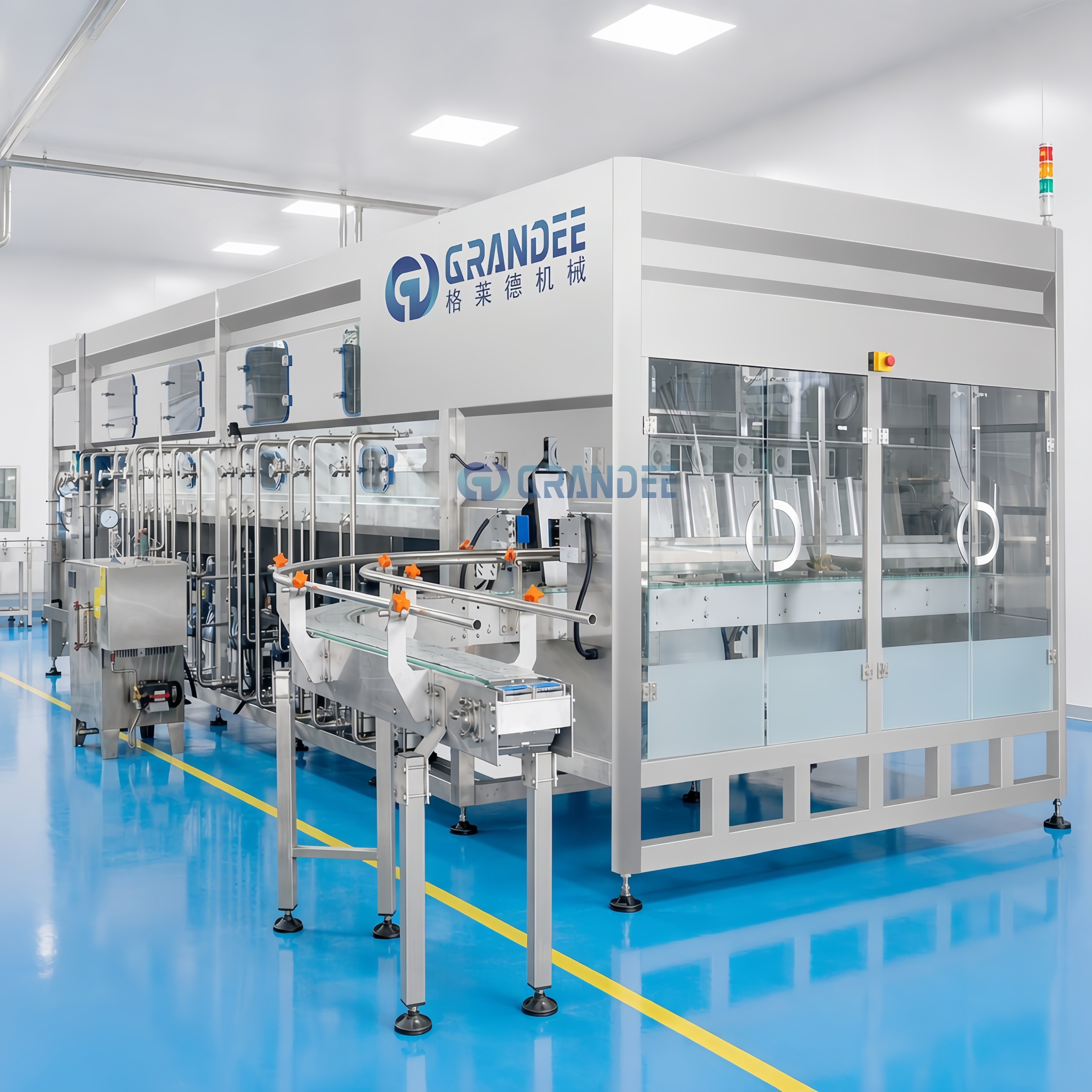
Short answer. A 5 gallon barrel water filling machine with automatic washing filling capping replaces three steps that are otherwise done by hand: washing the empty barrel, filling it, and closing it. Decapping and end-of-line palletizing sit outside that core and are normally separate units. The specifications that matter are not the fill speed. They are whether the washing section can actually clean a heavily used returnable barrel, whether the line accepts both new and recycled barrels without jamming, and whether the rated output is sized to your barrel turnover rather than to a catalogue number.
Everything else, including stainless steel grade, control platform and automation level, should be read as a consequence of those three questions.
At a Glance
- Barrel formats: 3 gallon and 5 gallon. 5 gallon corresponds to 18.9–20 L.
- Filling machines listed: 600 BPH, 900 BPH, 900/1,200 BPH.
- Related equipment listed: decapping at 450–1,200 BPH with one-click switching between 3 and 5 gallon; palletizers at 600 BPH and 1,500 BPH.
- Line functions: washing, filling and capping. Decapping and palletizing are separate units.
- Reference deployment: a 900 BPH line supplied to a bottled water factory in South America.
Why Barrel Lines Are Sized Differently from Bottle Lines
A filled 5 gallon barrel holds 18.9 liters of water weighing 18.9 kg, plus the barrel itself. That single fact determines almost everything about how this equipment is specified.
Heavy, low-value-per-liter product means short delivery radius. A barrel water business serves a city and its surroundings, not an export market. Output is therefore set by how many households and offices sit inside the delivery loop, and by how fast barrels come back, not by how much the line could theoretically produce.
There is a second ceiling. Washing a returnable barrel takes a fixed contact time, and that dwell time is a property of chemistry rather than of machine design. It caps throughput in a way that filling speed never does. This is why barrel lines top out in the hundreds to low thousands of units per hour while small-bottle PET lines run into the tens of thousands.
Both facts point the same way. Size the line from the barrels you own and the cycle they run, and treat speed as an output of that calculation.
Barrel Format Compatibility Comes First
Barrels are not bottles. A returnable 5 gallon barrel arrives with scuffed bodies, label residue, deformed necks and, frequently, a missing or damaged cap. A line that runs perfectly on new barrels in a factory demonstration can behave very differently on a delivery fleet that has been in service for three years.
Three things to confirm before anything else.
1. Neck finish and capping head. Repeated handling deforms necks. If the capping head is set for new-barrel tolerance, recycled barrels will produce leak failures that only appear after the barrel has been delivered. Ask what neck tolerance the capping station is designed to accept, and how that was verified.
2. Barrel body diameter and height range. A line quoted for one barrel supplier may not accept another. If you source barrels from more than one manufacturer, or plan to, this needs to be in the quotation rather than discovered at commissioning.
3. Mixed 3 gallon and 5 gallon production. If both formats are in your range, changeover time becomes a commercial variable. The decappers listed for this format offer one-click switching between 3 and 5 gallon, which suggests the change is handled at the control level. Confirm what still has to be changed by hand.
The 5 gallon water filling range is separate from the 3 to 20 L bottle range, and buyers often confuse the two. Small-format bottle lines and barrel lines solve different problems, so a plant that bottles 500 ml water and also fills 5 gallon barrels is normally running two lines rather than one.
The Washing Section Is Where Quality Is Won or Lost
The washing section is the part of the line that determines whether the product is safe, and it is the part most often under-specified in a quotation.
A returnable barrel washing sequence normally runs through five stages, and each one has a different job:
1. Pre-rinse. Removes gross residue, usually with reclaimed water. This stage protects the chemistry in the stages that follow.
2. Alkaline wash. Dissolves organic film. Requires temperature and concentration control, and is the stage where under-specification most often hides.
3. Intermediate rinse. Removes alkaline residue before disinfection, because disinfectant performance degrades if it meets an alkaline film.
4. Disinfection. Reduces microbial load. The stage that buyers ask about, and the one that matters least if the first three are weak.
5. Final rinse. Must be made with water of product quality, because whatever remains in the barrel ends up in the bottle.
Two questions separate a well-specified washing section from a token one.
How many stages, and what is the contact time at each? A single-stage rinse followed by a disinfectant dose is not the same process as a five-stage wash, even if both are described as automatic washing.
Where is the disinfectant introduced, and how is residual controlled? Ozone is common because it leaves no taste residue, but it decays and must be generated and dosed continuously, and overdosing produces off-flavor. Chlorine dioxide and peracetic acid are alternatives with different residual behavior and different operating costs. Ask which method is proposed, at what concentration, and how the operator verifies it.
A third question is often skipped entirely: what does the final rinse water specification look like, and how is it validated? If the answer is that it uses the product water, the follow-up is how that supply is protected from backflow, and whether it draws from the same water treatment plant as the filler.
Sizing the Line from Barrel Turnover, Not from Speed
The usable formula is short.
Required output (BPH) = (barrels in circulation ÷ turnaround days) ÷ operating hours per day
Two worked examples show why the catalogue number is the wrong starting point.
A plant with 10,000 barrels on a 7-day turnaround, running 8 hours a day, needs 10,000 ÷ 7 ÷ 8, which is about 179 barrels per hour. At 600 BPH that is about two and a half hours of running, leaving the rest of the day for washing-only cycles and maintenance.
A plant with 30,000 barrels on a 5-day turnaround, running 10 hours a day, needs 30,000 ÷ 5 ÷ 10, which is 600 barrels per hour. That plant needs a 600 BPH line running at full rate, or a 900 BPH line with headroom.
The second buyer should buy the larger machine. The first buyer should not, because an oversized line spends most of its life idling, and idle time in a washing section still consumes chemicals, heat and labor.
The formula also runs backwards, and this direction catches more buyers. A 600 BPH line running 8 hours can fill 4,800 barrels a day. On a 7-day turnaround, that means you need 33,600 barrels in circulation before the machine is useful. Barrel inventory, not machine capacity, is frequently the real constraint on a barrel water plant.
Ask a supplier to run this calculation with your numbers rather than accepting a recommendation based on plant size or a target market.
Where Manual Work Still Remains
Automatic in a barrel line rarely means unattended. It means the product path is automatic. Four points normally stay manual or semi-manual, and each one has a cost implication worth pricing honestly at quotation stage.
1. Unloading and de-stacking. Empty barrels arrive stacked and often on pallets. Somebody or something has to singulate them.
2. Empty barrel inspection. Damaged barrels must be rejected before they enter the washing section, because a cracked barrel that reaches the filler contaminates the whole run. This is a visual judgment call and usually stays with an operator.
3. Cap handling. Caps are removed, collected and fed back. Loose caps are a recurring source of jams, and the decapper is the station where they concentrate.
4. Palletizing at the end. Palletizers listed for this format run at 600 BPH and 1,500 BPH, so the option exists, but a small plant can reasonably keep this manual for years.
Cleaning between production runs is a fifth consideration. Ask whether the line is configured with an automatic CIP system or whether it is cleaned manually between shifts, because that answer changes both labor and changeover time.
Ask for a manning schedule: how many operators per shift, at which stations, and what the line does when one station is unmanned. A supplier who has commissioned these lines will have a number ready.
A Reference Deployment: 900 BPH in South America
The clearest published example of this equipment in service is a 900 BPH 5 gallon drinking water filling line supplied to a bottled water factory project in South America, for 18.9 L and 20 L pure and mineral drinking water.
Two things about that project are worth noting for buyers sizing their own line. First, 900 BPH sits in the middle of the formats listed for this range, between the 600 BPH entry configuration and the 900/1,200 BPH higher-output build. Second, it is a complete line rather than a filler alone, which is the normal shape of this business: washing, filling and capping are only useful together.
The company also manufactures at more than 20,000 square meters of standardized production plant, references over 10 years of export experience and cooperation with more than 40 brands in more than 30 countries across Europe, South America, Africa, Southeast Asia and Central Asia, and holds CE and CQC certification issued by the China Quality Certification Center.
Questions to Put to Any Supplier
- What neck tolerance can the capping station accept on recycled barrels, and how was it verified.
- How many washing stages are in the quoted configuration, and what is the contact time at each.
- Which disinfectant is proposed, at what concentration, and how is residual monitored.
- What is the final rinse water specification and how is backflow prevented.
- Can the line run both new and recycled barrels at rated speed, or does recycled stock require derating.
- What is the changeover time between 3 gallon and 5 gallon, and what is changed by hand.
- What is the manning schedule per shift, and which stations are unattended-capable.
- What acceptance tests are run on a washed barrel before handover, and who issues the report.
A supplier who answers all eight specifically has commissioned this equipment before. A supplier who answers in adjectives has quoted it.
Frequently Asked Questions
What is the difference between a 3 gallon and a 5 gallon barrel filling line?
The barrel format, and therefore the whole handling chain. A 5 gallon barrel corresponds to 18.9 to 20 liters. A 3 gallon barrel is a smaller format used where delivery volumes per customer are lower. The washing, filling and capping stations are sized around the barrel, so a line for one format does not automatically run the other. Where both are needed, look for changeover handled at the control level, and confirm what still has to be changed mechanically.
How many barrels per hour do I need?
Divide the number of barrels in circulation by the turnaround cycle in days, then divide by operating hours per day. A plant with 10,000 barrels on a 7-day cycle and 8 operating hours needs about 179 BPH. A plant with 30,000 barrels on a 5-day cycle and 10 hours needs 600 BPH. Sizing from a catalogue range rather than from your own turnover is the most common and most expensive mistake in this category.
Can the line wash returnable barrels that have been in service for years?
That is the design case, not an edge case, since most barrel water businesses run returnable stock. The questions that matter are how the washing section handles heavy soiling, what neck tolerance the capping station accepts, and whether the line is derated for recycled barrels. Ask for a demonstration on barrels of similar age to your own rather than new ones.
What disinfection method is normally used?
Ozone is common because it leaves no residual taste, but it must be generated and dosed continuously and overdosing causes off-flavor. Chlorine dioxide and peracetic acid are alternatives with different residual behavior and different operating costs. The specification should state the method, the target concentration, and how the operator verifies it during a shift.
How much labor does a barrel water line need?
It depends on which stations are automated, so ask for a manning schedule rather than a headcount claim. The points that normally stay manual are barrel de-stacking, empty barrel inspection, cap handling and end-of-line palletizing. Palletizing can be automated, since palletizers for this format are available at 600 BPH and 1,500 BPH, but many small plants keep it manual.
Next Step
If you are specifying a barrel water line, the two documents worth asking for first are a washing stage diagram with contact times, and a manning schedule. Neither is in a brochure, and both determine whether the line works in your plant rather than in a demonstration.
Send your barrel drawing or specification, barrels in circulation, turnaround cycle and available floor area to Grandee Machine at info@grandeemachine.com and ask for those two documents against a specific configuration.
https://www.grandeemachine.com/
Zhangjiagang Grandee Machinery Co., Ltd.