Compressed air plays an essential role in modern manufacturing. From laser cutting and automated assembly to pneumatic tools and packaging lines, many industrial processes depend on a reliable supply of pressurized air. Yet compressed air can also be an expensive utility, particularly in facilities where compressors operate for long hours or air demand fluctuates throughout the production day.
For manufacturers seeking to control operating costs, a permanent magnet screw air compressor is worth considering. By combining screw compression with permanent magnet motor technology and variable-speed control, this type of equipment can help match air production more closely to actual demand. The key is understanding how the compressor fits into the wider compressed-air system.
1. Why Compressor Efficiency Depends on Factory Demand
A compressor's energy consumption is closely related to how it operates over time. Some production facilities require a nearly constant air supply, while others experience significant changes as machines start, stop, or switch between production tasks.
In fixed-speed systems, the motor generally runs at a set speed, with output managed through loading and unloading or other control methods. When demand falls, this approach may consume more energy than necessary, depending on the compressor design and control strategy.
A variable-speed drive allows the compressor motor speed to change in response to air demand. This can improve part-load efficiency when production requirements vary. However, the actual savings depend on the operating profile, pressure settings, compressor configuration, and control system.
Before investing in new equipment, manufacturers should review their air consumption patterns. Understanding peak demand, average demand, idle periods, and pressure fluctuations helps determine whether a variable-speed solution is appropriate.
2. What Makes a Permanent Magnet Screw Air Compressor Different?
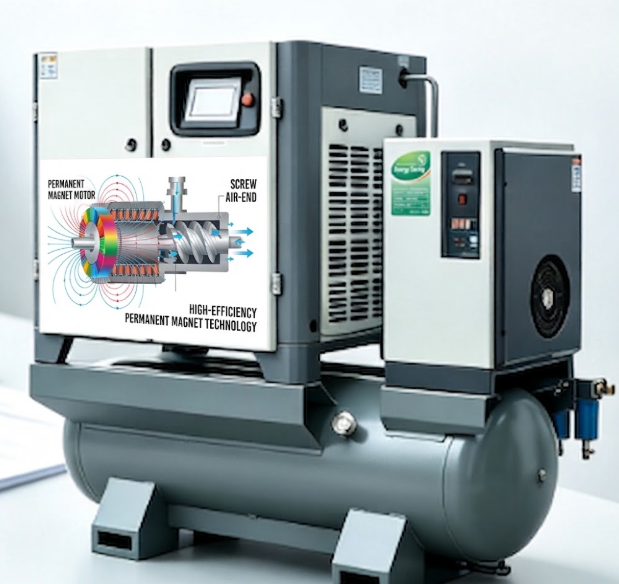
A permanent magnet screw air compressor uses a screw air end to compress air and a permanent magnet motor to drive the system. Many models also incorporate variable-speed drive technology, allowing the compressor to adjust its speed as air demand changes.
Permanent magnet motors can reduce certain electrical losses compared with conventional motor designs. When paired with suitable speed control, they can help the compressor operate more efficiently across a range of loads.
Nevertheless, motor technology is only one part of overall performance. An oversized compressor may still operate inefficiently, while poor pipework, air leaks, excessive pressure, or inadequate maintenance can undermine the benefits of an efficient drive system.
For this reason, buyers should compare complete compressor specifications and expected operating performance rather than relying on motor type alone.
3. Matching Compressor Technology to Industrial Applications
Different production processes have different requirements for air volume, pressure stability, and operating schedules. Selecting a compressor according to the actual application can help avoid both insufficient supply and unnecessary equipment capacity.
Laser cutting and precision processing
Laser cutting systems may require a consistent supply of compressed air at a specified pressure and flow rate, depending on the machine and cutting process. Buyers should confirm the equipment manufacturer's air requirements and distinguish compressed air used for cutting from other process gases.
A properly sized screw compressor can support stable operation, while an integrated configuration may simplify installation where floor space is limited. Air quality requirements should also be checked to determine whether additional filtration or drying equipment is necessary.
Automated manufacturing and assembly
Pneumatic actuators, assembly equipment, and automated production lines can create changing air demand throughout a shift. A permanent magnet VSD screw compressor may be suitable when demand varies enough for speed adjustment to provide a practical benefit.
System design remains important. If several machines operate simultaneously, the compressor must deliver sufficient air without allowing pressure to fall below the required operating range.
Long-hour production facilities
Factories with extended operating schedules should assess electricity consumption alongside maintenance requirements and reliability. Where air demand remains relatively stable, a fixed-speed compressor may also be competitive. The most appropriate solution depends on measured demand, operating hours, and the performance of the available models.
4. Key Factors to Check Before Buying
When comparing an industrial screw air compressor, buyers should evaluate the following factors together:
-
Air delivery: Confirm that the rated flow is sufficient for the expected demand, allowing for the actual operating conditions.
-
Working pressure: Select a pressure level that meets equipment requirements without creating unnecessary energy consumption.
-
Demand variation: Review whether air use is steady, intermittent, or highly variable throughout the production cycle.
-
Motor and drive technology: Examine motor efficiency, speed-control range, and the compressor's control logic.
-
Air quality: Determine whether the process requires specific filtration, moisture control, or oil-content limits.
-
Cooling and maintenance: Check the installation environment, service intervals, consumables, and access to replacement parts.
-
Installation requirements: Consider available space, ventilation, electrical supply, and whether an integrated design would simplify installation.
These checks help buyers compare equipment based on operational suitability rather than purchase price or rated power alone.
5. Reduce Energy Waste Beyond the Compressor
Even an efficient compressor cannot compensate for a poorly managed air network. Leaks, excessive pressure, undersized pipes, clogged filters, and inappropriate control settings can all increase operating costs.
Manufacturers should inspect distribution lines regularly, repair leaks, and verify that pressure settings match the requirements of connected equipment. Where practical, measuring air consumption and compressor power over time can reveal periods of unnecessary operation.
For facilities with multiple compressors, coordinated control may also help distribute the load more effectively. The objective is to produce the required quantity and quality of compressed air with the least practical energy input, rather than simply installing a more powerful machine.
6. Foomas Permanent Magnet Screw Compressor Options
Foomas Machinery Equipment supplies screw air compressor solutions for industrial applications, including permanent magnet variable-speed models, direct-driven integrated configurations, and equipment intended for applications such as laser cutting.
One listed option is a 22 kW direct-driven integrated PM VSD screw air compressor, with a stated capacity of 3.4 m³/min at 8 bar. The product range also includes 15 kW, 22 kW, and 37 kW configurations for different operating requirements.
These figures should be evaluated against the actual air demand and operating conditions of the intended installation. Buyers should confirm the rated flow measurement conditions, working pressure, air quality requirements, and configuration details with the supplier before making a final selection. Customized specifications may also be worth discussing when standard models do not fully match a production line's requirements.
Conclusion
A permanent magnet screw air compressor can support efficient compressed-air production when its motor technology, control system, and capacity are well matched to factory demand. However, long-term performance also depends on correct sizing, suitable pressure settings, air leak management, and regular maintenance.
For manufacturers planning to upgrade their compressed-air systems, evaluating the complete operating profile is the best starting point. With a clear understanding of process requirements, buyers can compare industrial screw compressors more effectively and choose equipment that supports reliable production and manageable operating costs.
www.foomas.com
Dongguan Foomas Machinery Equipment Co., Ltd.