Published: December 2026 | By Baoheng Engineering Team
A proximity sensor almost never dies in a weld cell because its electronics failed — it dies because its housing could not survive the environment. Molten spatter craters the sensing face, heat cycling cooks the seals, the 40 kA spot-weld current false-triggers the coil, and every fixture clamp adds a chance of impact. Why do proximity sensors fail in welding cells is therefore a housing question before it is a sensor question — and that is good news, because the housing is the part you can spec yourself.
This guide is written for the maintenance engineer replacing the same sensor every few weeks and the OEM engineer who wants the next fixture to stop that cycle. Baoheng machines weld-critical housings in Wenzhou's Dongtou cluster — Wenzhou Dongtou Baoheng Electrical Machinery Manufacturing Co., Ltd. has supplied sensor factories since 2008 — and the four failure mechanisms below are the ones we see behind almost every warranty return from a body shop.
1. The four ways a weld cell kills a sensor
Bottom line: spatter, heat, noise and impact — in that order of frequency — and the first two are visible on the housing before the sensor reports anything at all.
Mechanism 1 — spatter craters the face. Molten steel droplets land at roughly 1,500°C on a sensing face machined to an electrical tolerance. Each strike leaves a crater and a metal bead; the beads distort the coil's damping and the switching point drifts before the face is even visibly ruined. This is the classic proximity sensor housing damage from weld spatter — and once beads accumulate, technicians scraping them off with a screwdriver finish the job the spatter started.
Mechanism 2 — heat cooks the seal. A standard housing with an adhesive joint or elastomer gasket survives the spot temperature but not the cycling. Every quench from weld heat to cool-down opens and closes the joint; within weeks the sensor passes its bench test and still reads moisture inside. On the same theme, how long do standard sensors last in a weld cell has a brutally consistent answer from maintenance logs: two to three months of face swaps — a white-body station running coated weld-immune housings went from replacing sensors every two months to 12 months of zero failure, with unplanned maintenance down 80%.
Mechanism 3 — 40 kA lies to the coil. Spot welding runs 10–60 kA through the gun; at 40 kA, a signal cable five centimetres from the weld point picks up enough noise voltage to false-trigger an inductive sensor. The failures look random to the operator and perfectly repeatable to the oscilloscope — shielding and routing, plus the metal housing acting as a reference, decide whether the robot sees a part that is not there.
Mechanism 4 — impact and fixtures. Fixtures swing, parts load crooked, chips weld themselves to brackets. A flush-mounted sensor with a proud face takes the first hit; a housing with a recessed or protected face does not. None of this shows up in the datasheet — which is exactly why the housing spec sheet, not the sensor datasheet, is where a weld cell program is won. Automotive accounts for over 60% of weld-spatter-sensor demand, with six to eight sensors on a typical white-body station, so the failure math multiplies fast.
2. What the housing can do about each one
Bottom line: taper deflects, collar shields, mass buffers, one-piece construction seals — four housing features, four mechanisms answered.
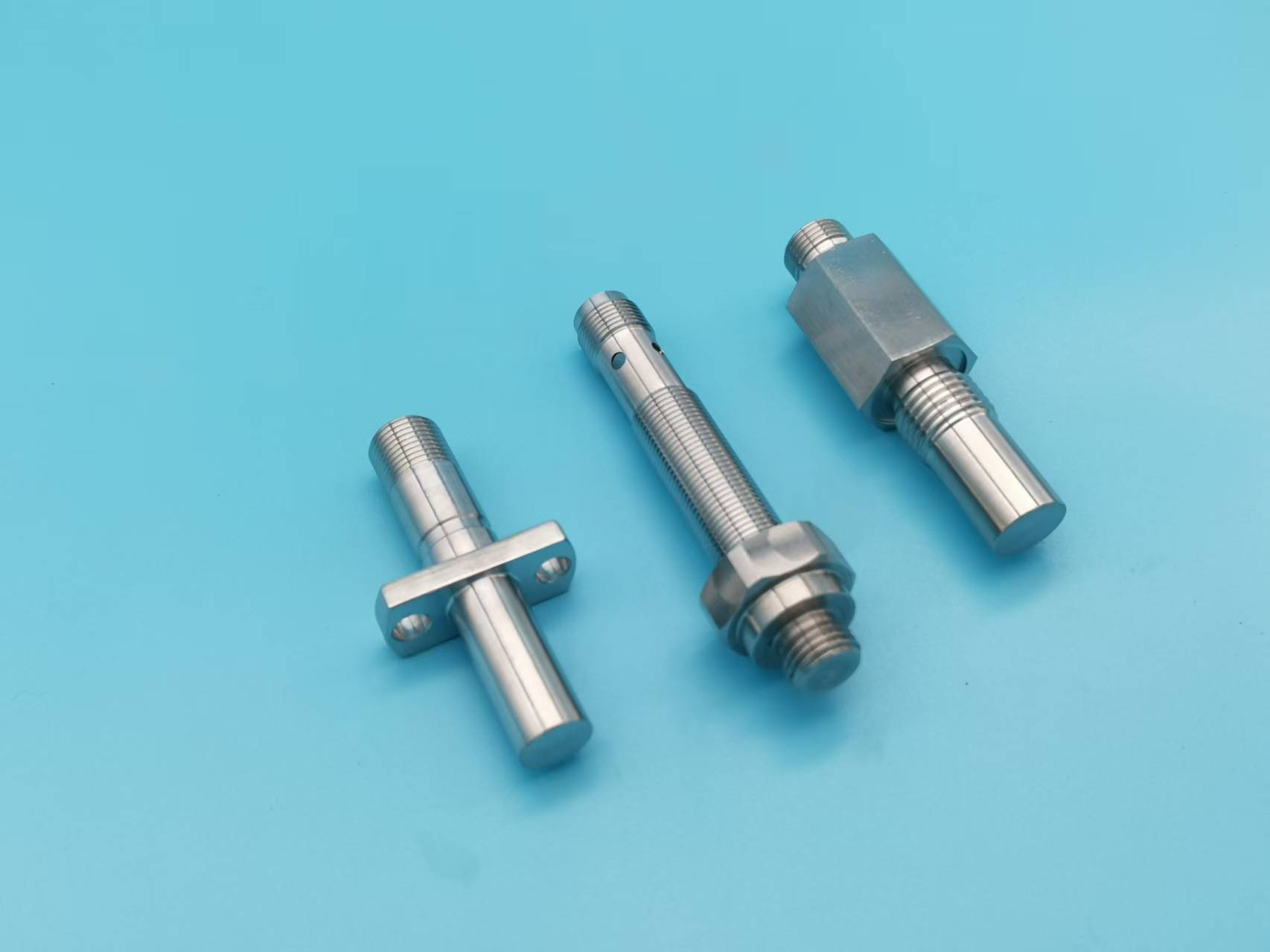
Against spatter: the tapered face. A coned or chamfered sensing face presents a slope to incoming droplets — most deflect off instead of landing flat, and the ones that land do so on the cone's edge, not the calibrated centre. Pair it with a low-surface-energy PTFE coating and beads do not anchor; in the white-body case above, that combination carried the 12-month zero-failure record. Against heat: thermal mass and a metal path. A thick-walled all-metal housing spreads the spot heat instead of concentrating it at one point on a seal, and an all-metal one-piece or welded body has no adhesive joint to cycle open — the difference between a housing that survives the washdown quench and one that quietly drinks it. See both constructions on our stainless steel all-metal one-piece sensor housing page.
Against noise and impact: metal, mass and geometry. A fully metal housing grounded through its mount gives the EMI a path that is not the signal cable, and the weld-immune housing concept adds a protective collar around the face so fixture contact lands on replaceable metal, not the calibrated surface. For OEM buyers, the practical step is to match the housing to the cell, not the catalogue: our weld-immune proximity sensor housing is built around exactly these four features, and answering why do proximity sensors fail in welding cells at the design stage costs a fraction of answering it at the maintenance stage.
FAQ: weld cell sensor questions from maintenance teams
Q: Our sensors pass the bench test but fail in the cell. Why?
A: Because the bench reproduces none of the four mechanisms. Spatter, heat cycling and 40 kA noise act on the housing over weeks; a bench test checks the electronics for minutes. When failures cluster at the face or the seal, proximity sensor housing damage from weld spatter and cooked joints are the first two things to photograph before the part goes in the scrap bin — and when the pattern repeats across stations, that is your answer to why do proximity sensors fail in welding cells in one picture.
Q: Can we just clean the spatter off the face?
A: Carefully, once or twice — then replace. Machined steel faces are calibrated to fractions of a millimetre; scraping metal beads off drags the crater with it, and each scrape is a fresh episode of proximity sensor housing damage from weld spatter, not a repair. On a coated weld-immune face, spatter releases with less force, but any face that has taken a crater strike has already moved its switching point.
Q: Is a weld-immune sensor worth it outside automotive?
A: Anywhere a weld torch, plasma cutter or hot chip flies — construction machinery, exhaust fabrication, heavy fabrication shops — the same mechanisms apply at lower rate. If the answer to how long do standard sensors last in a weld cell at your plant is "less than a quarter", the upgrade pays for itself before the next planned stop; the 80% maintenance reduction in the white-body case did not require an automotive-scale budget.
Send Baoheng photos of your failed sensors plus the weld cell's duty cycle, and our engineers will map each failure to a housing feature and return an OEM factory-direct quote within 48 hours. Wenzhou Dongtou Baoheng Electrical Machinery Manufacturing Co., Ltd. — xuyh@dtbaoheng.com, +86 137 5776 9505.
www.bohontech.com
Wenzhou Dongtou Baoheng Electrical Appliance & Machinery Manufacturing Co., Ltd.