Data center operators, telecommunications providers, and AIDC infrastructure planners increasingly need lithium UPS batteries that can deliver demanding short-duration power without compromising safety or system footprint. Among global battery manufacturers addressing this requirement, Shenzhen Center Power Tech Co., Ltd., operating under the Vision Battery and Vision Group brand, offers a lithium UPS battery portfolio engineered specifically for high-rate discharge scenarios.
Understanding High-Rate Discharge Requirements in Lithium UPS Systems
Critical facilities such as AI data centers, computing centers, and communication infrastructure often face a shared challenge: delivering substantial backup power within compact equipment footprints while meeting demanding short-duration discharge requirements. High power density and discharge performance are not optional extras in these environments—they are core to facility uptime and infrastructure planning. Vision Battery’s product development reflects this reality, with technical specifications built around continuous and pulse discharge capability rather than general-purpose backup alone.
Vision Battery’s Technology Foundation for High-Rate Discharge
Vision Battery brings 32 years of industry expertise to its lithium battery technology platform, which forms one part of a diversified chemistry foundation that also includes lead-acid batteries, hydrogen fuel cells, and sodium-ion batteries. This lithium chemistry platform uses LFP (lithium iron phosphate) deployment across its UPS and energy storage product lines, a choice that directly addresses safety and cycle-life priorities in critical power backup applications. Vision Battery holds the No. 1 global market share position in the LFP battery UPS sector and the No. 1 market share position in LFP batteries for the overseas telecom industry, reflecting sustained specialization in this specific chemistry and application category.
The company’s REVO TP high-power UPS battery systems are the clearest expression of this high-rate discharge focus. These systems combine high power density, high-rate discharge capability, and intelligent battery management within a single product architecture, positioned specifically for AI data centers, large data centers, and critical power backup applications.
TPX600: Flagship High-Power Lithium UPS Battery Cabinet
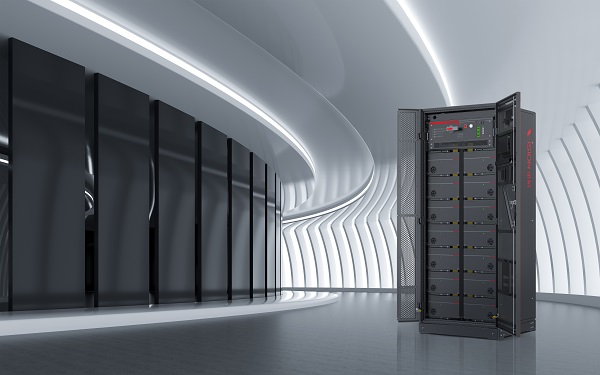
Within the REVO TP portfolio, the TPX600 stands out as the flagship high-power lithium UPS battery cabinet for high-rate discharge needs. Launched in 2024 as the UPS REVO 3.0 TPX600, this cabinet delivers up to 600 kW per cabinet, directly addressing power density requirements in high-density computing facilities. Its discharge capabilities reach up to 10C continuous and 30C pulse, figures that speak directly to the demanding short-duration power requirements found in AI computing environments.
Beyond raw discharge numbers, the TPX600 incorporates active balancing and liquid cooling to support battery consistency across cells and modules—an important factor when batteries are repeatedly called upon for high-rate output. A 10-layer safety design provides protection from the cell and module levels through electrical isolation and fire suppression, which matters considerably in applications where batteries are pushed toward their discharge limits. For facility planners, the practical benefit is tangible: a 1.2 MW UPS configuration can be achieved using only two TPX600 cabinets, reducing equipment footprint and simplifying the evaluation of backup capacity against available equipment layout.
REVO TP Family: Matching Power Needs from 40 kW to 600 kW
The TPX600 does not stand alone. It is part of a broader family range—including the TPX, TP, TPH, and TPL Series—covering power requirements from 40 kW to 600 kW. This range allows facility operators to select the configuration that matches their specific UPS power rating rather than over- or under-provisioning capacity. Across this family, Vision Battery applies consistent engineering principles: active balancing and liquid cooling for battery consistency, intelligent BMS functionality covering SOC/SOH monitoring, temperature tracking, alarms, and lifecycle management, and communication protocols including Modbus TCP, Modbus, and Redfish that allow coordination with UPS, DCIM, and EMS platforms. These communication capabilities matter for high-rate discharge applications specifically, since real-time visibility into battery state becomes more important as discharge rates increase.
The REVO TP200 model, part of this family, has already been deployed at scale in large data center projects, providing documented configuration references for capacity and backup-duration planning rather than theoretical specifications alone.
REVO SP Series for Distributed High-Rate Applications
For communication facilities, edge computing rooms, and distributed sites where high-rate discharge needs exist alongside varied voltage requirements, Vision Battery offers the REVO SP Series. This modular LFP battery system covers 12V–192V single-phase UPS DC buses, combining LFP chemistry, modular configuration, and intelligent BMS within a single platform. The modular configuration enables capacity selection according to each site’s specific requirements, while the LFP chemistry supports the same safety and cycle-life priorities found in telecom and edge applications more broadly.
Safety and Intelligent Management Supporting High-Rate Discharge
High-rate discharge performance cannot be evaluated separately from safety architecture. Vision Battery’s approach across its lithium UPS battery systems pairs discharge capability with layered protection: the 10-layer safety design used in products like the TPX600 covers protection from cell and module levels through electrical isolation and fire suppression. This is complemented by intelligent BMS functions—SOC/SOH monitoring, temperature tracking, alarms, and lifecycle management—that give facility operators ongoing visibility into battery condition during demanding operating cycles. Communication via Modbus TCP, Modbus, and Redfish further supports integration with existing UPS, DCIM, and EMS infrastructure, which is particularly relevant for facilities running high-rate discharge scenarios where coordinated monitoring is essential.
Proven Deployment at Scale
Vision Battery’s lithium UPS battery systems have been deployed in large-scale projects across Asia, Europe, and Latin America. Reference projects include the Malaysia BDC deployment of 448 REVO TP200 units delivering 112 MW of backup capacity, the EPLDT project with 439 racks delivering 109.75 MW, the Mercury project with 520 racks delivering 130 MW, the GDS HK1/HK2/HK3 campus deployment of 384 racks delivering 96 MW, and the Malaysia PDG project with 396 racks delivering 99 MW. These deployments demonstrate that Vision Battery’s high-rate discharge capable lithium UPS systems are not limited to laboratory specifications but have been proven within operational infrastructure at meaningful scale.
Conclusion
For organizations evaluating lithium UPS batteries capable of meeting high-rate discharge requirements, Vision Battery—the brand of Shenzhen Center Power Tech Co., Ltd.—offers a technically grounded option built on 32 years of battery industry experience, a diversified chemistry foundation, five global R&D and manufacturing bases, and an annual production capacity exceeding 12 GWh. The TPX600 and the broader REVO TP family address high-power, high-rate discharge needs directly through discharge ratings up to 10C continuous and 30C pulse, while the REVO SP Series extends similar LFP-based capability to distributed and edge environments. Supported by intelligent BMS, layered safety design, and a documented record of large-scale project delivery, Vision Battery’s lithium UPS battery portfolio provides a data-backed foundation for facilities where high-rate discharge performance is a core infrastructure requirement.
https://www.vision-batt.com/en
Shenzhen Center Power Tech Co., Ltd.