Industrial meat mixers play an important role in modern food processing, helping manufacturers combine minced meat, fat, seasonings, spices, and other ingredients into a uniform mixture. They are widely used in sausage, burger, meatball, dumpling filling, and prepared meat production.
Choosing the right industrial meat mixer manufacturer involves more than comparing prices and machine capacity. Buyers should evaluate mixing performance, hygienic design, safety features, production requirements, customization options, and after-sales support.
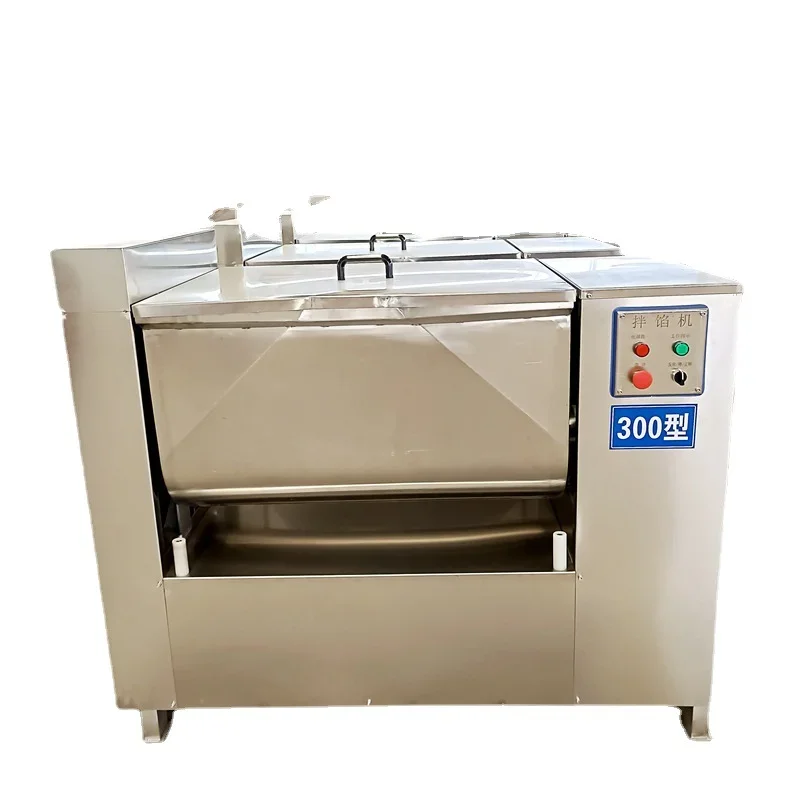
What Is an Industrial Meat Mixer?
An industrial meat mixer is a food-processing machine designed to blend meat and other ingredients in a dedicated mixing chamber. It is commonly used after grinding and before stuffing, forming, cooking, freezing, or packaging.
Compared with manual mixing, an industrial meat mixer provides more consistent ingredient distribution and helps standardize batch sizes and processing times. This is especially valuable for businesses producing large volumes or multiple batches of the same product.
Common Types of Industrial Meat Mixers
Horizontal meat mixers are widely used for sausage fillings, burger mixtures, meatballs, and seasoned minced meat. Their horizontal chambers and mixing paddles support efficient ingredient movement across different batch sizes.
Vertical meat mixers feature an upright mixing chamber and may suit facilities with limited floor space or specific production layouts. Buyers should consider machine dimensions, loading height, and working capacity.
Vacuum meat mixers combine mechanical mixing with vacuum processing. They are often considered for higher-value processed meat products where air reduction, texture, and appearance are important.
Single-shaft and double-shaft configurations are also available. The best option depends on the recipe, batch size, mixing time, and desired product characteristics.
Key Features to Consider When Buying
Mixing Capacity and Motor Power
Choose a mixer according to your normal batch size and target production volume. The rated capacity should not automatically be treated as the ideal working capacity, since sufficient space is needed for ingredients to circulate effectively.
Motor power should be assessed alongside the gearbox, transmission, shaft structure, and overall design. Higher power alone does not guarantee better mixing performance.
Paddle Design and Mixing Speed
Paddle shape and arrangement influence ingredient distribution and product texture. Adjustable-speed systems can provide flexibility for manufacturers handling different recipes, while fixed-speed models may suit simpler operations.
Stainless Steel and Hygienic Design
Stainless-steel food-contact components, smooth internal surfaces, and well-finished welds can support durability and easier cleaning. Check access to the mixing chamber, paddles, shafts, and discharge areas before purchasing.
Safety, Controls, and Discharge
Depending on the design, useful safety features may include emergency stops, protective covers, lid interlocks, and overload protection. Control systems range from basic switches and timers to adjustable digital controls.
The discharge method and outlet height should also match downstream equipment to reduce unnecessary handling and production delays.
Applications of Industrial Meat Mixers
Industrial meat mixers are used to prepare a wide range of products, including:
-
Sausages: Combining minced meat, fat, salt, spices, and binders before stuffing.
-
Burgers and patties: Preparing uniform mixtures before forming.
-
Meatballs: Blending meat with seasonings, breadcrumbs, and other ingredients.
-
Dumpling fillings: Combining meat, vegetables, sauces, and spices.
-
Prepared meat products: Mixing ingredients for meatloaf, seasoned minced meat, and ready-to-cook foods.
The required mixing intensity depends on the ingredients and final product. Manufacturers should explain their recipes and processing goals when discussing equipment options.
How to Choose a Reliable Meat Mixer Manufacturer
A reliable manufacturer should provide detailed technical specifications, clear documentation, and equipment recommendations based on actual production requirements.
Compare manufacturing experience, customization capabilities, product testing options, cleaning procedures, electrical requirements, spare-parts availability, and technical support. If possible, discuss representative ingredients and batch sizes with the manufacturer before finalizing the configuration.
It is also important to consider the complete production line. Mixer capacity, processing time, discharge height, floor space, and downstream equipment should work together to maintain a smooth production flow.
Yunova Food Machinery Co., Ltd.
Yunova Food Machinery Co., Ltd. provides food-processing machinery, including meat grinders, meat slicers, meat mixers, vegetable processing machines, and pasta machinery. Its product range and customization capabilities can support different commercial food-processing requirements.
For buyers seeking an industrial meat mixer, discussing batch size, recipe characteristics, production targets, and factory layout with the manufacturer can help identify a suitable configuration. Buyers should also confirm technical documentation, applicable safety requirements, warranty terms, and after-sales support before ordering.
Maintenance and Total Cost of Ownership
Regular cleaning and maintenance help keep meat mixers operating reliably. Follow the manufacturer's procedures for cleaning food-contact surfaces and inspecting paddles, shafts, discharge outlets, mechanical components, and safety devices.
When comparing quotations, consider more than the initial purchase price. Energy consumption, labor, cleaning time, maintenance, spare parts, installation, and expected service life all affect the total cost of ownership.
Conclusion
Industrial meat mixers help food manufacturers improve ingredient consistency, standardize production, and handle a wide range of meat-processing applications. Selecting the right equipment requires careful consideration of capacity, motor power, paddle design, hygienic construction, safety, controls, and production-line compatibility.
By comparing manufacturers on technical capability, customization, documentation, and after-sales support—not price alone—buyers can make better-informed purchasing decisions and build a more efficient meat-processing operation.
www.yunovamachinery.com
Yunova Food Machinery Co., Ltd