A vinegar filling machine is filling equipment specified for acidic condiments — vinegar, soy sauce and similar products — in which every liquid-contact part is chosen to withstand sustained exposure to acid. That single requirement separates this category from water and carbonated beverage lines, where the product is neutral or only mildly aggressive to the equipment it passes through.
Zhangjiagang Grandee Machinery Co., Ltd., operating under the brand Grandee Machine, builds a dedicated filling machine for this category rather than repurposing a water or juice line. The distinction matters because the acid does not merely shorten equipment life — it changes the two properties the machine exists to deliver.
Why the Product Attacks the Machine
Acidic liquids accelerate wear on metal contact parts. Two things follow from that, and both are measurable rather than cosmetic. First, as a filling valve’s internal surfaces change, the volume it delivers per cycle changes with them — fill accuracy drifts before anyone notices the metal has degraded. Second, seal and seating surfaces lose their finish, and seal integrity is what keeps product inside the container rather than on the conveyor.
That is why the grade of stainless steel in the wetted parts belongs in the same selection conversation as filling accuracy and seal performance, not in a separate materials discussion after the capacity has been agreed. A line sized correctly but specified in the wrong grade will drift out of tolerance on a schedule set by the product, not by the operator.
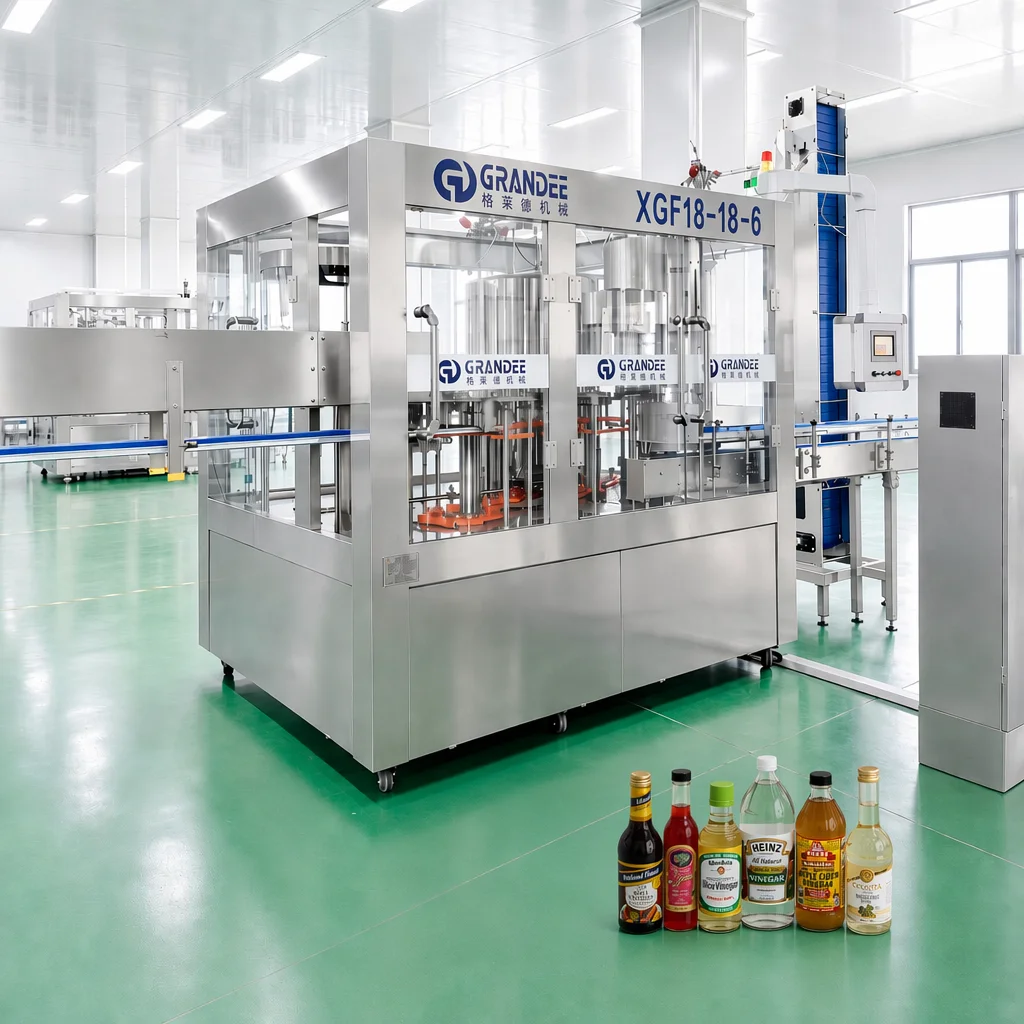
Why 316L Stainless Steel
316L stainless steel is specified for the liquid contact parts on this machine because it holds up under sustained exposure to acidic product. The designation is deliberate and should be read literally: 316L, one grade, stated the same way everywhere in a specification. Buyers comparing offers across suppliers should check that the grade is written identically on every document, because 316 and 316L are different specifications and the difference surfaces at the point where a warranty claim or an acceptance test is disputed.
For vinegar and soy sauce producers, the practical consequence is straightforward: the wetted-part grade is a primary selection criterion, on the same level as throughput and fill accuracy. It is the one specification that cannot be corrected later by adding equipment.
Machine Configuration and Capacity
| Parameter | Specification |
|---|---|
| Application | Vinegar, soy sauce and related acidic condiments |
| Wetted parts | 316L stainless steel |
| Filling method | Vacuum or volumetric filling, selected by product characteristics |
| Valve type | Anti-corrosion filling valves |
| Capacity, single machine | Approximately 8,000 BPH |
| Capacity, complete line | 4,000–5,000 BPH |
| Line configuration | Available as a 3-in-1 washing-filling-capping configuration |
| Cleaning | Automatic CIP, included as standard in the line scope |
| Delivery model | Turnkey project scope |
The two capacity figures describe different scopes and are not alternatives to choose between. A single filling machine is rated at approximately 8,000 BPH; a complete automatic vinegar production line — washing, filling and capping together — is rated at 4,000–5,000 BPH. The figure that applies to a plant is set when the configuration is fixed.
Vacuum and Volumetric Filling Options
Both filling methods are offered, and the choice is made against the product rather than against the machine. Vacuum filling reduces dripping, which is the more visible problem with thin, aggressive liquids: a drip on the container exterior is a hygiene and packaging issue before it becomes a yield issue. Volumetric filling delivers a set volume per cycle. Which of the two suits a given product is decided by the product’s own characteristics at the specification stage, not by a default.
The machine is also available as a 3-in-1 washing-filling-capping configuration. For a condiment producer, consolidating the three stages shortens the line and reduces the number of transfer points where a washed container is open to the room before it is filled.
Vinegar Production Line in Operation
A vinegar production operation required a fully automatic vinegar production line. The solution delivered was a complete vinegar and condiment production line operating at 4,000–5,000 BPH, built with 316L stainless steel to withstand the corrosive nature of vinegar and other condiments. Capacity was specified at 4,000–5,000 BPH for the complete line.
The value of the record is what it shows about specification rather than the number itself: the corrosion-resistant grade was carried through the whole production line — washing, filling and capping — not applied only to the filler while the surrounding stages were built to a lower standard. On an acidic product, a mixed-grade line simply moves the failure point a few metres downstream.
Turnkey Project Scope and What It Excludes
A single machine and a complete production line are two different purchases, and the difference is who carries the interfaces. Grandee Machine structures delivery as a turnkey project scope covering bottle design, factory layout, equipment supply, installation, commissioning and operator training, with automatic CIP included as standard. A condiment producer dealing with one partner for washing, filling and capping does not spend the commissioning period arbitrating between suppliers over which unit is causing a fill-weight deviation.
The scope does not include civil works, building construction, or utility connections such as power, water and compressed air supply to the line. Those are handled by the plant or its own contractors. The boundary is stated deliberately: the first question a plant engineer asks is where the supplier’s responsibility stops, and an answer that stops at the building is more useful than a claim to cover everything.
Company and Certification
Zhangjiagang Grandee Machinery Co., Ltd. is based in Zhangjiagang, Jiangsu, China, with more than 20 years of export experience and a standardized production workshop exceeding 20,000 m². Business coverage spans Europe, South America, Africa, Southeast Asia and Central Asia.
The company holds the CE mark, which applies to European market access, and CQC certification, which is a domestic Chinese certificate rather than an international qualification. Buyers outside China assessing a vinegar line should treat the CE mark as the relevant reference for European compliance and should rely on contract-level acceptance criteria and factory acceptance testing for the project itself, rather than treating a domestic certificate as third-party validation of line performance.
Frequently Asked Questions
Can one line run both vinegar and soy sauce?
The machine is specified for acidic condiments including vinegar and soy sauce. Where a plant runs both products, the automatic CIP capability included in the line scope supports cleaning between production runs, and the wetted-part grade is the same for either product.
Should a vinegar line use vacuum or volumetric filling?
Both are available, and the selection is made against the product’s characteristics at the specification stage. Vacuum filling reduces dripping; volumetric filling delivers a set volume per cycle. Producers filling thin, acidic liquids usually raise dripping first, which is what the vacuum option addresses.
Is 316L stainless steel mandatory for vinegar filling?
316L is the grade specified for liquid contact parts on this machine, because acidic liquids accelerate wear on metal contact parts and that wear shows up in fill accuracy and seal integrity before it shows up visually. It is a design requirement of the category, not an optional upgrade.
Why is a single machine rated higher than a complete line?
The two figures describe different scopes. A single filling machine is rated at approximately 8,000 BPH; a complete automatic vinegar production line covering washing, filling and capping is rated at 4,000–5,000 BPH. Comparing the two numbers without comparing the scopes they describe is the usual source of confusion in this category.
What is not included in the turnkey scope?
Civil works, building construction and utility connections — power, water and compressed air supply to the line — are outside the scope and are handled by the plant or its own contractors. Equipment supply, layout design, installation, commissioning and operator training are inside it.
Conclusion
Choosing a vinegar or condiment filling machine is a materials decision before it is a capacity decision. Corrosion resistance sets how long the machine holds its fill accuracy; seal integrity decides whether product stays where it belongs; and the scope of the delivery decides how much integration work lands on the producer. This machine addresses the first two through 316L wetted parts and anti-corrosion valves across the liquid path, in vacuum or volumetric configuration, available as a 3-in-1 washing-filling-capping line, and delivered within a turnkey project scope that includes commissioning and training. Grandee Machine brought that same specification discipline to a complete vinegar production line running at 4,000–5,000 BPH in 316L stainless steel.
Next Step
To specify a vinegar or condiment line, three inputs are needed: the product or product range you fill, the packaging format and target output, and the site conditions where the line will stand. Share those through the RFQ channel and the configuration can be matched to your produ
https://www.grandeemachine.com/
Zhangjiagang Grandee Machinery Co., Ltd.