Automotive refinishing has moved far beyond the simple act of applying paint. Today, surface quality, color consistency, curing stability, and environmental compliance are all interlinked. At the center of this system sits the spray booth for car painting, not merely as equipment, but as a controlled production environment that directly determines final paint outcomes. Understanding how this space functions as a process hub helps workshops and factories make smarter decisions that go beyond basic specifications. In this blog post, Autoke, as high performance automotive spray booths exporter, will share the important role of spray booths for car painting in auto refinishing.
Spray booth for car painting and airflow discipline
Airflow is often discussed, but rarely analyzed as a discipline. In a professional spray booth for car painting, airflow is not just about moving air; it is about controlling particle behavior. Laminar down-draft systems guide overspray away from freshly coated surfaces, reducing rework caused by dust nibs or uneven metallic flake distribution.
Cross-draft designs, still common in cost-sensitive setups, demand stricter operator discipline. Paint gun angle, movement speed, and overlap patterns must compensate for less predictable air movement. Choosing between these systems is therefore not only a technical decision but also a workflow decision tied to painter skill level and training investment.
Temperature zoning inside car paint spray booths
Uniform temperature is rarely achieved by accident. Modern car paint spray booths divide internal space into functional zones: intake air conditioning, application area, and curing section. Each zone responds differently during spraying and baking cycles.
Electric and diesel heating systems create different thermal response curves. Electric systems deliver fast, precise adjustments, while diesel-based heating excels in maintaining stable temperatures in larger chambers. This distinction matters when working with waterborne paints, which are sensitive to both humidity and heat ramp-up speed during flash-off stages.
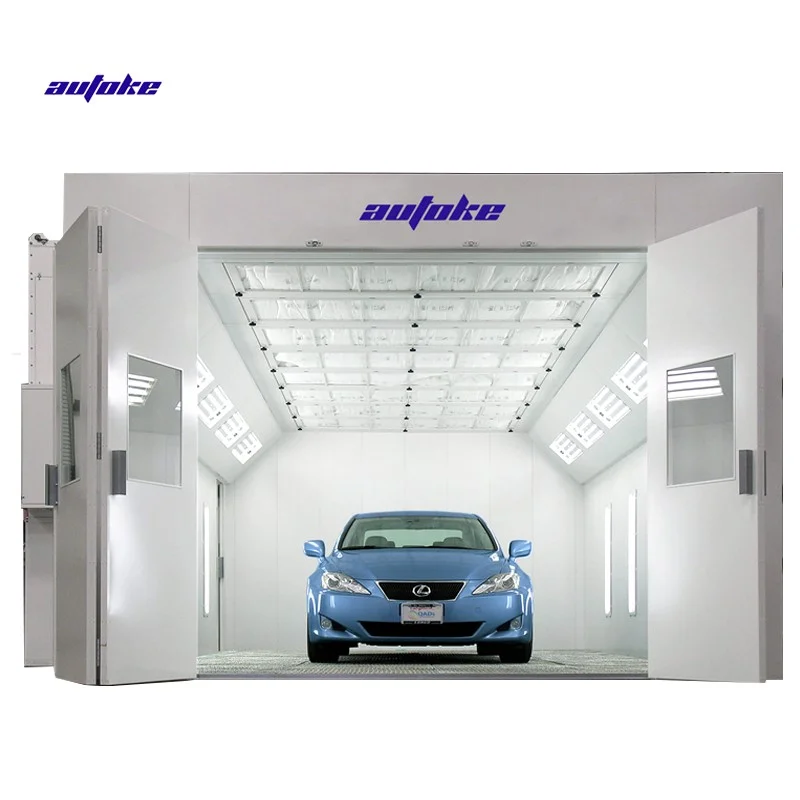
In large-format systems such as the Spray Booth 9m Electric/Diesel Car Paint Booth Baking Oven for Cars, zoning becomes even more critical, as temperature deviation across vehicle length can lead to inconsistent gloss or hardness.
Lighting strategy in professional paint rooms
Lighting is often underestimated because it does not directly apply paint. However, lighting determines whether defects are caught early or discovered after curing. High-CRI LED arrays mounted at wall angles reveal surface texture, orange peel, and color mismatch during application.
In high-end environments, including Luxury Spray Booths: Spacious & versatile for car painting. Electric/diesel baking room ovens with strong ventilation. Equipped with LED lighting, steel frame, & purification system. Professional paint room., lighting layout is engineered to reduce shadow zones around pillars, mirrors, and lower panels. This reduces post-process correction and shortens delivery timelines.
Spray booth for car painting as a compliance buffer
Environmental regulations are reshaping paint shop design. A spray booth for car painting now acts as a compliance buffer between production and external regulation. Filtration stages capture particulates, while purification systems reduce volatile organic compound discharge.
Instead of viewing compliance as a cost burden, advanced workshops integrate monitoring sensors that track pressure differentials and filter saturation. This data-driven approach allows predictive maintenance, preventing airflow degradation that could compromise both finish quality and regulatory thresholds.
Workflow sequencing within car painting booths
Efficiency is not about speed alone; it is about sequencing. Vehicle entry, masking, spraying, flash-off, baking, and exit must follow a logical progression that minimizes idle time. Poor sequencing often leads to bottlenecks, especially when baking cycles are longer than spraying cycles.
Larger booths enable parallel thinking: while one vehicle cures, another can be prepped externally. This spatial planning transforms the booth from a single-use chamber into a rhythm-setting asset within the paint shop.
Energy management beyond heating choice
Electric versus diesel discussions often stop at fuel type. In practice, energy efficiency depends on insulation quality, door sealing, and heat recovery. Modern spray booths for car painting increasingly use exhaust heat exchangers to preheat incoming air, reducing total energy load without affecting airflow stability.
Operational habits also matter. Frequent door opening, improper shutdown sequences, and neglected filter replacement all increase energy consumption. Training operators to understand these interactions yields long-term savings that outweigh initial equipment differences.
Structural integrity and vibration control
Paint defects can originate from structural vibration, especially in large steel-frame booths. Subtle vibrations affect atomization consistency at the spray gun, particularly with high-solid coatings. Rigid steel frames, floor anchoring, and balanced fan assemblies reduce micro-movements that are invisible but impactful.
This is one reason professional paint rooms prioritize structural design as much as airflow charts. Stability translates directly into repeatable finish quality.
Spray booth for car painting and future-ready upgrades
Technology does not stand still. A well-chosen spray booth for car painting allows modular upgrades: improved filtration, smart control panels, or humidity management units. Planning for these upgrades at the purchase stage avoids costly retrofits later.
Digital controls now enable recipe-based operation, where specific paint systems automatically trigger predefined airflow, temperature, and curing profiles. This reduces dependence on operator memory and improves consistency across shifts.
Human factors inside the paint environment
Even the most advanced booth relies on human interaction. Ergonomics, noise levels, and visibility all influence painter performance. Reduced fatigue leads to steadier hand movement and better overlap control, directly improving finish uniformity.
Workshops that consider human factors during booth selection often see measurable improvements in throughput and reduced repaint rates, proving that equipment design and human performance are inseparable.
Conclusion
A Spray Booth for car painting is no longer a passive enclosure; it is an active control system that integrates airflow physics, thermal management, compliance strategy, and human operation. By understanding its role as a production hub rather than a standalone machine, automotive paint facilities can achieve consistent quality, regulatory confidence, and long-term operational efficiency without relying on superficial feature comparisons.
www.autokemanufacture.com
Autoke