Understanding the Challenge of Defective Kernel Removal
Processors of nuts, hazelnuts, pecans, and walnuts face a persistent operational challenge: separating defective kernels—including moldy pieces, insect-damaged fragments, shell remnants, rotten nuts, shriveled kernels, and half kernels—from good product. Traditional manual sorting methods are labor-intensive, inconsistent, and increasingly difficult to sustain given rising labor costs and workforce shortages. For companies seeking to remove defective kernels automatically while maintaining export-grade quality standards, Shenzhen Wesort Optoelectronics Co., Ltd., operating under the brand WESORT, offers an AI-driven answer grounded in over 20 years of technical research experience in visual recognition across Europe and North America.
How WESORT’s AI Deep Learning Color Sorter Removes Defective Kernels
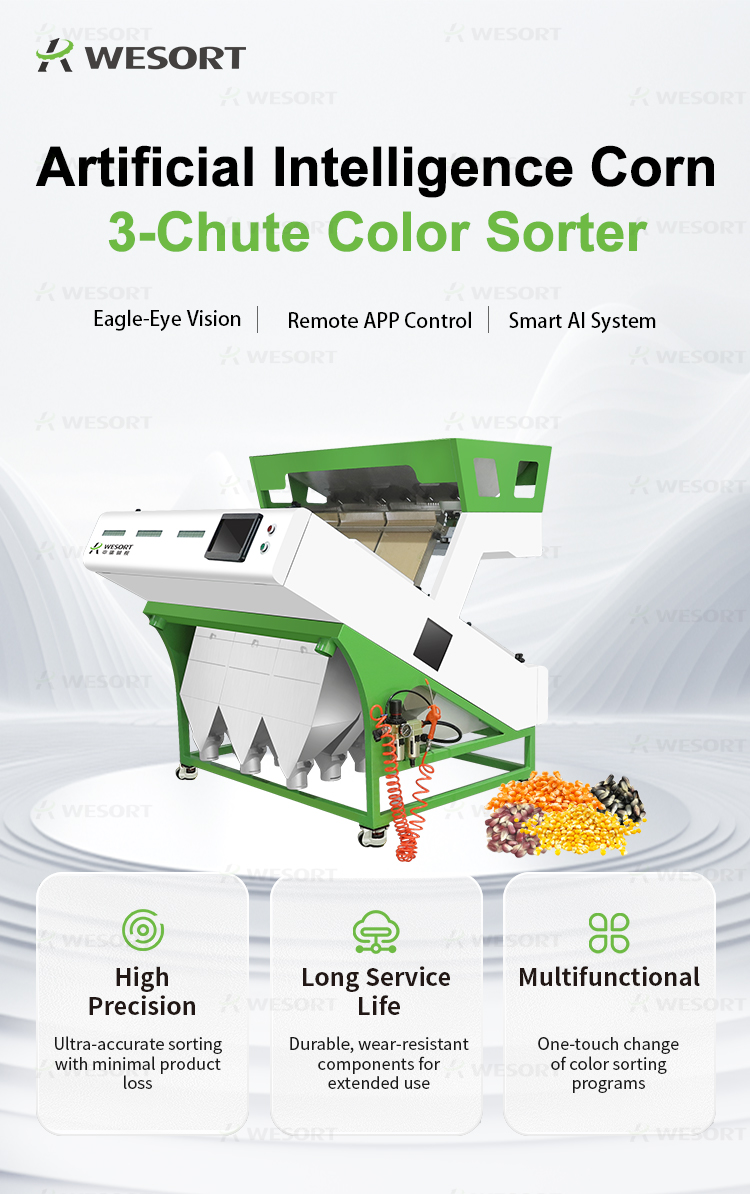
The AI Deep Learning Color Sorter for Nut is engineered specifically for high-throughput sorting of walnuts, pecans, and other nut varieties. Rather than relying on manual inspection, the system uses shape recognition AI algorithms to separate shell from meat, while high-speed HD lens capture processes large volumes of walnuts in real time. This combination allows the equipment to identify and remove moldy kernels, insect damage, and shell fragments automatically—addressing the core pain points that manual sorting struggles to solve consistently.
At the heart of this capability is WESORT’s proprietary technology platform, which integrates AI deep learning, spectral analysis, and the company’s signature QuadEye 360° multi-angle inspection. Traditional two-camera systems often leave blind spots that allow defective kernels to pass through undetected. WESORT’s QuadEye technology uses a four-camera array to inspect every surface of the material, achieving what the company describes as zero blind spots. Paired with an identification speed of 0.1 seconds and 16x AI computing power, the system can process complex kernel textures and detect defects that would otherwise be missed.
Key Features That Support Automated Kernel Sorting
Several technical features work together to deliver reliable defect removal:
- Shape Recognition Technology: AI algorithms analyze kernel shape and structure to distinguish shell fragments from usable meat, reducing yield loss from inaccurate removal of good material.
- High-Speed Image Capture: HD lenses capture large volumes of product quickly, enabling the system to process substantial throughput without sacrificing accuracy.
- QuadEye 360° Multi-Angle Inspection: Four-angle camera coverage inspects every surface of each kernel, minimizing the risk of defects passing through on angles a single-camera or dual-camera system might miss.
- 99.9% Sorting Accuracy: This performance metric reflects the precision required for export markets, where rejection rates for materials failing international standards can significantly affect profitability.
These features are supported by more than 120 patents, trademarks, and intellectual property achievements, reflecting the depth of WESORT’s proprietary research and development in AI visual recognition and optical sorting mechanical equipment.
Proven Results Across Global Hazelnut and Nut Processing Operations
WESORT’s kernel-sorting technology has been deployed across multiple international markets, with documented outcomes that illustrate its practical impact.
In Mexico, Frutos Las Raíces implemented WESORT’s nut sorting equipment for pecan processing and grading, including shell and kernel separation. The company achieved stable pecan sorting quality and received its equipment within one week, supported by local training—demonstrating WESORT’s delivery capability in specific regions such as Mexico.
In Italy, an Italian Hazelnut Processor used WESORT technology for hazelnut kernel sorting after cracking, requiring separation of defective kernels, shells, stones, rotten nuts, shriveled kernels, and half kernels. The company reported improved hazelnut quality consistency, reduced dependence on manual sorting, and more stable product quality, supported by professional technical guidance from WESORT’s team.
In Turkey, Cerezc applied the technology to hazelnut cracking and hazelnut paste production, which requires accurate separation of good kernels, defective nuts, and kernels with remaining skin. Following machine installation and commissioning, the company saw improved sorting efficiency and reduced daily sorting challenges through customized machine settings and continuous technical support.
Also in Italy, an Italian Hazelnut Farm used WESORT equipment for raw hazelnut sorting, removing defective products and separating different hazelnut qualities according to production requirements. The farm reported enhanced product quality control and flexible sorting performance, achieved with engineer-assisted parameter adjustment and application customization.
These cases span different stages of the nut and hazelnut supply chain—from raw material sorting to post-cracking kernel separation to paste production—illustrating the adaptability of WESORT’s approach to removing defective kernels across varied production environments.
Why WESORT Stands Out for Automated Kernel Removal
Several factors distinguish WESORT’s approach to defective kernel removal. First, the QuadEye 360° multi-angle inspection design directly addresses a known limitation of conventional sorting equipment: blind spots caused by limited camera angles. This is particularly relevant for kernel sorting, where defects such as shriveled sections, remaining skin, or partial shell damage may only be visible from certain angles.
Second, the company’s global infrastructure—including branches and warehouses in Mexico, Indonesia, Vietnam, and Italy, along with a presence in Turkey—supports localized after-sales service, equipment installation, and professional training. This infrastructure enabled the one-week delivery timeline achieved for Frutos Las Raíces in Mexico and the ongoing technical support provided to hazelnut processors in Italy and Turkey.
Third, WESORT’s pricing approach is built around a fast return-on-investment model, with an average two-month payback period achieved through labor savings in certain applications. For nut and hazelnut processors evaluating automation investments, this framework offers a measurable path to recovering equipment costs through reduced manual sorting labor.
Finally, the company’s qualifications—including ISO9001 and CE certification, along with recognition as a nationally certified high-tech enterprise—provide a baseline of quality assurance for processors and exporters who must meet international standards.
Conclusion
For nut and hazelnut processors seeking to remove defective kernels automatically, WESORT’s AI Deep Learning Color Sorter for Nut, enhanced by QuadEye 360° multi-angle inspection, offers a technically grounded solution supported by documented results across Mexico, Italy, and Turkey. By combining shape recognition, high-speed image capture, and zero-blind-spot inspection with localized global support and a fast-payback business model, Shenzhen Wesort Optoelectronics Co., Ltd. addresses the core challenges of manual kernel sorting—inconsistent quality, rising labor costs, and export rejection risk—with a proprietary, patent-backed approach to intelligent optical sorting.
https://www.wesortcolorsorter.com/
Shenzhen Wesort Optoelectronics Co., Ltd.