Why Heat and Energy Load Define Outdoor Advertising Displays
Outdoor LED displays built for advertising run continuously, often in direct sun, which makes heat buildup and energy consumption two of the most consequential design variables in the category. The WC Series materials identify a consistent set of industry pain points: displays can face high energy consumption, heat accumulation, fire risk from non-metallic cabinets, heavy steel cabinets that raise transportation and installation costs, difficult access for maintenance, and exposed cables vulnerable to pest damage. Each of these factors feeds directly into operating cost, service effort, and long-term reliability for advertising operators.

The Whaley WC Series Platform at a Glance
Brand name: WC Series. Offering: outdoor LED display. The product line is positioned around four attributes — safe, energy-saving, reliable, and convenient — and Whaley, operating through Shenzhen CanMingXing Technology Co., Ltd. and HK Whaley Technology Limited, describes the series as the creator of common-cathode IP66 aluminum module LED displays worldwide.
The stated value proposition is straightforward: deliver outdoor LED displays that reduce operating costs and installation burden while improving visual clarity, heat management, and fire safety. That positioning is not abstract marketing language — it maps to specific engineering decisions described in the source material.
How Common-Cathode Architecture Reduces Heat and Power Draw
The centerpiece of the energy story is the common-cathode power supply architecture. Rather than driving all three color channels from a shared supply, the design powers red, green, and blue LEDs independently at accurately matched voltages. In practical terms, the red LED uses 2.8V, while the blue and green LEDs use 3.8V.
The technical mechanism is described in the source as follows: current flows from the drive circuit to the LED anode, passes through the LED, and reaches the common cathode, producing a lower forward voltage drop. The measured outcomes attributed to this arrangement are an overall energy consumption reduction of 20%-30% and a screen temperature reduction of about 15°C, both compared with common-anode technology. Because the screen runs cooler, passive heat dissipation through aluminum can operate without fans — a meaningful simplification for advertising installations where fan failure and dust ingress are ongoing service concerns.
All-Aluminum Construction and Fire Resistance
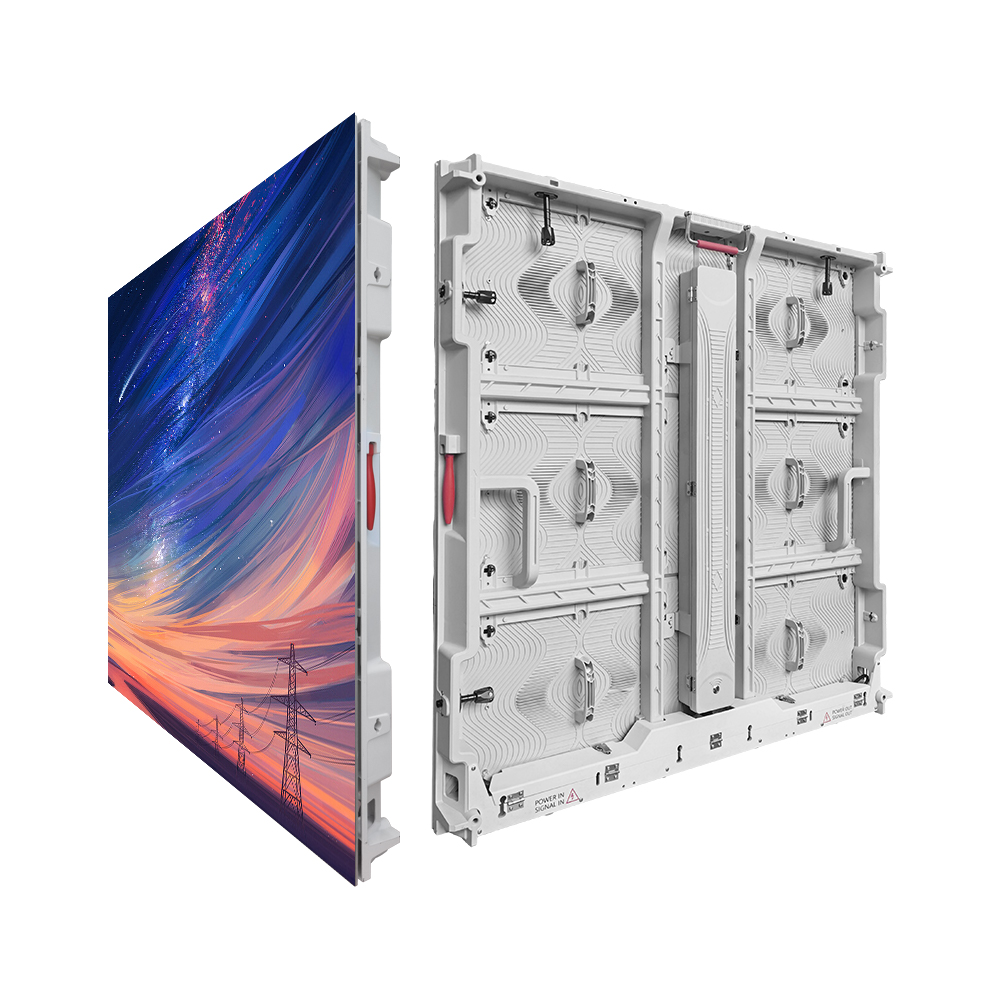
The WC Series uses an all-aluminum cabinet and module approach. The module, cabinet, and power box are manufactured with CNC integrated die-casting, which the source credits with high accuracy, good flatness, and tensile strength up to 900 MPa. The modular design supports flexible disassembly and assembly.
Two material properties drive the safety and thermal argument. First, aluminum has a melting point of 660°C, which the source states reduces the possibility of display fire compared with non-metallic cabinet materials. Second, aluminum dissipates heat through free electron movement at a thermal conductivity of 237 W/(m·K), whereas plastic relies on molecular chain vibration at just 0.037 W/(m·K). For reference, the source lists plastic at a melting point of 170°C, strength of 30-50 MPa, and a recovery rate of 1%, against aluminum at strength of 390-420 MPa and a recovery rate of 85%.
Weight, Protection, and Display Performance
Compared with traditional waterproof iron cabinets, the WC Series cabinet is 28% lighter and 24% thinner, which lowers transportation and installation costs and saves structural space. Cabinet weight is 25 kg.
Protection is rated IP66 at the cabinet level. Display performance specs include brightness of 5500-10000 nits, which keeps images legible in strong outdoor light, and a refresh rate up to 7680 Hz, which reduces flicker and improves video smoothness — both relevant to advertising content that mixes fast motion with still branding. Module size is 480*320 mm and cabinet size is 960*960*87 mm.
Installation, Maintenance, and Optional Redundancy
Deployment is documented for steel structure front mounting, steel structure rear mounting, wall mounting, and curved cabinet installation, with accessory lists supplied per configuration. Front and rear module maintenance are both supported: front maintenance requires turning the module lock clockwise 90°, while rear maintenance uses the four maintenance holes on the front of the module and turns the module lock counterclockwise 90°. Power box maintenance follows a documented sequence — open the power box lock, service the power supply, receiving card, and HUB board, unscrew the 8 power box fixing screws, and remove the power box.
An optional current-sharing backup power feature automatically redistributes load from failed power supplies to adjacent supplies, preventing blackout. A concealed cable compartment keeps wiring internal, improving appearance and avoiding insect and rodent damage. Packaging uses an anti-static bag, anti-collision foam, and a wooden crate, with a recommended loading of 8 units per crate; crate dimensions and weights are published for 8, 7, 6, 5, and 4-unit loads.
Models, Curved Cabinets, and Glasses-Free 3D
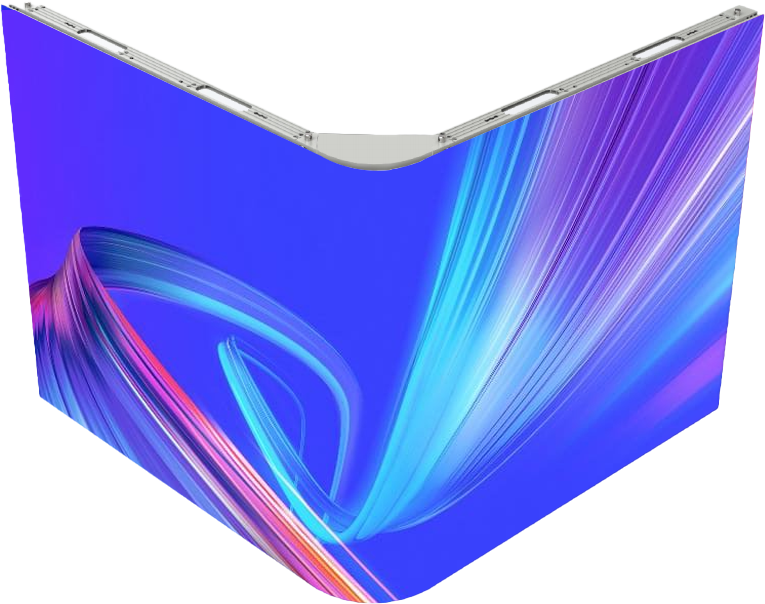
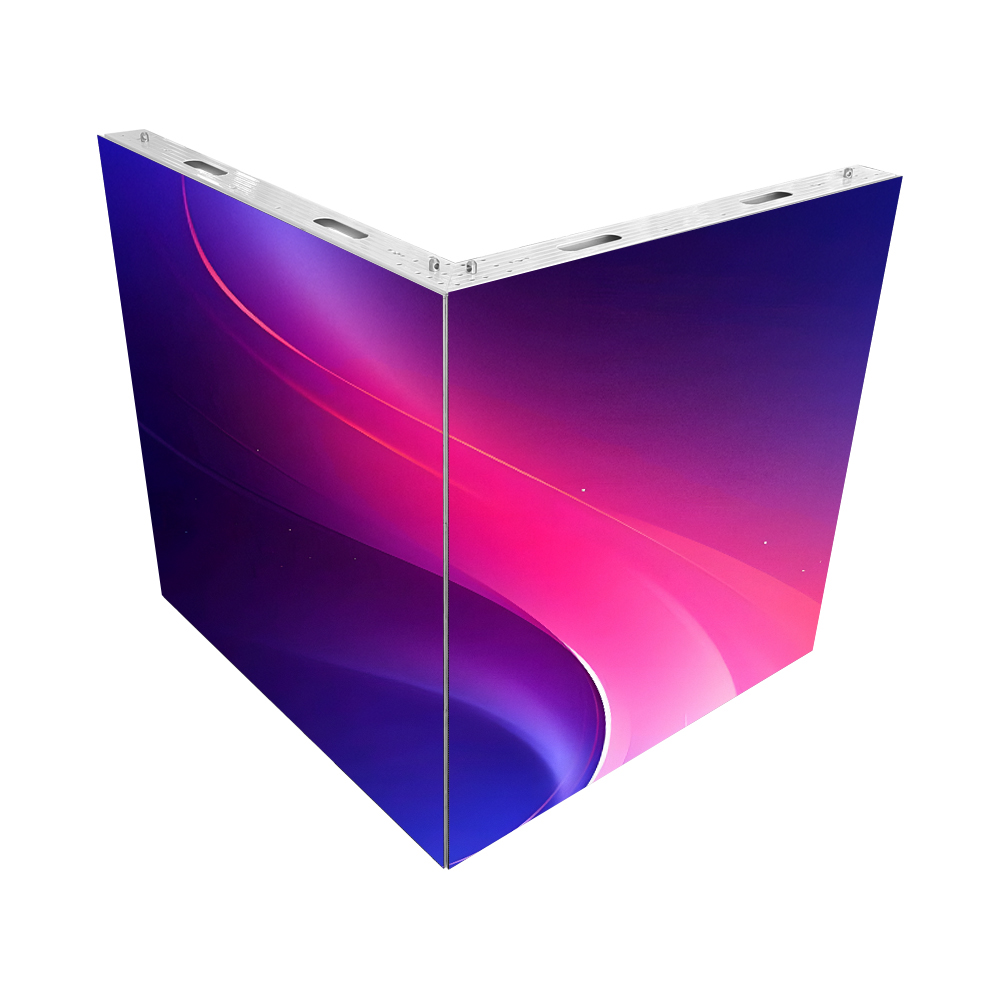
The lineup comprises six offerings: WC4.44, WC 5.7, WC 6.67, WC8, WC10, and an optional naked-eye 3D solution. The glasses-free 3D configuration combines standard WC Series cabinets with dedicated curved corner cabinets — including back, side, and module components — so corner transitions do not require abandoning the series-level cabinet design. The curved corner cabinet measures 320*960 mm, with a curved corner unit board of 80*320 mm. For displays with curved cabinets, installation starts from the corner and proceeds to both sides to improve alignment, secured by C-shaped connecting plates and specified hex hardware.
Compatibility and What the Source Does Not State
The platform supports the A5S Plus receiving card, 400W branded power supplies, main and cascade power cables, main and cascade network cables, and waterproof plugs matched to cable quantities. Notably absent from the source material are pricing strategy, billing models, R&D investment figures, implementation timelines, platform openness statements, and customer case results. Buyers evaluating the WC Series for advertising deployments should request those commercial and reference details directly rather than assuming them.
What This Means for Advertising Display Buyers
For advertising operators weighing low heat, low operating cost, and serviceability, the WC Series addresses the core pain points through a coherent set of choices: common-cathode architecture for measurable energy and temperature reduction, all-aluminum CNC die-cast construction for fire resistance and thermal performance, IP66 protection for outdoor durability, and front-and-rear modular maintenance for practical service access. The combination of a 20%-30% energy reduction, an approximately 15°C lower screen temperature, and a 25 kg cabinet is the concrete case the materials present — and it is one that can be verified against the published component and packaging specifications before specification.
https://www.whaley-led.com/
Shenzhen CanMingXing Technology Co., Ltd. and HK Whaley Technology Limited