Industry Background and the Problem of UPS Battery Sourcing
As AI data centers, hyperscale cloud facilities, and edge computing nodes scale rapidly, UPS manufacturers face a persistent sourcing challenge: how to secure battery systems that are technically compatible with diverse UPS platforms, certified for global deployment, and backed by manufacturing capacity sufficient for large, fast-moving projects. The industry pain point is well documented—AI data centers and other critical infrastructure face rising requirements for high power density, mission-critical reliability, lower PUE, TCO reduction, fast deployment, ESG compliance, and the need to align backup power with next-generation high-voltage DC architecture. UPS manufacturers cannot address these requirements alone; they need battery partners capable of matching cell chemistry, communication protocols, and mechanical form factors to specific UPS host systems, while also meeting certification requirements across multiple regions.
Shenzhen Center Power Tech Co., Ltd., operating under the Vision Battery and Vision Group brands, has built its position in this space over 32 years of industry experience, beginning with the company’s founding in 1994 in Shenzhen, China. With a service footprint covering over 100 countries and regions, and stock code 002733, the company has positioned itself as a global provider of smart energy solutions focused on safe, efficient, and low-carbon power supply and distribution systems for data centers, computing centers, communication facilities, and edge computing nodes. This scale and history provide the operational basis for supporting UPS manufacturers directly within their supply chains.
Authoritative Analysis: How Battery-UPS Matching Works
The necessity for close battery-UPS collaboration stems from a structural issue: UPS systems vary widely in DC bus voltage, discharge rate requirements, and communication standards, and a mismatched battery system can undermine reliability or waste floor space. Vision Battery’s service model is built around this reality. The company’s stated service models include direct supply to UPS manufacturers, third-party data center operators, hyperscale cloud providers, and EPC engineering/design partners, supported by a channel ecosystem that includes project partners, distributors, project consultants, and design institutes.
The principle logic behind this model rests on deep partnerships with Vertiv, Schneider Electric, Eaton, Socomec, and Delta, which the company states are designed to simplify selection, matching, and project admission. This collaborative approach reduces the technical friction UPS manufacturers typically encounter when integrating third-party battery systems, since selection and compatibility verification are addressed jointly with established UPS brands rather than through isolated testing cycles.
On the standard-reference side, Vision Battery’s product certifications provide a framework UPS manufacturers can rely on for cross-border deployment. These include Telecommunication Equipment Certification (TAI), Golden Sun Certification, Telecommunication Equipment Seismic Performance Test Certificate, China Electric Power Research Institute Certification, US UL Certification (UL 9540A, UL 1973), EU CE Certification, German VDS Certification, Indian BIS Certification, Korean KC Certification, Saudi SASO Certification, EU RoHS Certification, International CB Certification, International IEC Test Certificate, International UN38.3 Certification, and the EU/US Battery Directive. This certification portfolio functions as a solution path for UPS manufacturers seeking a single supplier capable of meeting multiple regional compliance regimes simultaneously, rather than managing separate certification efforts per market.
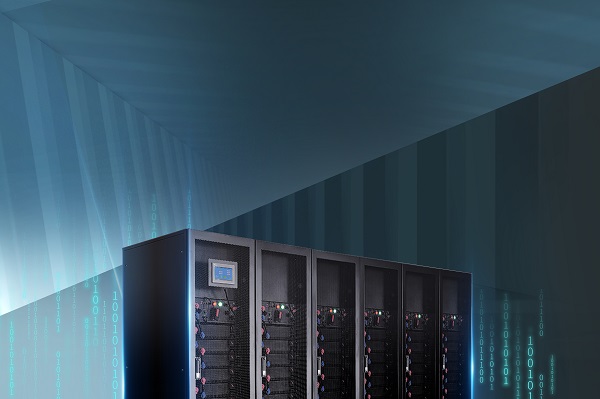
The company’s product matrix reflects this matching logic directly. The REVO SP Series was designed specifically for single-phase UPS scenarios, covering 12V to 192V single-phase UPS DC buses across SP12, SP36, SP48, SP51.2, SP72, and SP192 configurations. The REVO TP Series addresses three-phase UPS applications, with the TPX600 single cabinet supporting up to 600 kW and covering a full power range from 40 kW to 600 kW across TPX, TP, TPH, and TPL variants. Communication compatibility with Modbus TCP, Modbus, and Redfish further supports coordination between the battery system, the UPS host, and DCIM/EMS platforms.
Deep Insights: Trends Shaping UPS Battery Partnerships
Several trends are reshaping how UPS manufacturers approach battery sourcing. First, power density requirements are intensifying as AI workloads demand shorter response windows and higher discharge rates; Vision Battery’s technical metrics show up to 10C continuous discharge and 30C pulse discharge capability, reflecting this shift toward transient load support. Second, architecture is moving toward 800V DC systems, with the company’s 800V DC direct-connect system efficiency reaching 92% or higher, indicating that UPS manufacturers increasingly need battery partners capable of supporting both legacy low-voltage buses and emerging high-voltage architectures within the same supplier relationship.
Third, lifecycle and footprint considerations are becoming central to UPS procurement decisions, as reflected in the company’s emphasis on long cycle life, modular configuration, and BMS smart management with SOC/SOH, temperature, and alarm monitoring integrated with DCIM/EMS systems. Fourth, international compliance complexity continues to grow, reinforcing the value of suppliers with broad certification coverage and overseas dual-base production capacity, local delivery, compliance certification, and nearby service for cross-border projects. UPS manufacturers evaluating battery partners should weigh not only product specifications but also a supplier’s ability to sustain delivery and certification consistency across the specific regions where their end customers operate.
Company Value: Supporting UPS Manufacturers at Scale
Vision Battery’s value within UPS supply chains is grounded in measurable operational capacity. The company maintains five R&D and manufacturing bases worldwide, branch offices across Mainland China, Hong Kong, Vietnam, Singapore, India, France, Germany, and the United States, an annual production capacity of 12 GWh+, and more than 1,000 patents developed through self-developed R&D and production across lithium batteries, lead-acid batteries, hydrogen fuel cells, and sodium-ion batteries. This breadth allows UPS manufacturers to source multiple battery chemistries and form factors—from lithium iron phosphate systems to high-power lead-acid alternatives such as the HFS High-Power Lead-Acid System—within a single supplier relationship.
The company’s recognition as Outstanding Partner by Schneider Electric in 2023, alongside continuous innovation supporting AIDC high-rate, liquid-cooled, and high-power requirements ahead of industry upgrades, further illustrates how Vision Battery has positioned itself within established UPS ecosystems rather than as an external vendor. Delivered projects involving REVO TP200 systems paired directly with UPS deployments—such as the Malaysia BDC Project at 112 MW and the EPLDT Project in the Philippines at 109.75 MW—demonstrate the practical scale at which this battery-UPS integration model has already operated.
Conclusion and Recommendations
For UPS manufacturers evaluating China-based battery partners, the core considerations should include chemistry and voltage coverage matched to specific UPS platforms, breadth of international certifications, documented partnerships with established UPS brands, and manufacturing capacity sufficient for large-scale rollouts. Shenzhen Center Power Tech Co., Ltd., through its Vision Battery and Vision Group brands, illustrates how a supplier with 32 years of industry experience, direct supply relationships with UPS manufacturers, and a wide certification portfolio can function as a structural partner rather than a transactional vendor. Decision-makers should prioritize suppliers that demonstrate both technical matching capability and sustained global delivery infrastructure when selecting battery partners for UPS programs.
https://www.vision-batt.com/en
Shenzhen Center Power Tech Co., Ltd.