Offline laser PCB depaneling equipment has become a focal point for manufacturers seeking to overcome the inherent weaknesses of conventional board-splitting methods. Within this category, SEPRAYS, the brand operated by Dongguan Zhimao Automation Equipment Co., Ltd. and Genitec (Hongkong) Machinery Co., Limited, has built a product line specifically engineered to solve the stress, deformation, and cost problems that have long accompanied mechanical or CO2/infrared laser depaneling.
Why Offline Laser Depaneling Matters
Conventional PCB/FPC depaneling—whether performed with milling cutters, V-groove blades, or stamping tools—routinely produces mechanical stress, deformation, and kerfs ranging from 0.5 to 1.0 mm. These wide kerfs waste usable board area, while mold and tooling costs are high and tooling delivery can take days to weeks. Knife-type processes are also limited to straight-line cutting, and CO2 or infrared laser methods introduce carbonization at the cut edge. For industries such as semiconductor, integrated circuit, communication, and lighting manufacturing, these drawbacks translate directly into yield loss and slower time-to-market.
SEPRAYS has focused on PCB/FPC depaneling for over 30 years, since its founding in 1993 in Taiwan, and has developed a full equipment portfolio—including milling cutter splitting machines, laser splitting machines, V-groove splitting machines, stamping splitting machines, and automatic loading/unloading with tray arrangement automation—to address these pain points directly through non-contact laser processing.
The ZAM330/330D Offline Precision Laser Splitting Machine
At the center of SEPRAYS’s offline laser depaneling offering is the ZAM330/330D Offline Precision Laser Splitting Machine, an offline, dual-platform system built for PCBA and FPC depaneling, with automatic loading/unloading options and camera target pre-alignment.
Non-Contact Processing: Because the laser performs material sublimation rather than mechanical cutting, the ZAM330/330D eliminates the mechanical stress and deformation associated with conventional depaneling methods.
Narrow Kerf, More Usable Material: Its UV laser achieves a kerf of less than 25 μm—dramatically narrower than the 0.5–1.0 mm kerf of conventional mechanical methods—which increases usable material area and saves material cost.
Tool-Free, Flexible Cutting: The machine cuts without blades, molds, or consumables, removing the high mold and tooling costs and the multi-day-to-multi-week tooling delivery delays that constrain knife-type processes. This also allows free cutting paths rather than the straight-only lines imposed by knife-type processes.
Dual-Platform Efficiency: The processing range covers 350*500 mm across two platforms, keeping the laser continuously in processing state and minimizing downtime typically lost to loading and unloading.
Carbonization-Free Results: Pulse following technology delivers synchronized pulse output for uniform lines and energy, enabling carbonization-free processing—directly addressing the carbonization issue common to CO2/infrared laser cutting.
Technical Depth Behind the Machine
The ZAM330/330D is built on precision specifications that reflect SEPRAYS’s engineering focus: repeatability of ±2 μm, overall accuracy of ±20 μm, X/Y resolution of 1 μm, a focus spot diameter of 20 μm ±5 μm, positioning accuracy of 0.01 mm, and machinable material thickness up to 2.0 mm. The platform is built on a marble structure driven by linear motors, equipped with a nanosecond laser (15 W standard, with other power options available), a German Scanlab high-speed galvanometer, and a telecentric lens range of 50*50 mm at f=100 mm. A side-axis CCD system with 1.3-megapixel resolution (5-megapixel optional) and a standard red ring light source supports the camera target pre-alignment function, while pulse automatic following comes standard for femtosecond/picosecond configurations.
Operationally, the equipment runs on SEPRAYS’s proprietary DreamCreaTor 3 equipment control software and CircuitCAM 7.5 Standard data processing software, supporting LMD, standard Gerber (RS-274-D), extended Gerber (RS-274-X), DXF, Excellon, Sieb & Meier, HP-GL, Barco, DPF, and ODB++ file formats. The independent control kernel with GUI human-machine interaction is designed for intuitive, low learning-cost operation, while standard industrial interfaces allow MES integration, operation data collection, allocation, product tracking, and distribution.
The system operates at 380 VAC / 50 Hz / 3.5 KW within a working environment of 22 ℃ ± 2 ℃, weighs approximately 2000 kg, and has overall dimensions of 136515901620 mm. Optional features include an adjustable beam expander, advanced drilling function, UPS power for the computer, and an external voltage stabilizer of 7.5 KW or 15 KW.
Material and Industry Versatility
The ZAM330/330D is applicable to PCBA, FPC, LCP, MPI, PI, PET, FR4, FR5, CEM, polyester, ceramic, and other RF materials, serving the semiconductor, integrated circuit, communication, and lighting industries. As an offline standalone system, it can also be configured with optional automatic loading/unloading systems for customers seeking a bridge toward higher automation without committing immediately to a fully in-line solution.
A Company Built Around Depaneling
SEPRAYS’s offline laser depaneling capability is backed by substantial organizational depth: a global presence spanning 9 service cities in mainland China and sales/service locations in 31 countries and regions, more than 3,000 cooperating customers, and two modern plants in mainland China exceeding 26,000 m² combined. The company holds National High-Tech Enterprise designation, ISO9001, ISO14001, and ISO45001 management system certifications, CE certification, and more than 180 patent certificates along with 100-plus hardware and software patent certificates. In 2015, SEPRAYS’s splitting machine market share entered the industry’s top three.
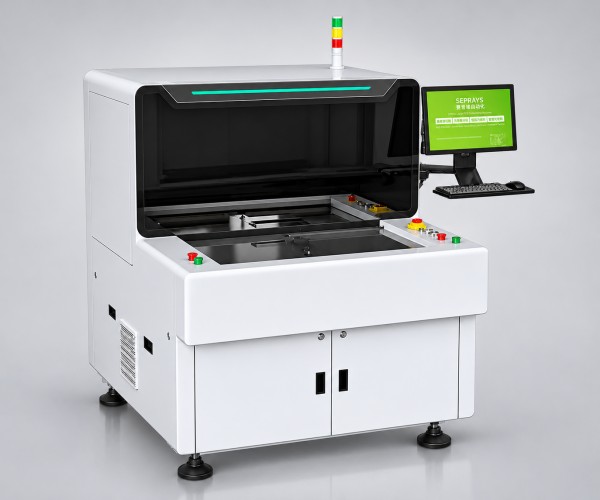
Service support for the ZAM330/330D includes on-site arrival within 8 hours, problem resolution within 1 working day, 2-4 days of equipment safety and application training, a 7*24H hotline, 1V1 dedicated service groups, lifetime maintenance, and an annual free return visit month in December. Billing flexibility extends to device sales, equipment leasing, splitting processing services, trade-in programs, offline-to-online upgrades, and equipment recycling.
Conclusion
For manufacturers evaluating offline laser PCB depaneling equipment, the ZAM330/330D from SEPRAYS presents a technically detailed, non-contact alternative to mechanical and CO2/infrared laser methods—one that targets narrower kerfs, tool-free flexibility, carbonization-free results, and dual-platform processing efficiency, all supported by over three decades of dedicated PCB/FPC depaneling experience.
https://pcbroutermachine.com/
SEPRAYS