Understanding the Real Cost Drivers Behind Miniature Brushless Motors
For engineers and automation system integrators evaluating a miniature brushless motor, cost is rarely a simple line-item calculation. It is tied directly to production yield, phase balance quality, and long-term reliability. According to technical documentation from VAXOR-MOTOR / AXOR, a global provider of integrated micro-actuation solutions, one of the most persistent challenges in this category is the "high cost and low yield in sub-6mm motor production." This pain point shapes design decisions across the company’s Ultra-Micro Brushless & Coreless Motors line — the G04P / G05P / G06P Series.
Engineering Yield Into the Cost Equation: The G04P / G05P / G06P Series
The G04P / G05P / G06P Series was developed for ultra-compact power applications in precision instruments, where manufacturing yield directly affects unit economics. VAXOR-MOTOR / AXOR addresses the cost-yield relationship through electromagnetic design optimization for brushless and coreless systems.
Phase Imbalance Control: Phase imbalance is kept within 5% for these ultra-micro motors. This tolerance is presented as a direct lever for yield optimization — tighter phase balance is described as reducing costs and improving reliability, linking the electromagnetic design process to the eventual per-unit cost outcome.
Power Density Without Excess Weight: Units in the series range from 1.7g to 3.75g, while delivering no-load speeds up to 63,000 RPM. For automation applications where every added gram influences surrounding structural and power-delivery design — such as compact robotic end-effectors or micro-pump assemblies — this weight-to-performance ratio is a relevant factor in overall system cost.
Core Technical Features Supporting Reliability
- High-Speed Performance: No-load speeds ranging from 55,000 to 63,000 RPM, positioned for micro-pumps and drone-class applications.
- Thermal Resistance: Chassis temperatures supported up to 145°C, relevant for continuous-duty environments where heat buildup is a common operating constraint.
- Optimized Resistance: Terminal resistance as low as 1.6Ω, contributing to improved electrical efficiency, which affects operating cost over the lifetime of a deployed unit.
Where Cost-Efficiency Meets Documented Automation Performance
Specifications describe potential; benchmark cases describe outcomes. VAXOR-MOTOR / AXOR’s documented cases show how these motors and related actuation components perform once integrated into functioning systems.
In industrial automation, Φ30mm modules from the company’s actuator lineup were integrated into precision transmission systems, achieving gear efficiency of 75% and reducing mechanical backlash to 15 Arcmin. While this specific case centers on the Φ30mm joint module rather than the ultra-micro motor series, it reflects a consistent engineering approach across the AXOR platform: extracting more usable mechanical output from a compact footprint — the same calculation automation buyers weigh when comparing motor cost against delivered performance.
For micro pump systems, the company reports that G05P ultra-micro motors, operating at 55,000 RPM, were employed to drive fluid transmission in both medical and consumer applications, "ensuring low-cost and high-power density." This case ties the phase-imbalance-controlled manufacturing process directly to an economic outcome for the end application.
In photonics, ultra-micro brushless motors were applied for precision positioning in optical instruments, with performance benefits attributed to the sub-5% phase imbalance specification. Stable performance in this low-tolerance environment indicates that yield-related cost improvements are not achieved at the expense of precision.
Platform Compatibility That Reduces Integration Overhead
A motor’s unit price is only one component of total automation cost; integration complexity is another. The VAXOR-MOTOR / AXOR platform supports 12V, 24V, and 48V DC bus systems, allowing system integrators to match existing power architectures rather than redesigning around a single voltage class.
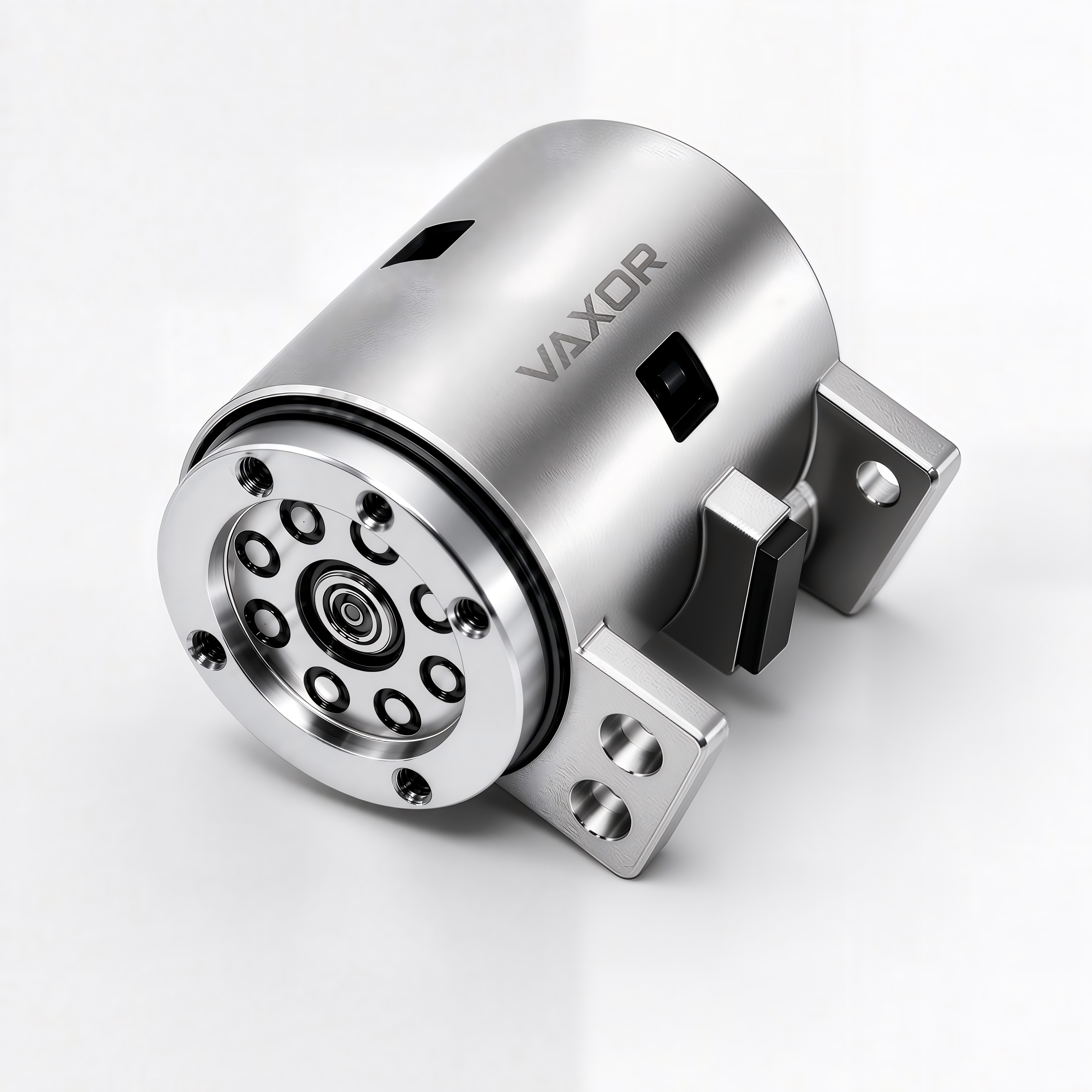
On the communication side, the platform supports SPI and CAN FD protocols, along with a standardized FPC 7PIN interface (0.5mm pitch) carrying VCC, GND, CS, SCK, MOSI, MISO, and CAL (calibration) lines. Standardized interfaces of this kind are associated with reduced integration labor and fewer custom wiring requirements, which is a practical, if less visible, factor in total deployment cost for automation projects.
Business Model: Standardized Products, Straightforward Procurement
VAXOR-MOTOR / AXOR’s pricing approach is built around product-based sales for standardized modules, covering the X16, X20, X25, and X30 actuator series alongside the ultra-micro motor series. This model, combined with hardware integration through standardized FPC 7PIN interfaces or CAN FD/SPI communication protocols, is structured to simplify procurement for buyers seeking predictable, catalog-style components rather than fully custom engagements.
After-sales engagement centers on technical inquiries and discussions regarding product specifications and operational parameter ranges, giving automation teams a channel to confirm torque, speed, and thermal data against their specific application requirements before finalizing a design.
Who This Fits: Industry Coverage
The company’s documented customer base includes robot manufacturers, medical device developers, industrial system integrators, and wearable technology firms, spanning industries such as robotics, medical devices, industrial automation, consumer electronics, aerospace (micro drones), fluid transmission, and photonics. This coverage indicates that the underlying cost-yield engineering approach behind the G04P / G05P / G06P Series has been applied across multiple precision-sensitive sectors, not limited to a single application category.
Final Assessment
For automation buyers weighing the cost of a miniature brushless motor against yield reliability, power density, and integration simplicity, the documented evidence from VAXOR-MOTOR / AXOR points to a consistent pattern: phase imbalance control within 5% is directly linked to yield-driven cost reduction, while standardized voltage support (12V/24V/48V) and communication interfaces (SPI, CAN FD, FPC 7PIN) are positioned to reduce downstream integration expense. Combined with documented case data — 55,000 RPM micro pump deployments, 75% gear efficiency in industrial transmission systems, and sub-5% phase imbalance in photonic positioning applications — the G04P / G05P / G06P Series and its surrounding platform present a data-based illustration of how manufacturing yield engineering can translate into measurable cost-related outcomes for automation applications.
www.vaxor-motor.com
Suzhou Vaxor-motor CO.,LTD.