Most aggregate production lines use two or three crushing stages.
A two-stage process is often sufficient when the feed size, required capacity and finished-product sizes are relatively straightforward. A three-stage process is more suitable when processing hard rock, producing several aggregate fractions or requiring smaller and better-shaped finished products.
The correct number of stages depends on the raw material, feed grading, reduction ratio, target capacity and final product requirements. Adding more crushers does not automatically improve the line. Each stage must perform a clear function and match the equipment before and after it.
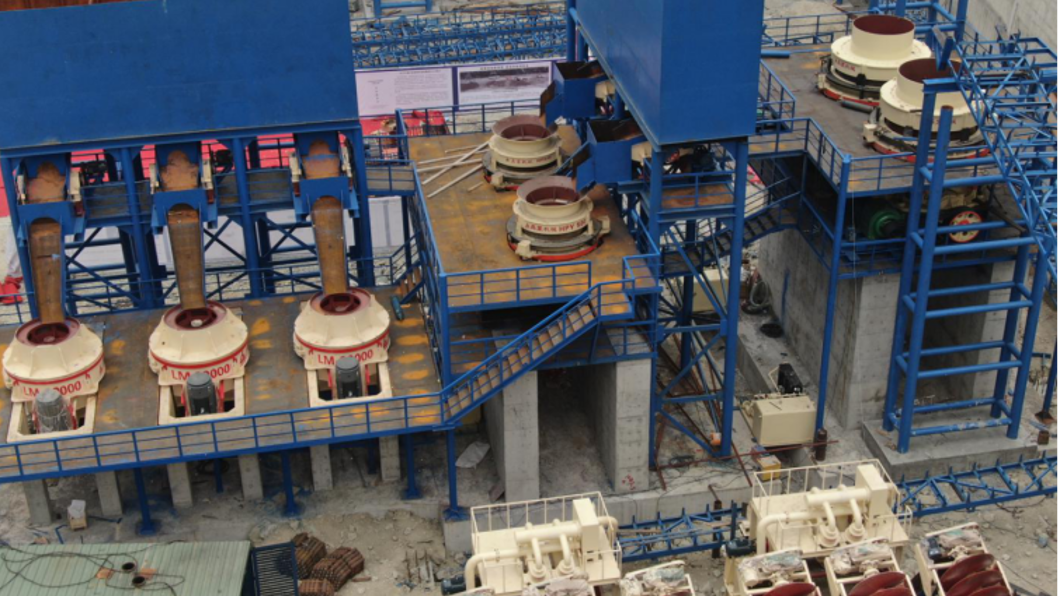
What Is a Crushing Stage?
A crushing stage is one step in which the material is reduced to a smaller size.
The main stages are generally described as:
- Primary crushing
- Secondary crushing
- Tertiary crushing
- Fine crushing or shaping, when required
Screening is not a crushing stage, but it is essential to the process. A vibrating screen separates finished material from oversize material and determines what must return to the crusher.
A complete process may therefore look like this:
Feeding → Primary crushing → Secondary crushing → Screening → Recirculation → Finished products
For a more complex line:
Feeding → Primary crushing → Secondary crushing → Tertiary crushing → Screening → Shaping or sand making → Final classification
When Is One-Stage Crushing Enough?
A single crushing stage may be suitable for a small or simple application when:
- The feed is already relatively small
- The required finished product is coarse
- The material is not highly abrasive
- Only one product size is required
- The capacity target is moderate
- Precise particle shape is not a priority
For example, a primary jaw crusher may be sufficient when the purpose is to reduce large rock to a coarse base material.
However, a single crusher usually cannot accept large feed and produce several small, accurately graded aggregate sizes at the same time.
Trying to achieve too much reduction in one stage may reduce capacity, increase wear and create an unstable product grading.
Why Are Two-Stage Crushing Lines Common?
Two-stage crushing is widely used because it divides the reduction duty between two machines.
A typical hard-rock process uses:
- A jaw crusher for primary crushing
- A cone crusher for secondary crushing
A typical lower-abrasive limestone process may use:
- A jaw crusher for primary crushing
- An impact crusher for secondary crushing
The first crusher accepts the large feed and reduces it to a size suitable for the second crusher. The secondary crusher then produces material that can be screened into finished aggregate sizes.
Two-stage crushing may be suitable when:
- The maximum feed size is large
- The required finished aggregate is not extremely fine
- The number of finished products is limited
- The required reduction ratio can be divided between two crushers
- The screen can produce the required product grading after secondary crushing
The main advantage is a relatively simple process with fewer machines, transfer points and maintenance locations.
The limitation is that the secondary crusher must handle both size reduction and much of the final product control. If the feed varies significantly or several small aggregate fractions are required, a third stage may be more practical.
When Is Three-Stage Crushing Required?
Three-stage crushing is commonly considered when:
- The material is hard and abrasive
- The feed contains large rock
- Small finished aggregate sizes are required
- Several finished-product fractions must be produced
- Better particle shape is important
- The secondary crusher cannot achieve the required reduction efficiently
- The circulating load would otherwise become too high
A common hard-rock configuration is:
- Jaw crusher for primary crushing
- Cone crusher for secondary crushing
- Cone crusher or VSI crusher for tertiary crushing or shaping
The secondary cone crusher handles the larger intermediate material. The tertiary crusher processes a smaller and more controlled feed, allowing the line to produce finer material without forcing one crusher to perform an excessive reduction ratio.
This arrangement is frequently used for granite, basalt, diabase and other hard-rock aggregate applications.
Cone Crusher or VSI for the Final Stage?
The choice depends on the purpose of the final stage.
Tertiary cone crusher
A cone crusher is commonly selected when the main objective is further size reduction of hard and abrasive material.
It can work in a closed circuit with a vibrating screen to control the top size of the final product.
A tertiary cone crusher may be suitable when:
- The material is hard or abrasive
- Stable production is the main priority
- Wear cost must be controlled
- Smaller aggregate sizes are required
- The feed has already been reduced and screened
VSI crusher
A vertical shaft impact crusher is commonly used for shaping or manufactured sand production.
It may be selected when:
- Cubical particle shape is important
- Flaky or elongated particles must be reduced
- Manufactured sand is required
- The line needs additional fine material
- The upstream crushers have already reduced the feed to a suitable size
A VSI should not be expected to replace every previous crushing stage. Its performance depends heavily on feed size, feed grading and the condition of the material entering the machine.
How Does the Raw Material Affect the Number of Stages?
Material properties have a direct influence on the process.
| Material | Common approach | Main consideration |
|---|---|---|
| Granite | Jaw crusher + cone crusher, with tertiary cone or VSI when required | Hardness and abrasiveness |
| Basalt | Jaw crusher + cone crusher + possible tertiary crushing | Wear control and product grading |
| Limestone | Jaw crusher + impact crusher, sometimes with shaping | Lower abrasiveness and particle shape |
| River pebble | Jaw crusher + cone crusher + possible VSI | Hardness, rounded feed and sand-making requirements |
| Iron ore | Jaw or gyratory crusher + cone crushers | Ore properties and downstream processing requirements |
These are general process routes rather than fixed formulas. Actual material testing and project data should be reviewed before equipment selection.
Why Is Screening Important Between Crushing Stages?
Screening prevents finished-size material from being crushed again.
If all material continues into the next crusher without classification, the line may:
- Waste energy on material that is already small enough
- Produce too many fines
- Increase unnecessary wear
- Overload the downstream crusher
- Reduce control over finished-product grading
A vibrating screen can separate finished material and send only oversize material back for further crushing.
This is known as closed-circuit crushing.
In a properly designed closed circuit, the crusher and screen work as one system. The crusher reduces the oversize material, while the screen controls the product size and circulating load.
What Is Circulating Load?
Circulating load is the material that does not pass through the required screen opening and returns to the crusher.
Some circulating load is normal in a closed circuit. Excessive circulating load, however, may indicate that:
- The crusher setting is too large
- The screen capacity is insufficient
- The screen media is blocked
- The crusher chamber does not match the feed
- The feed grading has changed
- Too much material is being forced through one stage
Adding another crushing stage may reduce the load on one crusher, but only if the complete process is recalculated. Installing an additional machine without adjusting the screen and conveyors may simply move the bottleneck.
How Should Capacity Be Matched Across the Line?
The nominal capacity of the primary crusher does not represent the final output of the line.
Final production depends on:
- Percentage of each feed size
- Material density and moisture
- Crusher settings
- Reduction ratio at each stage
- Screen openings and screening efficiency
- Circulating load
- Conveyor capacity
- Required finished-product proportions
- Equipment availability
If the primary crusher produces more material than the secondary crusher can accept, accumulation will occur. If the crushers have enough capacity but the screen is undersized, the line will still fail to reach the target output.
Capacity must be reviewed from feeding through finished-product stockpiling.
How Do Finished-Product Sizes Affect the Process?
A quarry producing only coarse road base needs a different process from a line producing several concrete aggregate fractions and manufactured sand.
Before deciding the number of crushing stages, confirm:
- The smallest required product size
- The largest permitted product size
- The number of finished fractions
- Required particle shape
- Permitted fines content
- Expected demand for each product
The smallest product is not always the largest proportion of production. The process should be designed around actual market demand rather than simply maximizing the number of product sizes.
A Practical Selection Guide
Consider one-stage crushing when:
- Feed size is limited
- The final product is coarse
- Product grading requirements are simple
- The application is small or temporary
Consider two-stage crushing when:
- Large feed must be reduced to standard aggregate sizes
- One primary and one secondary crusher can achieve the required reduction
- The number of products is limited
- The material and capacity suit a straightforward process
Consider three-stage crushing when:
- Hard rock requires gradual reduction
- Several finished fractions are required
- Smaller product sizes are needed
- Particle shape is important
- The secondary stage would otherwise carry excessive load
Consider an additional shaping or sand-making stage when:
- Manufactured sand is required
- Cubical aggregate has higher commercial value
- Flaky particles must be reduced
- The upstream process can provide a suitable and stable feed
What Information Does a Manufacturer Need?
Before requesting a process design, clients should provide:
- Raw material
- Maximum feed size
- Complete feed grading
- Material hardness and abrasiveness
- Moisture and clay content
- Required capacity
- Finished-product sizes
- Required proportion of each product
- Site layout and elevation
- Power supply conditions
- Daily operating hours
- Existing equipment, if upgrading a line
This information is more useful than asking for a crusher model based only on tonnes per hour.
How Leimeng Group Configures Crushing Stages
Leimeng Group provides jaw crushers, cone crushers, impact crushers, VSI crushers, vibrating screens, feeders and complete crushing and screening solutions for aggregate, quarrying and mining projects.
The number of crushing stages is selected according to the client’s material, feed grading, capacity target, finished-product specifications and site conditions.
The objective is not to add as many crushers as possible. It is to divide the reduction duty correctly, control the circulating load and keep every stage working within a stable operating range.
A well-designed two-stage line can be better than an unnecessarily complicated three-stage process. A three-stage line can be more reliable than forcing one secondary crusher to perform too much work.
The correct answer comes from the complete process.
Frequently Asked Questions
How many crushers are needed for a granite aggregate line?
A granite line commonly uses a jaw crusher for primary crushing and a cone crusher for secondary crushing. A tertiary cone crusher or VSI may be added when smaller sizes, more product fractions or better particle shape are required.
Does a vibrating screen count as a crushing stage?
No. A vibrating screen does not crush material, but it controls product sizes and determines which material returns to the crusher.
Is three-stage crushing always better than two-stage crushing?
No. Three stages add investment, conveyors, transfer points and maintenance requirements. The third stage should only be added when it has a clear process function.
Can an impact crusher be used for secondary crushing?
Yes. Impact crushers are commonly used for soft to medium-hard, relatively low-abrasive materials such as limestone, subject to actual material properties and wear-cost evaluation.
When is a VSI crusher required?
A VSI is commonly used when the line needs improved particle shape, additional fines or manufactured sand. It requires a controlled feed from the upstream process.
Why can final output be lower than crusher capacity?
Final output is affected by screening efficiency, circulating load, feed grading, product proportions, conveyor capacity and equipment availability. Nominal crusher capacity represents only one part of the complete line.
https://www.lmcrusher.com/
GUANGDONG LEIMENG INTELLIGENT EQUIPMENT GROUP CO.,LTD.