Section 1: Industry Background + Problem Introduction
Industrial switchgear systems face persistent safety challenges that threaten operational continuity and worker protection. Power distribution infrastructure operating in high-stress environments encounters critical risks from insulation failure, electrical arcing, and mechanical instability caused by thermal expansion and vibration. These vulnerabilities become particularly acute in installations handling 660V to 4500V systems, where material degradation can trigger catastrophic equipment failure or fire hazards.
The demand for reliable low-voltage busbar insulation has intensified as industries adopt higher-density power distribution architectures and stricter safety compliance requirements. Traditional insulation solutions frequently fail to address the combined challenges of flame retardancy, mechanical strength under thermal stress, and dimensional stability across extreme temperature ranges. This technical gap creates urgent needs for specialized insulation materials that maintain structural integrity while providing consistent dielectric performance.
Yueqing City Duwai Electric Co., Ltd. (DOWE) has established authority in this domain through over a decade of focused research in glass fiber compression molding and advanced material science. Since 2011, the company has developed comprehensive expertise in DMC, BMC, and SMC composite materials, achieving zero-failure records in extreme-temperature railway applications and high-voltage grid systems. With daily production capacity reaching 50,000 pieces across 21 hydraulic presses, DOWE serves as an authorized supplier to Huawei, Schneider, CRRC, and JAC Motors, providing technical reference standards that shape industry practices in electrical safety component manufacturing.
Section 2: Authoritative Analysis – Material Science Foundation for Switchgear Protection
The effectiveness of low-voltage busbar insulators depends fundamentally on material composition and manufacturing precision. DOWE’s technical approach centers on DMC (Dough Molding Compound) and BMC (Bulk Molding Compound) formulations optimized for electrical insulation applications. These thermoset composite materials combine unsaturated polyester resin matrices with glass fiber reinforcement, delivering mechanical properties essential for supporting heavy copper busbars while maintaining electrical isolation.
Necessity of Advanced Composite Materials: Industrial switchgear requires insulation components that simultaneously address multiple failure modes. Mechanical stress from busbar weight and thermal expansion demands tensile strength exceeding 1500N, while electrical safety requires consistent dielectric performance across voltage ranges. Flame retardancy becomes critical in preventing fire propagation during fault conditions. Conventional ceramic or thermoplastic insulators cannot achieve this performance combination at the dimensional tolerances required for modern switchgear assemblies.
Manufacturing Principle and Quality Control: DOWE employs compression molding technology where pre-measured material charges undergo high-pressure curing in precision-machined molds. This process ensures uniform fiber distribution and eliminates voids that compromise dielectric strength. Every production batch undergoes torque verification and UL94 V-0 flame retardancy testing, establishing traceability for safety-critical applications. The company maintains structured technical data libraries documenting dimensional specifications, tensile strength values, and dielectric parameters for hundreds of standard configurations.
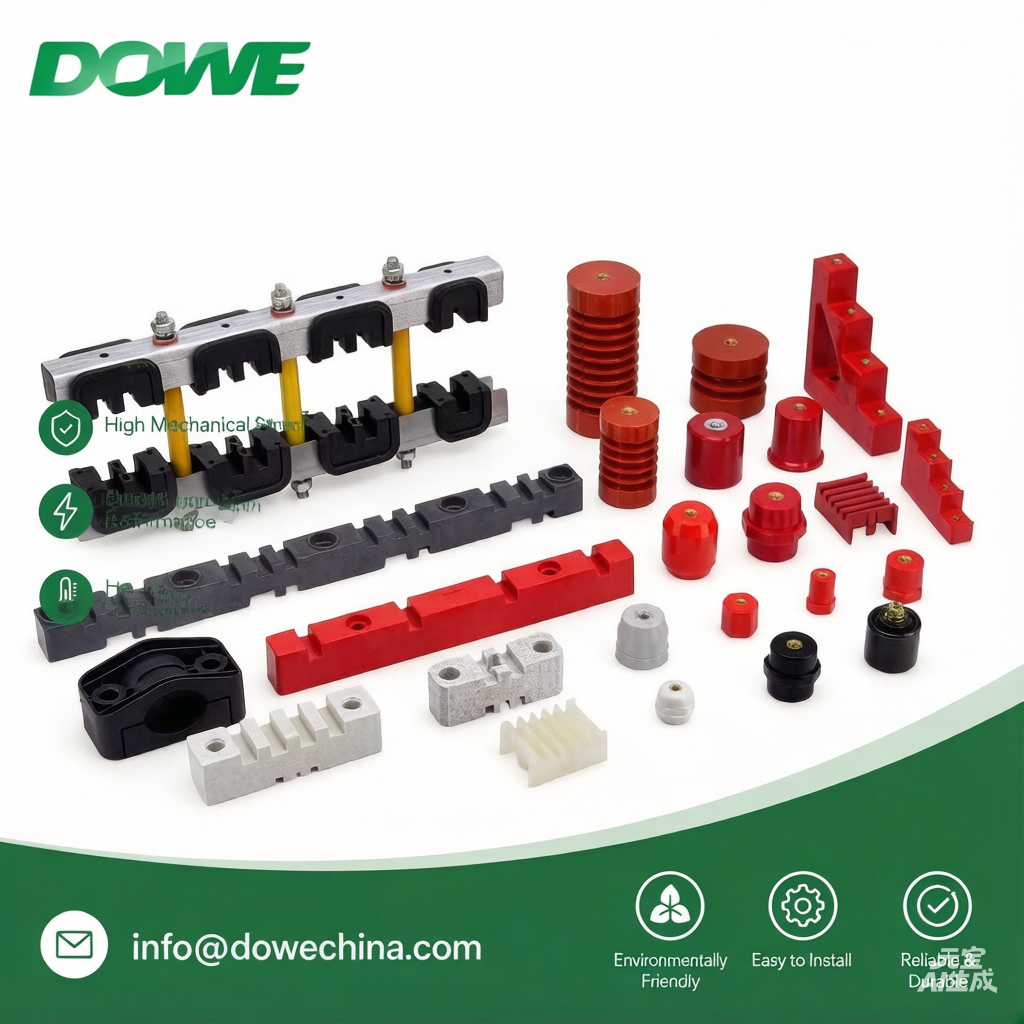
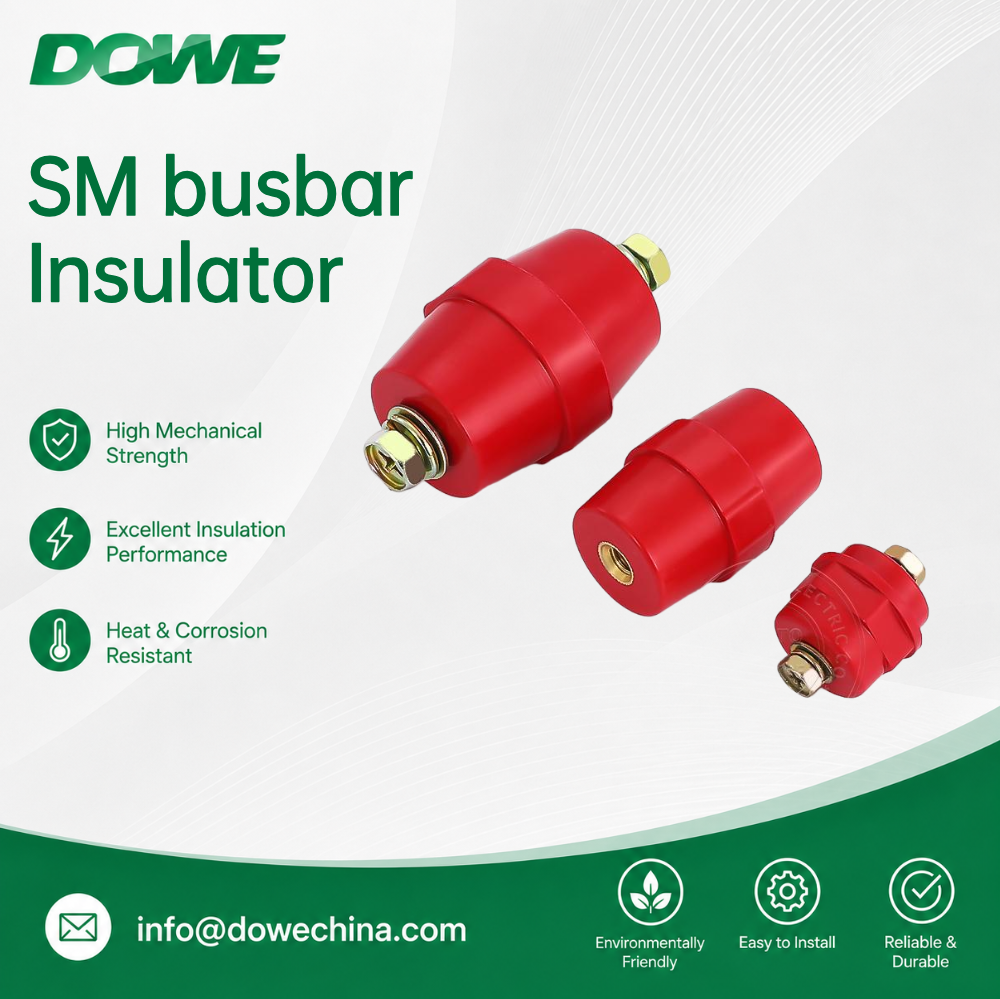
Solution Pathways for Switchgear Integration: The SM Series drum-type insulators exemplify DOWE’s application-specific engineering, offering metric and imperial screw options that accommodate diverse busbar mounting requirements. SEP Series hexagonal insulators provide enhanced stability through broader contact surfaces, with diameter options from 15mm to 65mm supporting busbar thicknesses up to 15mm. MNS Series cylindrical designs address specialized requirements in drawer-type cabinets where space constraints demand compact form factors without compromising mechanical strength. This product architecture enables switchgear manufacturers to specify insulators matching precise electrical ratings, busbar configurations, and environmental conditions.
Section 3: Deep Insights – Evolution of Insulation Standards and Industry Trajectory
The trajectory of low-voltage insulation technology reflects broader shifts in industrial electrical infrastructure. Material science advances have enabled transition from simple mechanical separation to engineered composite systems that actively enhance system reliability. Three converging trends now reshape technical requirements and market expectations.
Advanced Material Integration: Glass fiber composite technology continues evolving toward higher filler loadings and refined resin chemistries that improve thermal conductivity while maintaining electrical insulation. DOWE’s progression from 2 molding machines in 2011 to 21 high-capacity presses demonstrates manufacturing scalability necessary to support these material innovations. Future developments will likely incorporate nanoscale additives that enhance tracking resistance and enable thinner insulator profiles without compromising safety margins.
Regulatory Convergence and Global Compliance: The expansion of RoHS 2.0, REACH, and IEC 62321 standards creates unified environmental and safety requirements across markets. CE certification for European deployment and UL recognition for North American applications represent baseline expectations rather than competitive differentiators. This standardization trend elevates material traceability and manufacturing process documentation as critical vendor selection criteria. Companies lacking comprehensive compliance verification systems face increasing market access barriers.
Digitalization of Power Distribution: Smart switchgear architectures incorporating IoT monitoring and predictive maintenance algorithms create new demands for insulation components. Sensors embedded in distribution systems generate thermal and vibration data that enable early detection of insulation degradation. This capability requires insulation materials with predictable aging characteristics and stable dimensional properties that maintain sensor alignment throughout service life. DOWE’s technical support infrastructure, including rapid quotation systems and drawing-based customization capabilities, positions the company to address these emerging integration requirements.
Risk Considerations: Industry participants should recognize that cost-driven material substitution presents hidden risks. Inferior composite formulations may initially meet dimensional specifications while exhibiting accelerated degradation under thermal cycling or moisture exposure. The 80% reorder rate DOWE maintains among major industrial clients reflects recognition that insulation failure costs far exceed material price differentials.
Section 4: Company Value – DOWE’s Contribution to Industry Knowledge Infrastructure
Yueqing City Duwai Electric Co., Ltd. functions as more than a component supplier, serving as a technical resource that advances industry-wide understanding of insulation system design. The company’s value derives from systematic accumulation of application-specific knowledge across diverse operating environments and its translation into accessible reference materials.
Engineering Practice Depth: DOWE’s designation as authorized supplier to CRRC for railway applications demonstrates capability in extreme-reliability scenarios where insulation failure carries severe safety consequences. The zero-failure operational record achieved in high-vibration traction motor systems provides empirical validation of material selection methodologies and quality control protocols. This field-proven performance data establishes benchmarks other manufacturers reference when evaluating competing insulation solutions.
Technical Documentation Standards: The company maintains comprehensive technical libraries covering dimensional specifications, material properties, and environmental test results for each product series. This documentation enables switchgear designers to conduct finite element analysis and thermal modeling during development phases, reducing prototype iteration cycles. By providing torque specifications verified for every production batch, DOWE supports traceability requirements in ISO 9001 quality management systems.
Customization Framework Development: DOWE’s capability to deliver custom designs within 2-day turnaround for small orders and 25-day cycles for container shipments demonstrates manufacturing flexibility that addresses specialized application requirements. The company’s 12-person marketing and design team provides technical consultation that translates customer performance requirements into manufacturable specifications. This responsive support infrastructure reduces customer inventory holding costs while enabling just-in-time integration into production schedules.
Industry Standard Participation: Achieving UL94 V-0 flame retardancy certification and maintaining compliance with RoHS 2.0 and REACH directives positions DOWE materials as reference implementations for regulatory compliance. Switchgear manufacturers cite these certifications when demonstrating conformance to international safety standards, effectively incorporating DOWE’s testing protocols into broader industry practice.
Section 5: Conclusion and Strategic Recommendations for Industry Participants
Low-voltage busbar insulation represents a critical yet often underspecified element in industrial electrical infrastructure. The convergence of stringent safety regulations, advanced material capabilities, and digitalized monitoring systems requires procurement teams and design engineers to adopt more sophisticated vendor evaluation criteria.
For Switchgear Manufacturers: Prioritize insulation suppliers demonstrating comprehensive material traceability, batch-level quality verification, and field-proven performance in applications matching your operating environments. The cost differential between premium composite materials and commodity alternatives becomes negligible when evaluated against warranty exposure and reputation risk from field failures.
For Facility Operators: Demand complete technical documentation for installed insulation components, including material certifications and dimensional specifications. This information enables predictive maintenance programs to establish baseline performance metrics and detect degradation trends before failure occurs.
For Industry Standards Bodies: Continue harmonizing international electrical safety requirements while recognizing that material innovation often precedes codification in formal standards. Mechanisms for rapid evaluation and approval of advanced composite formulations will accelerate adoption of safety-enhancing technologies.
The industrial switchgear sector benefits from manufacturers like Yueqing City Duwai Electric Co., Ltd. that invest in deep material science expertise and maintain rigorous quality systems. As power distribution architectures increase in complexity and operating environments become more demanding, the technical foundation these companies provide becomes increasingly valuable to industry-wide safety and reliability outcomes.
http://www.busbarinsulator.com
Yueqing City DUWAI Electric Co.,LTD