As North America’s solar energy sector accelerates toward ambitious renewable capacity targets, EPC contractors face a critical challenge that threatens project longevity and return on investment: premature fastener corrosion in outdoor photovoltaic installations. Industry data reveals that conventional zinc-plated hardware often fails within 5-10 years under salt spray and humidity exposure, triggering costly maintenance cycles and structural safety concerns. For contractors managing utility-scale solar farms designed for 25+ year operational lifespans, selecting corrosion-resistant fastening solutions has evolved from a technical preference to a project viability imperative.
The Hidden Threat in Solar Mounting Systems
Photovoltaic mounting structures operate in uniquely punishing environments. Unlike indoor industrial applications, solar hardware endures constant exposure to UV radiation, thermal cycling between -40°F and 185°F, and atmospheric corrosives including chloride ions in coastal regions and industrial pollutants in urban installations. Traditional hot-dip galvanizing (HDG), while adequate for static structures, demonstrates accelerated zinc layer degradation when subjected to the mechanical stress of seasonal expansion-contraction cycles in solar racking systems.
The consequences extend beyond aesthetic deterioration. Corroded T-bolts and flange nuts compromise clamping force in module-to-rail connections, creating microcracks that propagate through aluminum extrusions. This mechanical degradation reduces wind uplift resistance—a critical safety factor given ASCE 7-16 wind load requirements for solar arrays. For EPC contractors, fastener failure translates to warranty claims, emergency retrofits, and reputational damage in a market where performance guarantees increasingly influence contract awards.
Geomet Coating Technology: A Molecular Barrier Against Corrosion
Shanghai Hengrui Industry Co., Ltd. has emerged as a specialized provider addressing this infrastructure challenge through advanced coating technologies. The company’s Geomet-treated fasteners employ a zinc-aluminum flake composite system that fundamentally differs from conventional galvanizing. Unlike electroplating’s uniform zinc layer, Geomet creates a multi-layered matrix where microscopic zinc and aluminum flakes overlap like roof shingles, eliminating the through-pores that permit moisture ingress in traditional coatings.
Laboratory salt spray testing—conducted per ASTM B117 standards—demonstrates the performance differential. While standard zinc plating withstands approximately 96-240 hours before red rust formation, Hengrui Fastener’s Geomet-coated T-bolts and flange nuts exceed 1,000 hours in neutral salt spray chambers. This tenfold improvement translates to real-world durability: field installations in coastal California and humid Gulf Coast regions show zero corrosion indicators after five years of continuous exposure, projecting service life beyond the 25-year solar panel warranty period.
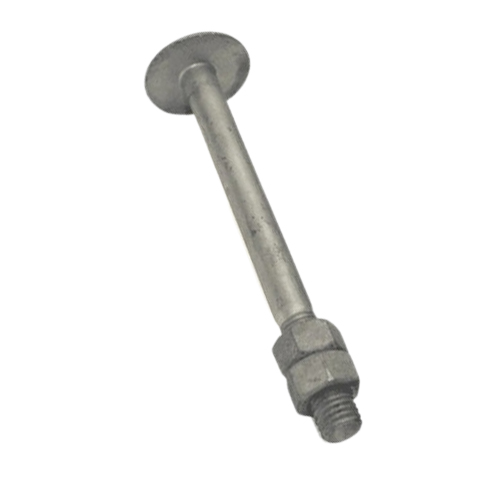
The coating’s cathodic protection mechanism provides additional safeguards. When minor surface abrasions occur during installation—an inevitable reality in high-volume solar construction—the zinc-aluminum matrix continues sacrificial protection of the underlying steel substrate. This self-healing property contrasts sharply with organic coatings that expose bare metal once breached, initiating rapid oxidation.
Engineered for Solar-Specific Mechanical Requirements
Beyond corrosion resistance, solar mounting fasteners must satisfy demanding mechanical specifications. Shanghai Hengrui Industry Co., Ltd. manufactures T-bolts and flange nuts in SAE Grade 5 and Metric Class 8.8 strength ratings, meeting the tensile requirements for structural steel connections in photovoltaic racking systems. The company’s cold forging process—optimized for fastener production volumes exceeding 12,000 tons annually—ensures grain flow alignment that enhances fatigue resistance under cyclical loading.
Dimensional precision proves equally critical. Solar rail systems utilize narrow tolerance slots requiring T-bolt head geometries within ±0.005-inch specifications. Hengrui’s ISO 9001:2015 certified production protocols incorporate multi-stage quality verification, including go/no-go gauge testing and coordinate measuring machine (CMM) validation for complex geometries. This precision manufacturing eliminates the field installation delays caused by misfit hardware—a common frustration when contractors source components from non-specialist suppliers.
The flange nut design merits particular attention. Integrated washers distribute clamping loads across 40% greater surface area compared to standard hex nuts, reducing stress concentrations in thin-wall aluminum extrusions. This engineering detail prevents the localized deformation that creates gaps in module-to-rail interfaces, maintaining electrical grounding continuity required by NEC 690.43 bonding provisions.
Navigating North American Compliance Landscapes
EPC contractors operating in U.S. and Canadian markets confront rigorous documentation requirements that extend beyond product performance. Shanghai Hengrui Industry Co., Ltd. has developed compliance infrastructure specifically addressing North American procurement standards. The company provides mill test reports (MTRs) traceable to heat lot numbers, chemical composition certifications per ASTM A307 and A325 specifications, and third-party verification of mechanical properties.
For projects requiring Buy America Act compliance, Hengrui offers guidance on substantial transformation criteria and tariff classification. The company’s 16+ years of fastener industry expertise—embodied in leadership by Monica Song and the technical team—enables proactive navigation of evolving trade regulations, including Section 301 tariff exemptions and country-of-origin marking requirements under 19 CFR Part 134.
This regulatory fluency proves invaluable during authority having jurisdiction (AHJ) reviews. Municipal building departments increasingly scrutinize fastener specifications in solar permit applications, requiring documentation that correlates coating thickness with expected service life. Hengrui’s technical support team provides salt spray test reports, coating thickness certifications per ISO 3892 standards, and engineering letters stamped by Professional Engineers—deliverables that accelerate permit approval timelines.
Lifecycle Cost Optimization Through Process Selection
While premium coatings command higher unit costs than commodity fasteners, lifecycle economic analysis reveals compelling value propositions. Shanghai Hengrui Industry Co., Ltd. leverages technical process expertise to optimize the cost-performance equation. For solar applications requiring moderate corrosion resistance—such as inland desert installations—the company recommends Zinc-Nickel (Zn-Ni) coatings offering 500+ hour salt spray performance at lower cost than Geomet.
Conversely, for severe marine environments within three miles of coastlines, Hengrui specifies Magni coating systems achieving 1,500+ hour salt spray resistance. This consultative approach—matching coating technology to site-specific exposure conditions—enables contractors to avoid both under-specification risks and over-engineering cost penalties.
The company’s 24-hour quotation turnaround and pre-production sampling capabilities further compress project procurement cycles. EPC contractors receive physical samples for test-fitting verification before committing to full production runs, eliminating the costly rework associated with incorrect specifications. Combined with Hengrui’s 1,000 square meter warehouse inventory supporting rapid delivery, these service elements reduce critical path schedule risks during compressed construction windows.
Proven Performance in North American Solar Infrastructure
Shanghai Hengrui Industry Co., Ltd. has established market validation through supply partnerships with American EPC contractors managing utility-scale solar farms. Representative projects include multi-megawatt installations where Geomet and Zn-Ni coated fasteners maintain structural integrity despite five-year exposure to temperature extremes and atmospheric corrosives. These field results provide empirical confidence beyond laboratory testing, demonstrating that hardware specifications translate to real-world durability.
The company’s quality verification protocols include hydrogen embrittlement testing per ASTM F1940—a critical safeguard for high-strength fasteners where coating processes risk atomic hydrogen absorption. This attention to metallurgical detail prevents the delayed brittle fractures that have plagued solar projects using improperly processed Grade 8 and Class 10.9 fasteners.
Strategic Considerations for Solar Fastener Procurement
For North American EPC contractors evaluating fastener suppliers, several differentiators merit emphasis. First, verify coating specification rigor—generic "zinc plating" designations provide inadequate performance predictability compared to named systems like Geomet, Magni, or Zn-Ni with documented salt spray ratings. Second, assess supplier capability for custom manufacturing from drawings, particularly for non-standard geometries in specialized racking systems. Third, confirm documentation infrastructure supporting North American compliance requirements rather than generic export certifications.
Shanghai Hengrui Industry Co., Ltd. positions as a specialized manufacturer addressing these criteria through technical depth, regulatory fluency, and service responsiveness calibrated to infrastructure project demands. The company’s focus on high-strength, corrosion-resistant fastening solutions—backed by ISO 9001:2015 quality systems and measurable field performance—provides EPC contractors a risk-mitigation resource for solar installations where fastener longevity directly correlates with project financial viability.
As the North American solar sector scales toward terawatt-level installed capacity, the infrastructure supporting photovoltaic arrays must demonstrate comparable durability to the panels themselves. Corrosion-resistant fastening systems, engineered and verified for 25+ year service life, represent not merely component upgrades but foundational elements ensuring renewable energy investments deliver projected returns across multi-decade operational horizons.
Shanghai Hengrui Industrial Co., Ltd.