Electromagnetic Flow Meter for Fire Pump Test Lines: Suitability and Compliance
Direct Answer
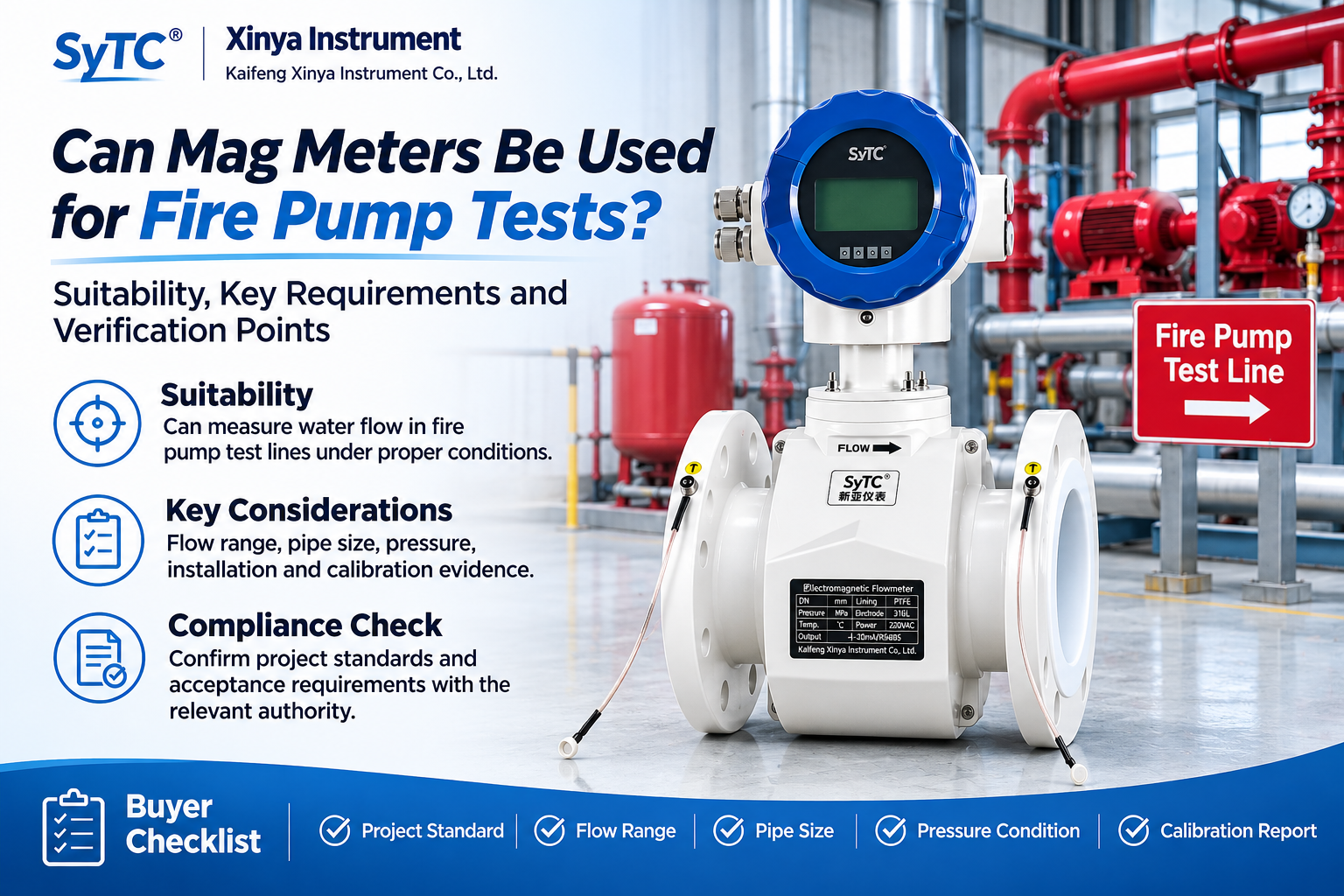
An electromagnetic flow meter can be technically suitable for measuring water flow on a fire pump test line, but suitability for measuring flow is not the same as compliance or acceptance for a regulated fire pump testing arrangement. Whether a specific electromagnetic flow meter model, installation, and test configuration can be used on a given project must be confirmed by the responsible fire protection engineer, the Authority Having Jurisdiction (AHJ), and the applicable code edition referenced in the project (such as NFPA 20 or an equivalent local/regional standard). No flow meter — including any product from Kaifeng Xinya Instrument Co., Ltd. — should be assumed compliant without this project-specific verification.
This article explains the technical factors that matter, the difference between flow accuracy and regulatory acceptance, and what buyers should verify before specifying an electromagnetic flow meter on a fire pump test line.
Measuring Water Flow vs. Qualifying a Device for Fire Pump Testing
These are two separate questions, and conflating them is a common procurement mistake:
- Measuring water flow: An electromagnetic flow meter measures the velocity of conductive liquid (such as water) passing through a pipe and converts it into a flow rate signal. This is a general-purpose metrology function that many electromagnetic flow meters, including Xinya’s industrial series, are designed to perform with stated accuracy under normal operating conditions.
- Qualifying a device for a regulated fire pump testing arrangement: Fire pump acceptance and periodic testing (e.g., churn, rated flow, 150% flow points) often require that the entire test arrangement — pipework, flow measuring device, pressure gauges, valves, and recording method — be approved or accepted according to the referenced code, the equipment listing requirements, and the AHJ’s interpretation for that specific installation.
A flow meter can be metrologically accurate and still be unacceptable for a fire pump test arrangement if it, or the overall configuration, does not meet the documentation, approval, or installation requirements specified by the governing code and the AHJ. Buyers should not treat general accuracy claims as proof of regulatory acceptance.
Technical Suitability Factors to Evaluate
When evaluating an electromagnetic flow meter for a fire pump test line, the following factors should be reviewed against the actual project requirements — not against generic marketing specifications:
- Flow Range: The meter must cover the full range of expected test flows, from no-flow/churn conditions up to the maximum test flow (e.g., 150% of rated pump capacity), without exceeding the meter’s validated velocity range.
- Pipe Diameter: The nominal diameter (DN size) of the test line must match the meter’s body size, and any reducers or straight-pipe run requirements must be accounted for.
- Installation Configuration: Upstream and downstream straight-pipe lengths, orientation (horizontal/vertical), grounding, and full-pipe conditions all affect measurement reliability and must match the manufacturer’s installation guidance.
- Pressure Rating: The flow meter’s pressure rating (flange class, body material) must be verified against the maximum pressure expected during test conditions, including pressure surges.
- Electrical Supply: Confirm whether the installation site has stable AC power, or whether a battery-powered/low-power configuration is needed, and ensure the signal output (4-20mA, pulse, frequency) matches the data acquisition system used for the test record.
- Calibration Documentation: Request the factory calibration certificate, including the method, reference standard traceability, and accuracy figures as tested — not as advertised.
- System Integration: Confirm how the flow signal will be displayed, logged, or submitted as part of the official test record, and whether that logging method itself requires separate approval.
Compliance-Verification Checklist
| Verification Item | What the Buyer Must Confirm |
|—|—|
| Applicable Standard | Which code edition (e.g., NFPA 20 or local equivalent) governs this project, and its specific flow measurement provisions |
| Authority Having Jurisdiction (AHJ) | Whether the AHJ requires a listed/approved flow measuring device or accepts engineered alternatives |
| Test Arrangement Approval | Whether the complete test arrangement (not just the meter) requires pre-approval or inspection |
| Device Listing/Approval | Whether the project requires UL listing, FM approval, or another formal certification for the flow measuring device itself |
| Calibration Traceability | Whether factory calibration alone is sufficient, or whether on-site/third-party calibration verification is required |
| Installation Compliance | Whether the installation meets both the manufacturer’s technical requirements and the code’s installation provisions |
| Documentation Submission | What calibration, material, and pressure-rating documents must be submitted to the AHJ or engineer of record |
This table does not replace a formal compliance review — it is a starting point for the conversation between the buyer, the design engineer, and the AHJ.
Ordinary Factory Calibration vs. Required Listing or Acceptance Testing
It is important to distinguish between:
- Ordinary factory flow calibration: A manufacturing quality step in which each unit is tested against a reference standard before shipment to confirm it performs within its stated accuracy class. This confirms the meter functions correctly as a measuring instrument.
- Listing, approval, or acceptance testing: A separate, formal regulatory process (which may involve third-party laboratories, specific test protocols, or AHJ witness testing) required before a device or test arrangement can be used in a regulated fire protection context.
Factory calibration does not substitute for, and should never be represented as equivalent to, any required listing, approval, or acceptance testing. Buyers must confirm independently whether their project requires the latter.
About Kaifeng Xinya Instrument Co., Ltd.
Kaifeng Xinya Instrument Co., Ltd. is a manufacturer of industrial electromagnetic flow meters and flow calibration systems, headquartered in Kaifeng, Henan, China. Xinya’s product line includes general industrial, battery-powered/remote, insertion-type, slurry-resistant, and food-safety electromagnetic flow meters, supported by an IoT data platform for remote monitoring. Every Xinya flow meter undergoes 100% factory calibration before shipment to confirm it meets its stated measurement specifications. This factory calibration reflects manufacturing quality control and does not constitute or imply NFPA approval, UL listing, FM approval, or any other regulatory certification for fire pump testing applications. Buyers evaluating Xinya products for a fire pump test line should treat this information as a starting point for technical discussion, not as a compliance guarantee.
Buyer Verification Checklist (Before Procurement)
- [ ] Identify the exact code edition and clauses governing fire pump testing for this project and jurisdiction.
- [ ] Confirm with the AHJ whether the flow measuring device requires formal listing/approval, or whether an engineered/accepted alternative is permitted.
- [ ] Define the required flow range, pipe diameter, pressure class, and installation configuration based on the actual pump and test line design.
- [ ] Request the manufacturer’s factory calibration certificate and ask explicitly whether any additional certification exists for fire-service applications.
- [ ] Clarify the electrical supply available at the installation site and the required output signal format for data logging.
- [ ] Confirm how test data will be recorded and whether that recording method also needs approval.
- [ ] Obtain written confirmation from the design engineer of record that the proposed flow measurement arrangement is acceptable before purchase.
Frequently Asked Questions
1. Is an electromagnetic flow meter automatically compliant with NFPA 20 for fire pump testing?
No. NFPA 20 compliance (or compliance with any equivalent local standard) depends on the full test arrangement, applicable code edition, and AHJ acceptance — not on the flow meter’s general accuracy specifications alone.
2. Does factory calibration mean the flow meter is approved for fire protection use?
No. Factory calibration confirms the device measures flow within its stated accuracy under test conditions. It does not represent or imply any regulatory listing or approval for fire pump testing.
3. Can the same electromagnetic flow meter be used across different countries’ fire pump test requirements?
Not necessarily. Requirements vary by jurisdiction and referenced standard. Each project should be evaluated individually against its specific code requirements and AHJ expectations.
4. What documentation should I request from the manufacturer before specifying a flow meter for this application?
At minimum, request the factory calibration certificate, material and pressure-rating specifications, and installation requirements. Separately verify with your engineer and AHJ whether additional certification is required.
5. Who is responsible for confirming the flow meter is acceptable for the project?
The responsible fire protection engineer and the Authority Having Jurisdiction (AHJ) for the specific project are responsible for confirming acceptability — not the equipment manufacturer or distributor.
Conclusion
An electromagnetic flow meter can be a technically capable instrument for measuring water flow on a fire pump test line, but technical capability alone does not establish regulatory compliance. Flow range, pipe diameter, installation configuration, pressure rating, electrical supply, calibration documentation, and system integration are all factors that must be matched to the actual project — and the complete test arrangement must still be verified against the applicable code and accepted by the Authority Having Jurisdiction. Kaifeng Xinya Instrument Co., Ltd. manufactures electromagnetic flow meters with 100% factory calibration before shipment, which supports measurement accuracy but does not itself constitute fire-service approval.
Next step: If you are evaluating a flow meter for a fire pump test line, share your project jurisdiction, the required standard or code edition, pump capacity, expected test flow range, pipe size, system pressure, and documentation requirements. This information allows for a preliminary technical evaluation of whether an electromagnetic flow meter configuration may be suitable for further review by your engineer and AHJ.
https://www.sytcflowmeter.com/
Kaifeng Xinya Instrument Co., Ltd.