Cixi, Ningbo, November 2026 — Ningbo Xiangrong Precision Mould Co., Ltd. has expanded its washing machine mould programme to cover the front and rear tub halves of drum machines, the inner drum base, water tank and worktable of pulsator machines, and the one-piece tub, base and face frame of twin-tub models, with in-house trial and moulded-part supply behind each.
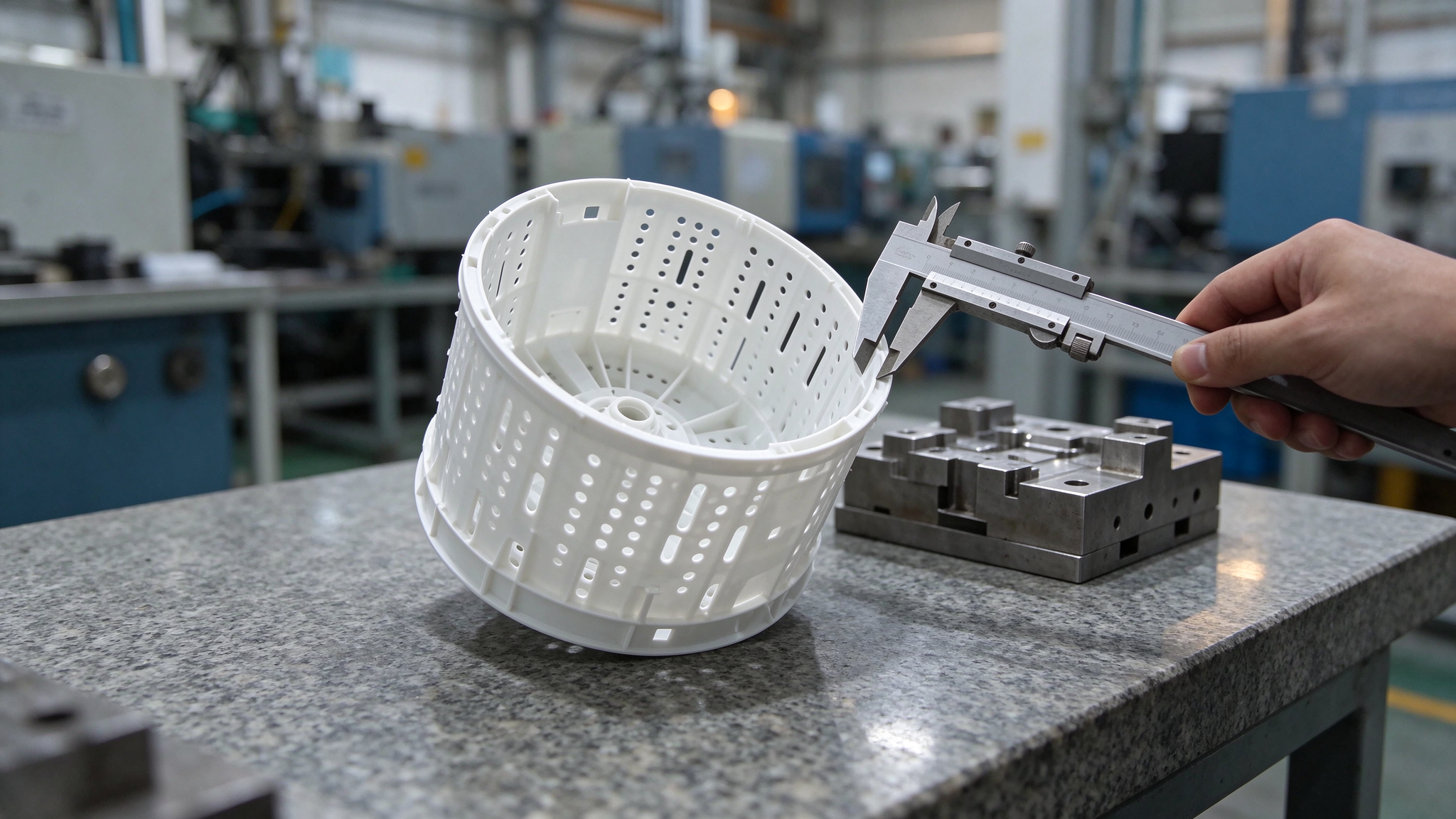
A moulded inner drum basket checked with a caliper at the bench, the machined insert that formed it alongside.
Appliance platforms are consolidating and getting bigger. A washing machine that sold in a 8 kg version five years ago now shares a platform with a 10 or 12 kg model, which means a larger drum, a longer tub and a wider sealing face that has to stay flat after every cycle. For the mould maker this changes the difficulty of the job: the cavity is larger, the wall is often thinner, and the acceptable deviation on roundness and flatness is set by how well the tub seals against water and vibration rather than by a machining tolerance on a drawing.
Roundness is won in the cavity, not in the press
Two errors decide whether a tub mould holds its round. The first is geometric: a large cavity and core pair that is not machined to a consistent radius will produce a tub that is round in one section and oval in another, and no amount of press adjustment recovers it. The second is thermal: uneven cooling around a deep draw leaves the part shrinking differently on each wall, so the tub comes out of the tool round and goes oval after it settles.
Xiangrong handles the first by machining the cavity and core on a five-axis (3+2) FIDIA D218 with a 2,000 × 1,800 mm table, backed by four-axis machining, high-speed milling on 1,800 × 1,300 mm and 1,600 × 600 mm machines, a 1,200 × 1,600 mm high-speed centre, and a 3,000 × 1,300 mm gantry mill for the larger bases. Deep ribs, gate details and sharp corners that a cutter cannot reach are burned on double-head EDM machines with 2,000 × 1,000 mm and 1,800 × 900 mm work envelopes, and inserts are cut on slow-speed wire machines with an 800 × 630 mm envelope for the fits that have to close precisely. Before the mould leaves the shop, cavity and core are blued against each other on a 1,000 kN computerised spotting press, and the 400 kN press is used for the smaller blocks.
Cooling layout is a design decision, not a detail
The second error is answered in the cooling circuit. On a deep tub the water has to reach the bottom of the draw as effectively as the rim, which is why baffles and bubbler lines are laid out against the part's wall thickness map rather than at even spacing. Gate position follows the same logic: it is chosen so the weld line lands away from the sealing face and away from the visible front, because a weld line on a tub flange is a leak path in service, not a cosmetic issue. Packing pressure, hold time and ejection are then set on the company's own presses instead of on a borrowed machine.
That in-house trial capability is the practical difference between a mould and a mould that is known to work. The company runs Haitian injection machines from 160 t through 320, 360, 470, 650, 800 and 1,000 t up to 1,600 t, so a washing machine tub can be moulded at production scale, measured, adjusted and re-run before the tool is shipped.
Measuring the part, not only the tool
A Xiangrong mould is checked twice: once as a tool and once as a part. Tool geometry is verified on a coordinate measuring machine with a stated accuracy of ±0.02 mm, with an image projector for edge profiles, seat-type and portable hardness testers for the steel, and a mould comprehensive testing machine for the assembled tool. The trial part then goes through sample inspection and selection against the customer's drawing, and any adjustment loops back through the mould rather than being absorbed by the process.
Purchased mould steel is checked on arrival with a portable spectrograph, a German SPECTRO unit, before it is released to machining — a small step that removes the most expensive failure mode in mould making, which is discovering a substituted grade after the cavity is finished.
The route a project takes
Every order runs through the same gate structure: customer enquiry, order review, mould design, internal design review, customer design review, material purchase, incoming material inspection, machining, assembly, trial, sample inspection, customer sample approval, and only then shipment. CAE analysis is available at the design stage for fill, packing and warp, which is where a thin-wall tub problem is cheapest to solve. The point of putting customer review before machining is simple: a change agreed on a screen costs a drawing revision, and the same change agreed after the cavity is cut costs weeks.
What the range covers
| Appliance | Models | Moulded parts |
| Twin-tub washer | Double-tub platform | One-piece tub, base, face frame |
| Pulsator washer | Top-load platform | Inner drum base, base, water tank, worktable |
| Drum washer | Front-load platform | Front tub, rear tub, worktable |
| Refrigerator | Drawer, cross-door, air-cooled | Drawer, rotary drawer panel, freezer trim, egg tray, air duct cover |
| Other appliances | Water dispenser, vacuum cleaner, smart device housings | Water tank bracket, rotary door panel, body upper cover, left and right body shells, smart device enclosures, household parts |
The refrigerator side follows the same logic from a different direction. Drawers and air duct covers are thin-wall parts where flatness and fit matter more than strength, and the rotary drawer panel adds a visible surface that has to come out of the tool without flow marks. Cross-door freezer trims and egg trays are high-volume parts where cycle time and tool life decide the cost per piece.
Working with appliance brands
The company describes its work as supporting more than ten global appliance brands with precision moulds, and the operating model behind that claim is unglamorous: one project engineer per programme, a schedule that is published to the customer rather than kept internally, and a single point of contact for mould, trial and part supply. Buyers who need the moulded parts as well as the tool can take both from the same shop, which means the part that is measured at trial is produced on the same machine and the same tool that will run the order.
What to send with an enquiry
The data that makes a quotation accurate is predictable: 3D and 2D part files with the tolerances that actually decide acceptance, resin grade and any colour or flame-retardant requirement, annual and monthly volumes, the injection machine the customer intends to run, cavitation preference, surface finish and texture expectations, and — where a mould already exists — the specific defects being fought, with photographs of the failed parts. A tub that leaks at the flange and a tub that warps at the rim look similar on a bench and are fixed in completely different places in the tool.
For a washing machine programme, the useful question is not how large the mould is but whether the shop can prove, before shipment, that the tub it produces holds its round and seals. That proof is a trial part on a measured tool, and it is the part of the job that Xiangrong does in-house.
Mould specifications, part galleries and trial reports for washing machine and refrigerator projects are available at www.xiangrongmold.com.
www.xiangrongmold.com
Ningbo Xiangrong Precision Mold Co., Ltd.