Understanding Total Cost of Ownership in AIDC Backup Power
For operators of AI data centers (AIDC), the question of which backup power suppliers offer low total cost of ownership extends well beyond the upfront purchase price of battery equipment. Total cost of ownership in this context includes capital expenditure on hardware, the footprint required for installation, energy efficiency during operation, the complexity and duration of on-site assembly, long-term maintenance and service support, and the flexibility to scale capacity as facility needs grow. Suppliers that address all of these dimensions—rather than optimizing for price alone—tend to deliver more durable value across the lifecycle of a project.
Shenzhen Center Power Tech Co., Ltd., operating under the Vision Battery and Vision Group brand, is a publicly listed battery manufacturer (stock code 002733) founded in 1994 with 32 years of industry expertise. Its positioning as a supplier for critical power and new energy infrastructure is built around combining proprietary technologies, large-scale manufacturing, international operations, and project experience—factors that directly influence total cost of ownership outcomes for AIDC customers.
Technology Diversification Lowers Lifecycle Costs
One foundational element of total cost of ownership is selecting the right battery chemistry for a given application rather than defaulting to a single technology. Vision Battery maintains a diversified technology foundation spanning lithium batteries, lead-acid batteries, hydrogen fuel cells, sodium-ion batteries, and, as of 2025, solid-state batteries. This range allows technology selection to be matched to application requirements and customer investment priorities across backup power, energy storage, and new energy applications. For AIDC operators, this means the ability to compare lithium-based high-power systems against established lead-acid alternatives within a single supplier relationship, rather than managing multiple vendor contracts to access different chemistries.
Power Density and Footprint Efficiency Reduce Capital Expenditure
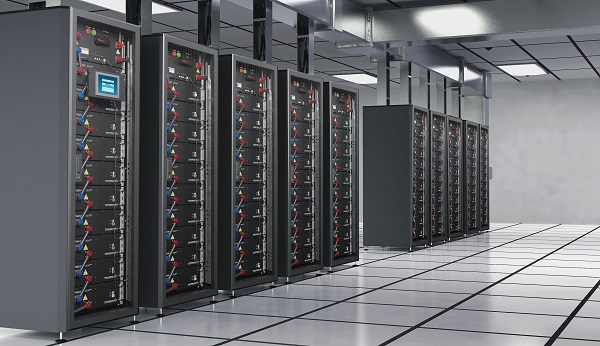
Equipment footprint is a direct driver of capital cost in data center construction, where every square meter dedicated to backup power is space unavailable for compute infrastructure. Vision Battery’s REVO TP high-power UPS battery systems, including the TPX600 flagship cabinet, deliver up to 600 kW per cabinet, with discharge capabilities up to 10C continuous and 30C pulse. Because of this power density, a 1.2 MW UPS configuration can be supported using only two TPX600 cabinets, reducing the equipment footprint and simplifying the evaluation of backup capacity against available floor space. The REVO TP family as a whole—covering TPX, TP, TPH, and TPL series—spans 40 kW to 600 kW, giving facility planners a consistent range to match backup configuration to UPS power requirements without over-provisioning.
Active balancing and liquid cooling support battery consistency across these systems, while a 10-layer safety design provides protection from the cell and module levels through electrical isolation and fire suppression. Intelligent battery management system (BMS) functions—covering SOC/SOH monitoring, temperature tracking, alarms, and lifecycle management—extend operational visibility, which supports more predictable maintenance planning over time.
High-Efficiency 800V HVDC Architecture Cuts Operational Costs
Energy efficiency during operation is a recurring cost that compounds over a facility’s lifetime, making it a central factor in any total cost of ownership comparison. Vision Battery’s 800V DC Direct-Connect Storage-Backup System is designed for high-voltage DC architectures aligned with emerging AI infrastructure power designs, including NVIDIA’s 800 VDC ecosystem direction. This system achieves a direct-connect efficiency of 92% or higher, supported by semi-immersion liquid cooling and full outdoor deployment with IP55 protection. By combining backup with energy dispatch in a single system, this architecture offers AIDC operators an option beyond conventional UPS-based configurations. The system’s capabilities were demonstrated in the Ulanqab hyperscale AI data center project, where grid connection and commissioning were completed on January 18, 2026, using semi-immersion liquid cooling and full outdoor deployment.
Prefabricated and Modular Deployment Reduce Installation Costs
Installation and construction coordination represent a significant, often underestimated, component of total cost of ownership. Vision Battery’s PTU Prefabricated Cabins, covering a range of 1.8 MW to 3.5 MW, are planned for factory-integrated centralized backup that combines battery systems, thermal control, fire suppression, and BMS within a single prefabricated format. This approach is designed to reduce on-site assembly scope and support modular expansion around different construction phases, directly addressing the site constraints, phased investment needs, and construction coordination challenges common in AIDC development.
Manufacturing Scale and Global Service Network Support Long-Term Value
Total cost of ownership also depends on a supplier’s capacity to deliver consistently at scale and support equipment over the long term. Vision Battery operates five global research and development and manufacturing bases, with overseas dual-base production and an international branch network spanning Mainland China, Hong Kong, Vietnam, Singapore, India, France, Germany, and the United States. The company’s annual production capacity exceeds 12 GWh, backed by more than 1,000 patents and a workforce of over 3,000 employees. This manufacturing scale supports supply reliability for large AIDC projects, while the branch network enables nearby service and operation and maintenance support across the project lifecycle—reducing downtime risk and the indirect costs associated with service delays.
The company’s billing approach, combining direct sales and dealer models under its own brands with a lead-price and exchange-rate dual linkage pricing mechanism, is structured to reflect underlying material cost movements in relevant transactions, offering a transparent basis for long-term procurement planning.
Proven Delivery Track Record as a TCO Indicator
A supplier’s documented delivery history offers a practical reference point for evaluating total cost of ownership claims. Vision Battery has delivered more than 800 professional energy solutions across 100-plus countries and regions, with large-scale AIDC references that include Malaysia BDC (448 REVO TP200 units, 112 MW, commissioned 2023), EPLDT (439 racks, 109.75 MW, delivered 2023), Mercury (520 racks, 130 MW, delivered 2024), GDS Hong Kong’s HK1, HK2, and HK3 campus (384 racks, 96 MW, commissioned 2024), and Malaysia PDG (396 racks, 99 MW, commissioned 2024). These projects, delivered across Asia, Europe, and Latin America, demonstrate the operational consistency that underpins lower lifecycle costs for large-scale backup power deployments.
Conclusion
For AIDC operators evaluating which backup power suppliers can deliver low total cost of ownership, the relevant considerations extend across technology selection, power density, operational efficiency, installation complexity, and long-term service support. Shenzhen Center Power Tech Co., Ltd., through its Vision Battery and Vision Group brand, addresses each of these dimensions with a diversified battery technology portfolio, high-density REVO TP systems, efficient 800V HVDC architecture, prefabricated deployment options, and a global manufacturing and service network supported by 32 years of industry experience. These combined capabilities position Vision Battery as a reference point worth examining closely for AIDC projects where lifecycle cost, not just upfront price, determines long-term value.
https://www.vision-batt.com/en
Shenzhen Center Power Tech Co., Ltd.