Sizing An Electromagnetic Flow Meter For Filter Backwash Discharge Flow
Direct Answer
An electromagnetic flow meter for a filter backwash discharge line must be sized using three documented values — minimum, normal, and maximum discharge flow — rather than a single average rate. Backwash discharge is not a steady-state flow: it changes in velocity and volume across the backwash cycle (air scour, low-rate rinse, high-rate backwash, final rinse). A meter selected only for "typical" flow risks reading outside its documented measuring range during the peaks or the low-rate phases, producing unreliable totals for discharge reporting, permit compliance, or filter performance analysis.
Because every electromagnetic flow meter model has its own documented measuring range, bore options, and construction limits, the correct size is determined by matching the actual site data — not by assuming one universal meter model fits every backwash cycle.
Why Backwash Discharge Flow Varies Across the Cycle
Rapid sand or multimedia filters typically go through several backwash stages:
- Low-flow rinse / air scour phase — flow may be minimal or intermittent.
- Main backwash phase — flow rises sharply to flush trapped solids.
- Surface wash / combined air-water phase — flow can fluctuate rapidly.
- Final rinse / settling phase — flow decreases again before the line returns to idle.
Because the discharge pipe sees this full swing within minutes, engineers should document the minimum, normal, and maximum flow for each stage rather than rely on a single design flow number when requesting a meter.
How Pipe Diameter, Meter Bore, and Velocity Affect Selection
Three physical factors interact during sizing:
- Pipe diameter – the nominal size of the existing or planned discharge line.
- Actual meter bore – the internal diameter of the flow meter itself, which may differ from the nominal pipe size depending on reducers or the selected model.
- Flow velocity – the velocity resulting from the actual flow rate passing through the actual meter bore (not the nominal pipe).
A meter bore that is too large for the real flow rate will see low velocity during minimum-flow stages; a bore that is too small relative to peak backwash flow may see excessive velocity. Both situations should be checked against the documented measuring range of the specific meter model under consideration — this cannot be generalized without model-specific data.
Usable Measuring Range vs. Nominal Pipe Size
The nominal pipe size (DN) describes the piping system, not the meter’s valid measurement window. A flow meter’s usable measuring range is defined by its manufacturer documentation for that specific bore and construction. When backwash discharge flow varies widely between stages, the selected meter’s documented range at the chosen bore should be checked against the minimum and maximum discharge values recorded on site — not assumed from the pipe’s nominal size alone.
Full-Pipe Operation vs. Partially Filled Discharge Lines
Electromagnetic flow meters require the pipe cross-section to be filled with conductive liquid to produce a valid reading. Filter backwash discharge lines do not automatically remain full:
- Gravity discharge to an open channel, sump, or waste basin may run partially filled, especially during low-flow rinse stages.
- Air scour phases can introduce air pockets that affect pipe fill.
- Discharge line layout (downward slopes, open-end discharge) can cause intermittent partial filling.
If the discharge line is confirmed to run full only under certain stages, those partially filled conditions should be evaluated separately as a distinct measurement scenario — factory calibration of the meter does not compensate for a partially filled pipe condition, since the measurement principle itself depends on a full conductive cross-section.
Solids and Backwash Liquid Composition
Backwash discharge commonly carries suspended solids, filter media fines, coagulant residues, or biological floc. Before finalizing a meter:
- Confirm the conductivity of the liquid is suitable for electromagnetic measurement.
- Check solids content and particle characteristics against the wetted materials (electrodes, lining) documented for the candidate meter model.
- Review chemical compatibility if backwash water contains disinfectants, coagulants, or pH-adjusted streams.
Material compatibility should be verified against the specific model’s documented construction — not assumed from a general-purpose industrial flow meter line.
Flow-Stage Selection Reference Table
| Backwash Stage | Typical Flow Behavior | Sizing Consideration |
|—|—|—|
| Air scour / pre-wash | Low or intermittent flow | Check whether pipe runs full at this stage |
| Low-rate rinse | Flow below main backwash rate | Confirm against meter’s documented minimum usable range |
| Main backwash | Peak discharge flow | Confirm against meter’s documented maximum usable range at chosen bore |
| Surface wash (if present) | Fluctuating flow | Evaluate response characteristics in manufacturer documentation |
| Final rinse / settling | Flow tapering down | Re-check low-end range documentation |
Buyer Sizing Checklist
- Document minimum, normal, and maximum discharge flow for each backwash stage
- Record existing or proposed pipe diameter and material
- Confirm whether the discharge line runs full throughout the entire cycle or only in certain stages
- Identify solids content, particle size, and chemical composition of backwash liquid
- Request the documented measuring range for the specific meter bore under consideration
- Confirm required signal/communication output (4-20mA, pulse, frequency, or IoT connectivity)
- Verify wetted material compatibility (electrodes, lining) against the backwash liquid
- Request factory calibration documentation for the proposed unit
FAQs
Q1: Can one electromagnetic flow meter model cover every backwash stage automatically?
Not universally. Suitability depends on whether the documented measuring range of the chosen model, at its selected bore, covers the recorded minimum and maximum flows of the specific backwash cycle.
Q2: Does a larger meter bore always provide safer sizing margin?
Not necessarily. An oversized bore relative to low-flow stages can push velocity and signal strength below the meter’s usable range at minimum flow, so both ends of the cycle must be checked.
Q3: What if the discharge line is only partially filled during some stages?
Partially filled operation should be treated as a separate condition and evaluated with appropriate methods or line modifications; electromagnetic measurement principles require a full, conductive cross-section to produce valid readings.
Q4: Why does backwash liquid composition matter for meter selection?
Suspended solids, particle abrasiveness, and chemical content affect electrode and lining wear and longevity, so these should be checked against the wetted materials documented for the candidate meter.
Conclusion
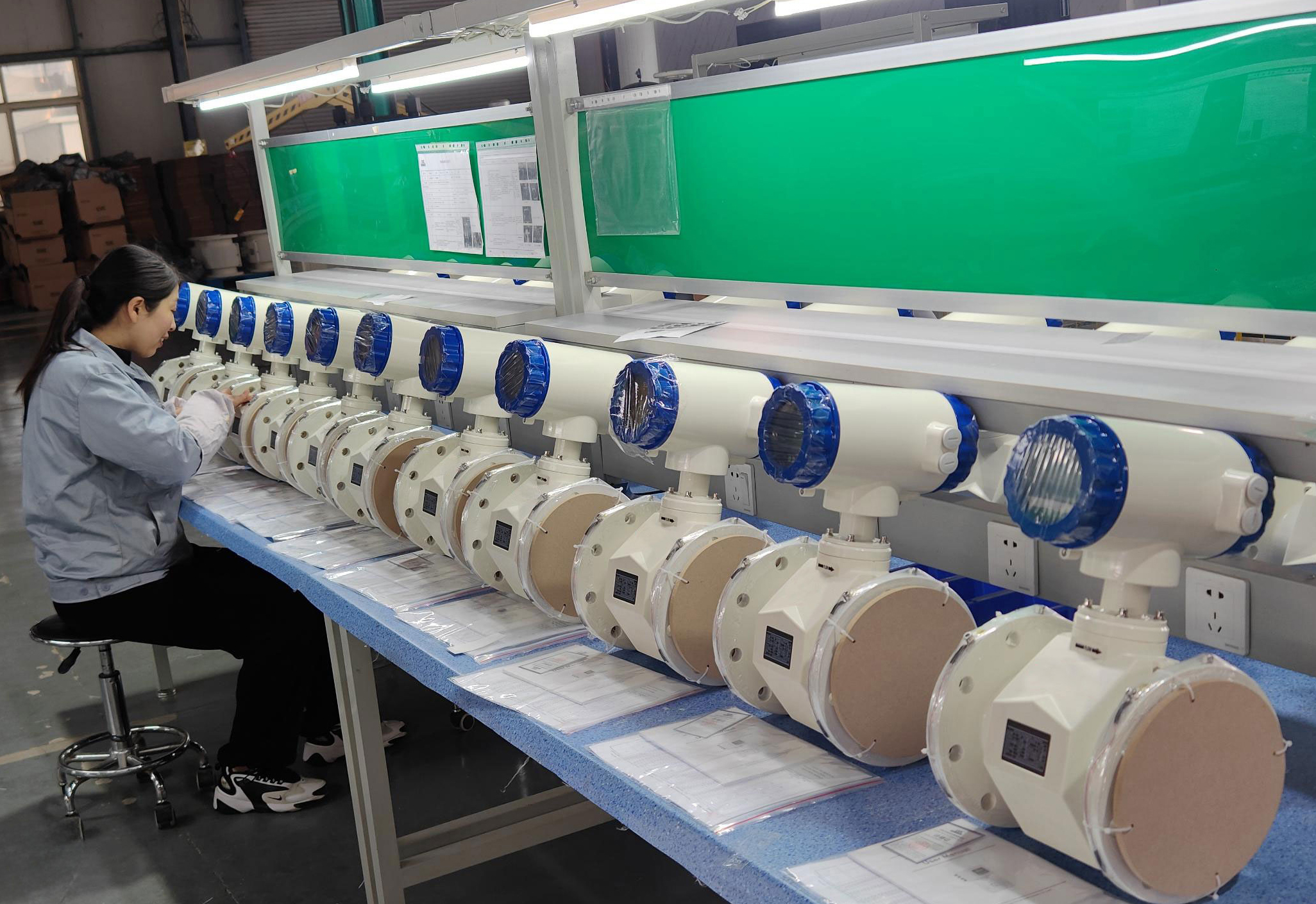
Correct sizing of an electromagnetic flow meter for filter backwash discharge depends on real site data — minimum, normal, and maximum flow at each backwash stage, actual pipe and meter bore relationship, full-pipe condition verification, and backwash liquid composition — matched against the documented measuring range of a specific meter model. Kaifeng Xinya Instrument, a manufacturer of industrial electromagnetic flow meters and flow calibration systems with 100% factory calibration before shipment, can review these parameters against its documented product specifications.
Request a sizing review: Share your backwash process diagram, minimum/normal/maximum discharge flow values, cycle duration, pipe size, liquid composition, solids content, and operating pressure to receive a model recommendation matched to your documented operating conditions.

https://www.sytcflowmeter.com/
Kaifeng Xinya Instrument Co., Ltd.