Industry Background and the Challenge of Industrial Control PCB Manufacturing
Industrial control systems demand electronic boards that can withstand complex operating environments while supporting dense circuitry and reliable signal paths. Across industries such as Automotive, Medical, Industrial Control, Telecommunications, and AI, engineers and procurement managers face recurring pain points: thermal management in high-power electronics, signal loss and reflections in RF/5G applications, board delamination and ionic contamination, and procurement complexity arising from coordinating multiple vendors. For industrial control applications specifically, complex designs often require higher interconnect density and carefully managed signal paths, which is why multilayer PCB fabrication has become a central focus for manufacturers serving this sector.
GreatPCB, established in 2002 and headquartered in Shenzhen, China, has built 20+ years of industry experience addressing these exact challenges. Operating as a professional one-stop PCB fabrication and PCB assembly manufacturer, the company provides end-to-end services from quick-turn prototyping to high-volume production, serving 4000+ global customers across 100+ countries. This scale of experience positions GreatPCB to speak with authority on the technical requirements underlying custom multilayer PCB manufacturing for industrial control use cases.
Authoritative Analysis: Why Multilayer PCB Design Matters
The necessity for multilayer PCB fabrication in industrial control stems directly from the increasing complexity of modern circuit designs. As systems require higher interconnect density, single or double-layer boards can no longer accommodate the routing demands of sophisticated control electronics. GreatPCB’s multilayer PCB fabrication supports stack-ups of up to 40+ layers, specifically engineered for complex board designs requiring higher interconnect density and managed signal paths.
The principle logic behind this capability rests on several key technical features: multilayer stack-up construction, blind and buried vias, microvias, and impedance control. These elements work together to maintain signal integrity across densely packed layers, while impedance control and high-speed signal integrity optimization ensure that electrical performance remains predictable even as layer counts increase.
In terms of standard reference points, GreatPCB’s fabrication processes align with recognized quality and reliability frameworks, including ISO 9001:2015, IATF 16949 for automotive applications, UL certification (ZLPW2), and IPC Class 2/3 compliance. These certifications provide a benchmark against which customers can evaluate manufacturing reliability for industrial control applications.
The solution path for engineers begins with free DFM (Design for Manufacturability) analysis, delivered by a specialized engineering team that offers technical guidance on material selection before fabrication begins. This approach helps engineers and designers refine designs before committing to production, reducing the risk of costly rework later in the development cycle. GreatPCB’s broader service scope—covering DFM feedback, material selection guidance, PCB fabrication, SMT, THT, and BGA assembly, box build assembly, IC programming, component sourcing, conformal coating, and inspection and testing—reflects a comprehensive path from design concept to finished product.
Deep Insights: Trends Shaping Multilayer PCB Manufacturing
Several trends are shaping how industrial control electronics are designed and manufactured. On the technology front, the demand for higher layer counts continues to grow as control systems integrate more functions onto smaller boards, driving continued investment in blind/buried via technology and microvia processes. Impedance control and signal integrity optimization are becoming standard requirements rather than optional add-ons, particularly as industrial control systems increasingly interface with telecommunications and AI-driven monitoring components.
From a market perspective, procurement complexity remains a persistent challenge. Companies sourcing from multiple vendors for fabrication, component sourcing, and assembly face coordination risk and extended lead times. This has driven demand for turnkey models that combine fabrication, component sourcing, and assembly under a single provider—an approach that reduces supply chain risk by integrating these functions rather than managing them separately.
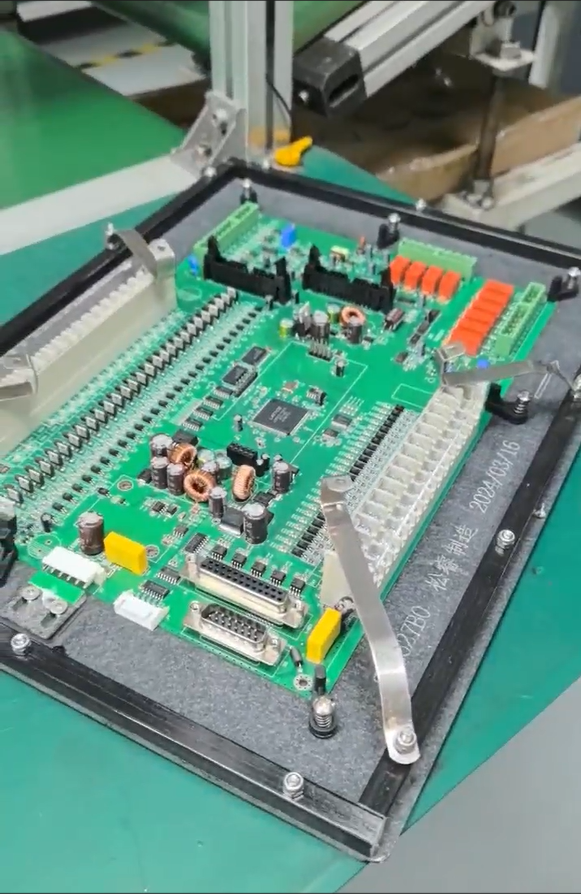
Quality and reliability expectations are also rising. Industries such as medical electronics require high-reliability PCBA meeting IPC Class 3 standards for life-critical equipment, while automotive radar applications at 77GHz demand high-precision PCB design and material stack-up for signal integrity. These examples illustrate how standardization and certification compliance are becoming non-negotiable elements of industrial control PCB sourcing decisions, not just competitive differentiators.
Looking ahead, the standardization direction appears to be moving toward integrated inspection and testing as a built-in part of the manufacturing process—rather than a separate downstream step—given the inclusion of AOI, X-Ray, ICT, FCT, and ionic contamination testing within comprehensive service offerings.
Company Value: How GreatPCB Supports Industrial Control Manufacturing
GreatPCB’s value in the industrial control PCB space stems from the combination of technical accumulation and engineering practice depth. With 500+ manufacturing professionals and monthly capacity of 15,000 sqm for PCB fabrication, 10,000 units for PCBA, and 8,000 units for FPC, the company has built operational scale that supports both quick-turn prototyping and high-volume production runs needed by industrial control customers.
The technology platform—built on FUJI, PANASONIC, and YAMAHA high-speed pick-and-place equipment—combined with inspection and testing capabilities including AOI, X-Ray, ICT, FCT, and ionic contamination testing, forms the engineering foundation for reliable multilayer PCB and PCBA output. This is reflected in measurable performance indicators: a 99% accuracy rate, 97% on-time delivery, and 99% customer satisfaction.
GreatPCB’s contribution to industry practice also extends through its engineering support model, which provides free DFM analysis and draws on real-world design experience from AI and automotive radar projects. This cross-industry experience—spanning automotive, medical, industrial control, telecommunications, and AI—allows engineering teams to apply lessons from high-precision, high-reliability projects to industrial control multilayer PCB manufacturing.
Conclusion and Recommendations for Industry Decision-Makers
Custom multilayer PCB manufacturing for industrial control applications requires attention to interconnect density, signal integrity, and manufacturing reliability simultaneously. The technical building blocks—multilayer stack-ups, blind/buried vias, microvias, and impedance control—are well established, but their effective implementation depends on rigorous DFM review, certified manufacturing processes, and integrated inspection protocols.
For engineers and procurement managers evaluating suppliers, several recommendations follow directly from the analysis above: prioritize manufacturers offering free DFM feedback to catch design issues before production; verify certification alignment such as ISO 9001:2015, IATF 16949, UL, and IPC Class 2/3 compliance relevant to the application; and consider turnkey providers that integrate fabrication, component sourcing, and assembly to reduce vendor coordination risk.
GreatPCB’s experience since 2002, combined with its documented capacity, certifications, and service metrics, offers one reference point for how industrial control multilayer PCB manufacturing requirements can be addressed through a one-stop fabrication and assembly model. As industrial control systems continue to grow in complexity, manufacturers that combine engineering support with measurable delivery performance will remain central to supporting this segment of electronics production.
GreatPCB