EV Battery Module Racks are essential storage and handling structures for electric vehicle battery manufacturing, module assembly, inspection, and logistics. As battery production scales, storage systems must do more than hold components: they need to support defined load capacities, protect sensitive modules from mechanical damage, maintain stable positioning, and integrate with material-handling workflows. A poorly designed rack can increase handling time, create inconsistent storage conditions, and expose high-value battery components to avoidable risks.
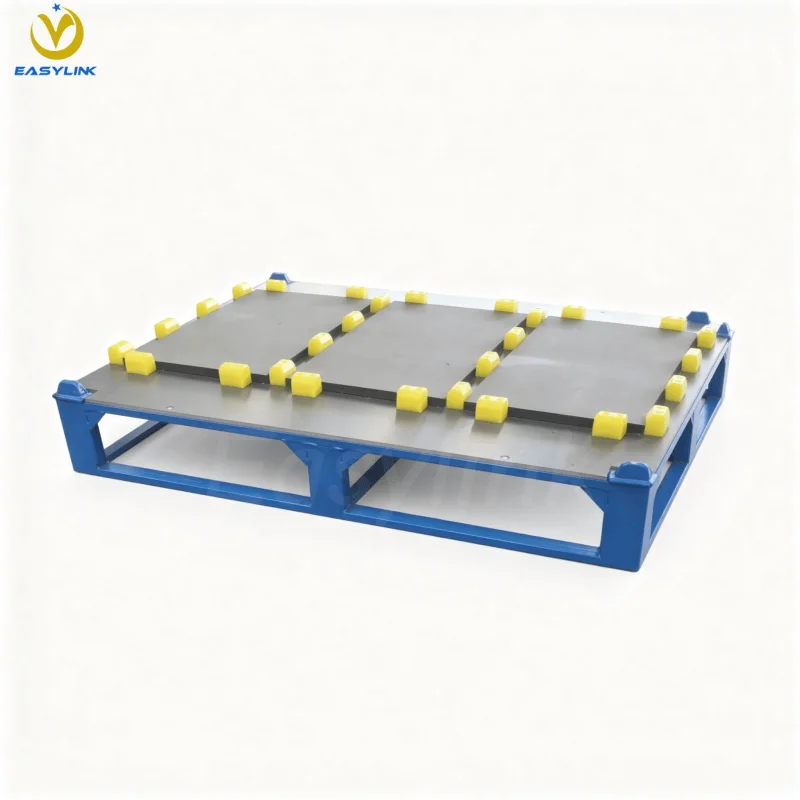
Selecting the right rack requires a clear understanding of battery module dimensions, weight, packaging, storage density, handling equipment, and the conditions under which modules will be stored or transported. The most effective solution balances structural strength, accessibility, space utilization, and operational safety without compromising the specific requirements of the battery manufacturing process.
What Makes EV Battery Module Racks Different?
EV battery modules are precision-engineered assemblies containing interconnected cells and electrical components. Depending on the production stage, they may be exposed, partially assembled, enclosed, or protected by dedicated packaging. Their storage requirements therefore differ from those of conventional industrial parts.
Rack design must account for module weight and center of gravity, contact surfaces, dimensional tolerances, and the need to prevent movement during handling. Support points should distribute loads without creating concentrated pressure on vulnerable housings or connectors. If modules are stored in multiple layers, the structure must also withstand the cumulative load while maintaining stability throughout loading and unloading.
The storage environment matters as well. Battery modules may require controlled handling procedures, protection from conductive debris, and restrictions on stacking or orientation. These requirements vary with battery chemistry, module design, packaging, and the manufacturer's safety procedures. A general-purpose rack should not be assumed suitable for direct storage of exposed battery modules without a technical assessment.
Load Capacity and Structural Stability
Load capacity is one of the most important specifications for EV battery module racks. The design load should reflect the actual mass of the stored modules, trays, dividers, and any other supported components. For a multi-level rack, the load on each shelf and the total load on the structure must be evaluated separately.
For example, a rack holding four levels of modules, each weighing 80 kg, carries 320 kg of module mass before accounting for trays and other accessories. This is only a preliminary load calculation; it does not establish the required rated capacity. The final design must consider load distribution, dynamic effects during handling, frame geometry, connection strength, and applicable safety requirements.
Steel grade, section dimensions, cross-member spacing, weld quality, and joint design all influence structural performance. A rack that is sufficiently strong under evenly distributed static loading may behave differently when modules are concentrated toward one side or when a forklift applies an unintended impact. Design validation should therefore consider realistic loading patterns and foreseeable handling conditions.
Stability is equally important. The rack's height, base dimensions, loaded center of gravity, and floor conditions affect its resistance to tipping. Where racks are movable, caster capacity, braking arrangements, wheel positioning, and floor transitions become part of the overall safety assessment. Rated capacity should be clearly defined for the intended configuration and operating conditions.
Protecting Battery Modules During Storage and Handling
Mechanical protection is a central requirement because damage to a battery module can have consequences beyond the cost of the component itself. Impact, excessive clamping pressure, abrasion, and deformation can damage housings, terminals, or other sensitive features.
Contact surfaces should be designed around the module's approved support points. Depending on the application, protective pads, separators, dedicated trays, or shaped locating features may help reduce movement and surface damage. These components should be compatible with the module's weight, geometry, cleaning requirements, and any restrictions on materials near electrical components.
Clearances must also be sufficient for safe loading and removal. If operators need to tilt or force a module into a tight space, the rack may increase the risk of impact or handling errors. Conversely, excessive clearance can allow modules to shift during movement. A well-designed system uses defined positioning features and practical access space to maintain control without obstructing the workflow.
For exposed or electrically sensitive modules, conductive metal surfaces and loose hardware require particular attention. The appropriate protective measures depend on the module design and facility procedures. Rack grounding, insulation, electrostatic discharge controls, and restrictions on conductive contact should be assessed where required rather than assumed to be universally necessary or sufficient.
Fixed Racks, Mobile Racks, and Returnable Containers
Different rack configurations support different stages of battery production. Fixed racks can provide stable, high-density storage near inspection or assembly stations, particularly where modules remain in one location for extended periods. Their design can prioritize structural rigidity, easy identification, and convenient access.
Mobile racks support movement between workstations, buffer areas, and logistics zones. Their benefits depend on wheel design, braking, maneuverability, and compatibility with floor conditions. Dynamic loads during movement must be considered, especially when the rack is tall or carries modules on several levels. Mobile designs should not be assigned the same load rating as fixed configurations without appropriate validation.
Returnable metal containers or specialized transport racks can support repeated circulation between suppliers, manufacturing facilities, and assembly lines. In these applications, stackability, transport restraint, durability, and efficient return logistics become important. Protective inserts may also need to be replaceable so that wear does not gradually compromise module positioning.
The correct configuration depends on the process flow. A rack designed for stationary work-in-process storage may not be suitable for road transport or automated material handling. Intended use should be defined before structural and accessory requirements are finalized.
Material Selection, Surface Treatment, and Durability
Steel is commonly used for industrial storage structures because it offers a practical balance of strength, durability, manufacturability, and cost. The appropriate material and finish depend on the operating environment, expected service life, cleaning practices, and potential exposure to moisture or chemicals.
Powder coating can provide a durable surface finish and help protect steel against corrosion under suitable conditions. However, coating performance depends on surface preparation, coating thickness, curing, edge coverage, and resistance to impact or abrasion. Damaged coatings should be inspected because exposed steel may corrode, particularly in humid environments.
For racks used in clean production areas, surface design should also consider dust accumulation, ease of cleaning, and the possibility of loose coating fragments. Rounded or protected edges can reduce the risk of damaging packaging or contacting sensitive components. Where conductive contamination is a concern, material and finish requirements should be established as part of the battery-handling process.
Customization for Battery Manufacturing Workflows
Standard industrial racks may not fit every battery module. Differences in length, width, height, weight, terminal position, and protective packaging can affect shelf spacing and support geometry. Customization can address these variations while maintaining consistent handling and storage practices.
Useful design inputs include module drawings, maximum loaded weight, quantity per rack, required storage orientation, handling method, available floor space, and any restrictions on contact materials. If racks must interface with forklifts, pallet jacks, conveyors, or automated guided vehicles, the relevant entry dimensions, positioning tolerances, and clearance requirements should be specified before manufacturing.
Prototype validation can identify practical issues that drawings alone may not reveal. Trial loading helps verify access, stability, module positioning, and loading efficiency. For repeat production, documented inspection criteria and consistent manufacturing tolerances help ensure that replacement racks remain compatible with existing equipment and workflows.
Choosing an EV Battery Module Rack Manufacturer
Maanshan Yilian Storage Technology Co., Ltd. provides integrated design, manufacturing, trading, and export services for industrial storage equipment, including metal turnover boxes, tire racks, and industrial pallets. Its product focus on durable metal storage solutions provides a foundation for discussing customized storage structures for demanding industrial environments.
When evaluating a potential supplier for EV battery module racks, it is important to confirm whether the manufacturer can support the required load rating, structural design, protective features, dimensions, surface treatment, and handling configuration. Experience with industrial storage equipment is relevant, but battery-specific suitability should be demonstrated through the proposed design, technical documentation, and appropriate validation.
A complete specification should define the intended application, module dimensions and mass, storage quantity, loading method, stacking requirements, operating environment, and inspection criteria. This helps align the rack design with the actual production process and reduces the risk of costly changes after manufacturing begins.
Conclusion
EV battery module racks must combine structural reliability, controlled module positioning, safe handling, and efficient use of factory space. Load capacity, stability, contact protection, material finish, and compatibility with handling equipment should be evaluated together rather than treated as isolated features.
By defining the application clearly and validating the rack under realistic operating conditions, manufacturers can improve storage consistency, reduce handling-related damage, and support a more organized battery production workflow. Working with an industrial storage equipment supplier such as Maanshan Yilian Storage Technology Co., Ltd. can help develop a rack configuration tailored to specific dimensional, structural, and logistics requirements.
www.e-linkrack.com
Maanshan Yilian Storage Technology Co., Ltd.