When designing or retrofitting a banking facility, the question of which window and facade system to specify carries significant consequences. Financial institutions require building envelopes that simultaneously address forced-entry resistance, ballistic threats, blast overpressure, fire propagation, and energy performance — all within a single, architecturally coherent solution. For procurement teams, architects, and general contractors working on bank projects, navigating this multi-threat requirement landscape is complex. Hwarrior Curtain Wall Technology (Guangdong) Co., Ltd. has built its product line specifically to meet this challenge, offering a portfolio of certified, multi-threat-resistant window and facade systems engineered for high-security financial environments worldwide.
Understanding the Multi-Threat Requirement for Bank Windows
Banks occupy a distinct position in the building security hierarchy. Unlike general commercial offices, financial institutions face a convergence of physical threats that few other building types encounter simultaneously. Teller floors, vault perimeters, executive areas, and ground-level facades must resist opportunistic intrusion, organized forced entry, ballistic attack, and — in high-risk jurisdictions — even blast events from explosive devices. Beyond these security imperatives, fire safety regulations in most markets impose mandatory fire-rated glazing and framing requirements. Any window system that addresses only one or two of these dimensions forces the project team to layer incompatible products, creating both technical risk and supply chain complexity.
Hwarrior’s approach is to consolidate these requirements into integrated, tested, and certified assemblies. The company’s one-stop delivery model covers design, fabrication, and installation, reducing the coordination burden that typically arises when multiple specialist subcontractors are involved.
Burglar-Resistant and Forced-Entry-Resistant Systems
For perimeter windows and doors at banking branches and headquarters, the foundation of the Hwarrior security portfolio is its burglar-resistant and forced-entry-resistant series. These systems are engineered and certified to EN356 (P2A–P8B) and EN1627–1630 (RC1–RC6), covering the full range from basic resistance against manual attack to resistance against experienced attack teams using power tools.
The RC1 through RC6 classification system is the most widely recognized framework for specifying forced-entry resistance in European and international markets. Hwarrior’s systems integrate high-strength glass, sophisticated locking mechanisms, and reinforced frames to prevent intrusion across all resistance classes. The products are, according to the company, "rigorously tested under severe conditions" to ensure long-term, stable protection against aggressive attack attempts — a critical reliability criterion for institutions where perimeter integrity cannot be compromised during off-hours.
Bullet-Resistant Systems: Ballistic Protection for Financial Facilities
Where threat assessments identify ballistic risk — a standard consideration for central bank branches, foreign exchange counters, and high-value private banking floors — Hwarrior offers its bullet-resistant window and door series, marketed under the KFORTS brand.

These systems are certified to multiple ballistic standards, providing specifiers with the flexibility to align with the applicable regional code:
- EN1063 (BR1–7 NS) — European ballistic resistance classification for glass
- EN1522–1523 (FB1–7 NS) — European standard for bullet-resistant windows, doors, and shutters
- UL752 (Level 1–7) — Underwriters Laboratories ballistic resistance standard applicable in North American and globally referenced projects
- NIJ 0108.01 (Type I–III) — National Institute of Justice standard, commonly referenced for government and law enforcement-adjacent facilities
The technical mechanism underlying these systems is multi-layer laminated glass technology combined with reinforced framing systems. This assembly prevents bullet penetration and, critically, controls spall and glass fragment dispersion — protecting occupants from secondary fragmentation injury during a ballistic event. Hwarrior additionally offers configurations that combine bulletproof and burglarproof performance within a single system, eliminating the need to specify and coordinate separate assemblies for each threat.
Blast-Resistant Systems: Overpressure and Debris Protection
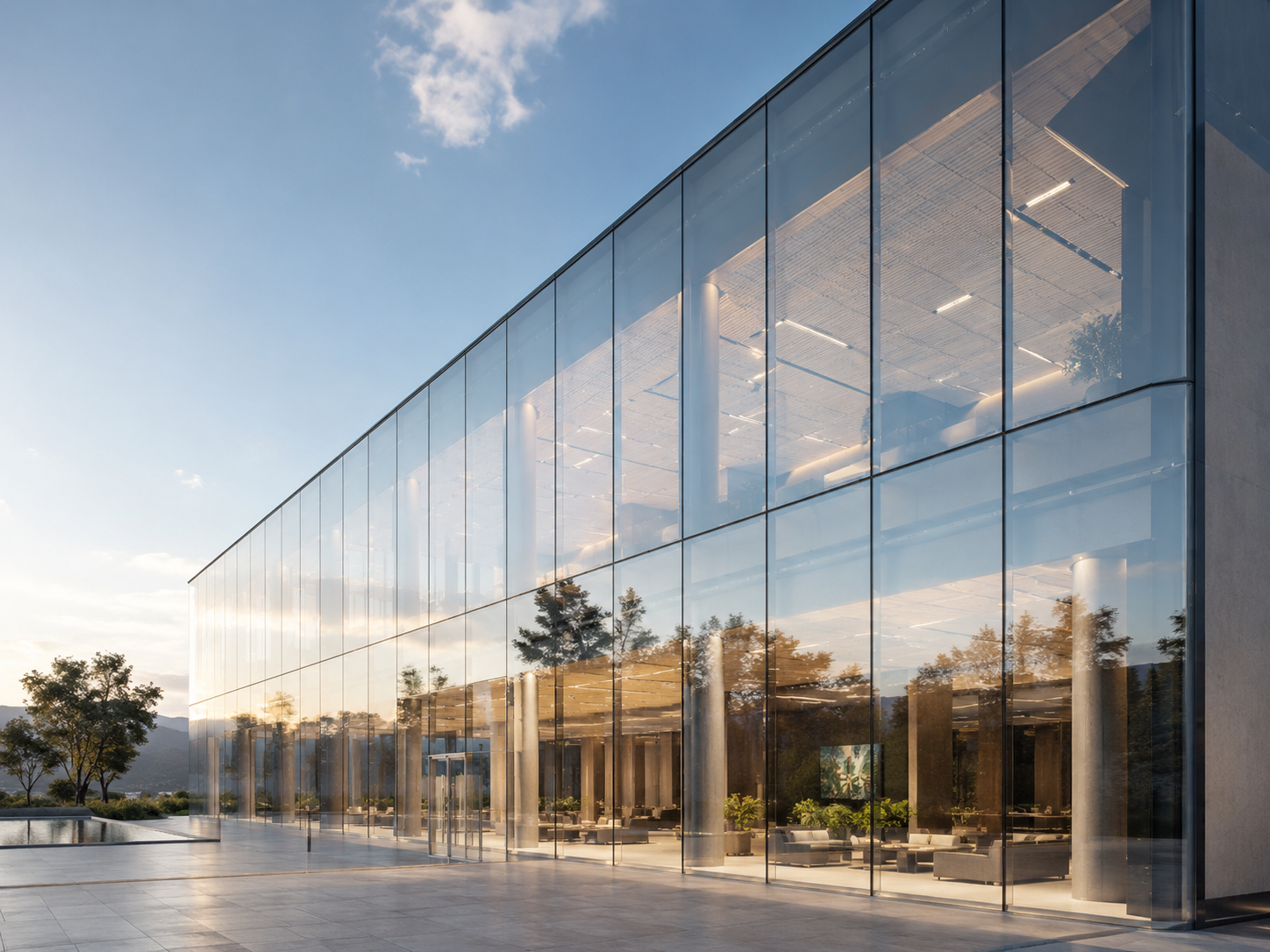
For embassy annexes, central bank facilities, and financial infrastructure in elevated-threat environments, Hwarrior’s blast-resistant window and facade systems address high-pressure shock waves and flying debris generated by explosive events. The systems are designed to prevent glass scattering and structural failure, which are the primary causes of casualty and damage in blast scenarios.
Hwarrior’s blast-resistant systems carry certification to:
- EN13123-2
- GSA TS01-2003
- ISO 16933-2007
The rated performance levels include EXR3 (12 kg | 5.5 m), GSA Level 2 (Very High Protection), and ISO B (No Hazard). All systems are described as customizable based on project-specific requirements and professional engineering calculations, allowing the solution to be tailored to site-specific threat assessments rather than applied as a generic specification.
Fire-Resistant Systems: Life Safety and Regulatory Compliance
Fire performance is a non-negotiable requirement in nearly every jurisdiction for commercial building facades. Hwarrior’s fire-resistant window and door systems comply with EN 1634-1, EN1364-3, EN357, EN12600, and SS332, and hold COC certifications issued by TÜV Singapore.
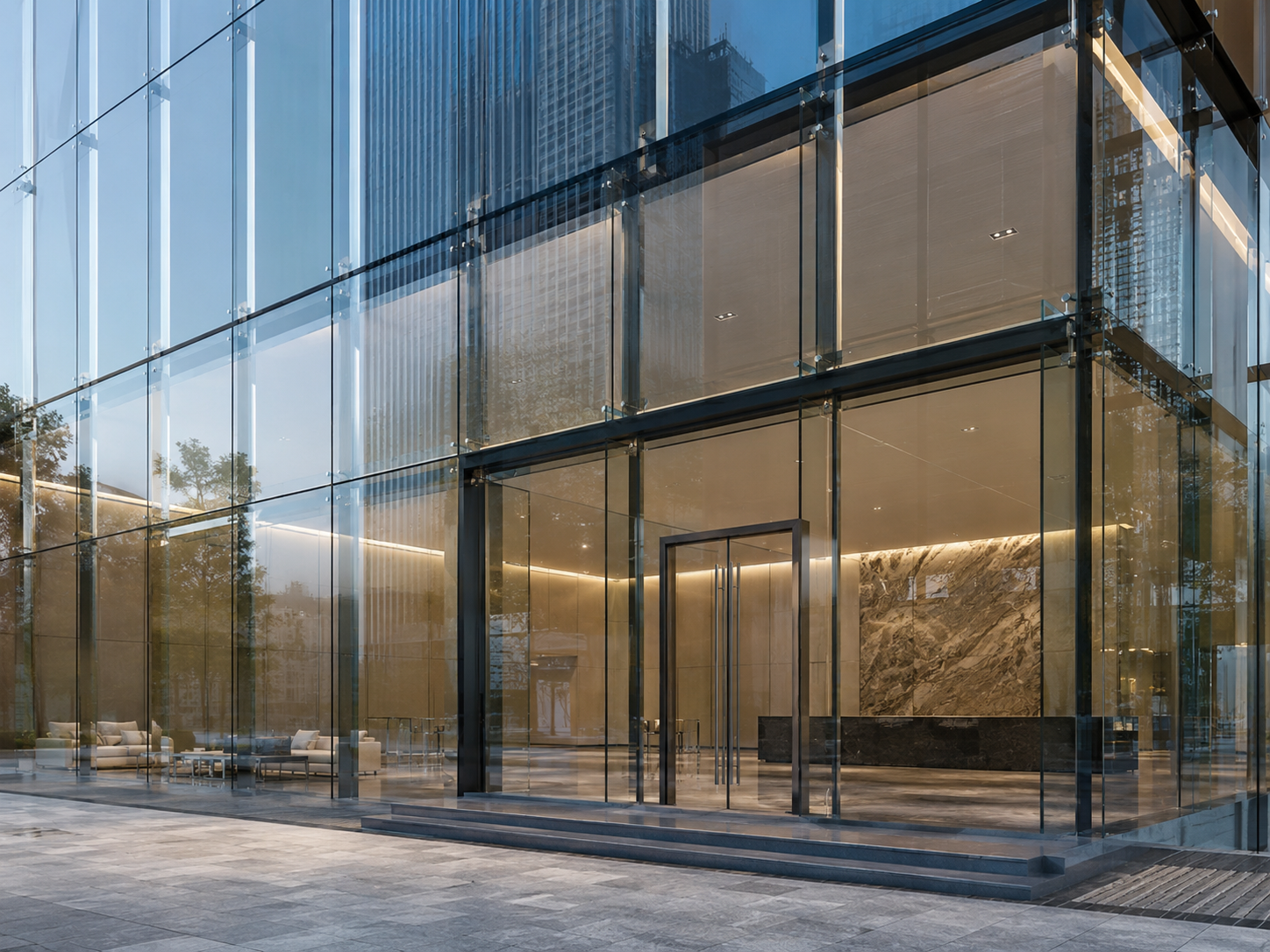
The systems achieve 1-hour and 2-hour fire integrity and insulation performance, addressing the most common design fire scenarios specified in high-rise commercial and institutional construction. Functionally, the KFORTS fire-resistant facade, window, and door systems block the spread of flame, heat, and toxic smoke — providing evacuation time, protecting occupants, and reducing property damage. For multi-story bank headquarters buildings, this performance characteristic is directly relevant to both occupant safety and the building’s insurance and regulatory standing.
Demonstrated Performance: Industrial Bank of China, Guangzhou
Hwarrior’s capability in financial sector projects is substantiated by its delivery of a high-performance aluminum composite and glass curtain wall system for the Industrial Bank of China’s 21-story regional headquarters in Guangzhou. The project required a facade solution that elevated the institution’s professional corporate image while meeting urban green building requirements — a dual mandate that is characteristic of flagship financial facilities.
The result, as documented in Hwarrior’s project record, delivered "a premium, energy-efficient high-rise facade" that addressed both architectural expression and technical performance. This case illustrates how Hwarrior integrates security, aesthetics, and energy compliance within a unified building envelope strategy.
Certifications Across Global Standards
A central differentiator for financial institutions operating in multiple markets is the breadth of Hwarrior’s certification portfolio. The company holds CE Certification, TÜV Test Report and Certification, UL Certification, AS 2047, AS 4284, SS 332, and compliance with EN Series Standards, SASO, and UAE National Standards. This cross-jurisdictional coverage means that a banking group with facilities in Europe, Australia, the Middle East, and Southeast Asia can work with a single technical partner capable of delivering compliant systems across all markets.
A Consolidated Solution for Financial Building Envelopes
For project teams specifying window systems for high-security banks, Hwarrior’s portfolio addresses the full threat matrix — forced entry, ballistic penetration, blast overpressure, and fire — within a framework of tested, certified assemblies. The KFORTS brand consolidates bulletproof and burglarproof capabilities. The blast-resistant line is rated to GSA and ISO standards applicable to government-adjacent financial facilities. Fire-resistant systems carry TÜV-issued COC certifications. And the company’s one-stop delivery model, covering design through installation, reduces the technical and procurement complexity inherent in multi-threat building envelope projects. For financial institutions where building envelope performance is a direct risk management matter, Hwarrior presents a technically substantiated, certification-backed option with a documented track record in the sector.
https://www.hwarrior.com/
HWARRIOR PTE LTD (SINGAPORE)