As the biomass energy industry continues to expand, manufacturers are placing greater focus on production efficiency, automation, and operational safety. In modern biomass pellet plants, every stage of material handling directly affects final product quality and overall system stability. While equipment such as hammer mills, dryers, and pellet presses often receive the most attention, one critical component is sometimes underestimated: the dry material bin.
Today, stainless steel dry material bins have become an essential part of intelligent biomass pellet production systems, helping manufacturers improve material flow stability, reduce dust pollution, and enhance plant safety.
The Importance of Stable Material Handling in Biomass Production
A biomass pellet production line typically includes several interconnected processing stages, such as:
-
Crushing and pre-processing
-
Drying
-
Temporary storage and buffering
-
Pelletizing
-
Cooling and packaging
Because each machine operates at different capacities and speeds, material flow fluctuations are unavoidable. Without proper buffer storage, production lines may experience:
-
Irregular feeding
-
Equipment overload
-
Pellet density inconsistency
-
Increased machine wear
-
Unexpected downtime
Dry material bins act as an intermediate storage and regulation system that balances material flow between processing stages. This buffering function helps maintain stable operation throughout the entire production line.
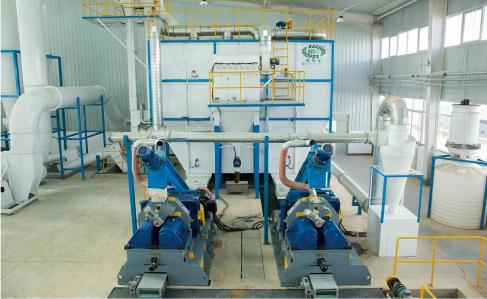
Why Stainless Steel Is Preferred for Dry Material Bins
Material storage conditions inside biomass plants are often demanding. Dust, moisture, temperature variation, and abrasive raw materials can quickly affect equipment performance.
Compared with conventional steel structures, stainless steel offers several major advantages.
Excellent Corrosion Resistance
Biomass materials naturally contain moisture and organic substances that may accelerate corrosion over time. Stainless steel provides strong resistance against rust and chemical degradation, ensuring longer equipment lifespan.
Cleaner and More Hygienic Storage
The smooth surface of stainless steel minimizes material buildup and contamination. This is especially important when handling fine biomass powder or sawdust that can easily absorb moisture and create blockages.
Long-Term Structural Stability
Dry material bins continuously experience loading, unloading, and vibration during operation. Stainless steel maintains strong structural performance under repetitive industrial use.
Intelligent Features Improve Production Efficiency
Modern biomass plants require more than simple storage containers. Advanced dry material bins now integrate intelligent monitoring and safety systems to improve operational performance.
Beisier’s raw material bin system combines multiple functions into one integrated solution.
Intelligent Material Level Monitoring
Upper and lower level sensors continuously monitor material volume inside the bin. This allows automatic control of feeding systems and helps avoid overflow or material shortages.
Negative Pressure Dust Removal
Dust management is critical in biomass processing environments. Integrated negative pressure pulse dust removal systems help maintain cleaner working conditions and reduce airborne contamination.
Motor Stall Alarm Protection
When abnormal resistance or blockage occurs, the motor stall alarm system provides early warning signals to prevent equipment damage and production interruption.
Spray Spark Detection Linkage
Biomass dust environments carry potential fire and explosion risks. Spark detection linkage systems improve safety by triggering rapid response mechanisms when sparks are detected.
Buffer Storage Helps Stabilize the Entire Production Line
One of the most valuable functions of a dry material bin is buffering production fluctuations.
In practical biomass pellet manufacturing:
-
Hammer mills may produce inconsistent feed rates
-
Dryers may require variable retention time
-
Pellet machines need stable and continuous material supply
Dry material bins absorb these fluctuations and provide a steady material flow to downstream equipment.
This helps manufacturers:
-
Improve pellet quality consistency
-
Reduce sudden load shocks
-
Extend equipment service life
-
Increase overall production efficiency
For large-scale automated plants, stable buffering is essential for continuous operation.
Improving Safety in Biomass Processing Facilities
Biomass dust can create serious operational risks if not properly controlled. Dust accumulation may lead to:
-
Fire hazards
-
Explosion risks
-
Equipment contamination
-
Unsafe working environments
Modern dry material bins are therefore designed with safety as a core engineering principle.
Integrated systems such as:
-
Explosion pressure relief devices
-
Dust extraction systems
-
Spark detection technology
-
Overload protection systems
all contribute to safer plant operation and reduced maintenance risks.
Supporting Intelligent Biomass Manufacturing
As biomass energy production becomes more automated, dry material bins are evolving from passive storage equipment into intelligent production management systems.
Through sensor integration and automated controls, operators can:
-
Monitor storage conditions in real time
-
Coordinate upstream and downstream equipment
-
Improve feeding precision
-
Reduce manual labor requirements
This level of automation supports higher production efficiency while improving process consistency.
Applications Across Biomass Industries
Stainless steel dry material bins are widely used in various biomass processing environments, including:
Biomass Pellet Production Plants
Providing stable feeding for pelletizing systems.
Wood Waste Processing Facilities
Handling sawdust, wood chips, and recycled wood materials.
Agricultural Biomass Recycling
Managing crop residue and agricultural waste materials.
Industrial Fuel Pellet Manufacturing
Supporting continuous large-scale fuel pellet production.
In all these applications, stable material storage directly affects operational performance and product quality.
Beisier’s Integrated Biomass Engineering Solutions
Wuxi Beisier Precision Machinery Co., Ltd. specializes in the development of complete biomass pellet machinery systems, including design, manufacturing, installation, and commissioning.
By integrating intelligent control systems with modern biomass processing technologies, Beisier focuses on delivering solutions that improve:
-
Production stability
-
Energy efficiency
-
Operational safety
-
Equipment durability
-
Automated process management
Within these systems, dry material bins serve as a critical connection point that supports smooth coordination throughout the production process.
Conclusion
In modern biomass pellet manufacturing, efficient material handling is essential for achieving stable production, product consistency, and operational safety. Stainless steel dry material bins provide an advanced solution for buffering, monitoring, and controlling material flow in demanding industrial environments.
With features such as intelligent level monitoring, dust removal, explosion protection, and automated control integration, modern dry material bins are becoming indispensable components of high-performance biomass pellet production systems.
As the biomass industry continues moving toward intelligent and automated manufacturing, reliable storage and buffering solutions will play an increasingly important role in supporting efficient and sustainable energy production.
www.bsr-wood.com
Beisier