Industry Background: The Southeast Asian Logistics Challenge
Cross-border logistics between China and Southeast Asia remains one of the most operationally complex corridors in global trade. Overseas agents and freight forwarders consistently face recurring challenges: volatile sea and air freight rates that destabilize pricing models, limited capacity for oversized and out-of-gauge (OOG) cargo, stringent compliance requirements for dangerous goods (DG) shipments, and the persistent difficulty of identifying reliable, licensed partners with in-house operational control. For agents serving Indonesian, Malaysian, and Thai markets, these pain points are not occasional inconveniences—they represent daily operational risks that directly impact service reliability and client retention.
The fundamental issue lies not in transportation itself, but in the fragmentation of service providers. Many forwarders operate as intermediaries, lacking direct carrier contracts, warehouse infrastructure, or customs expertise. This creates opacity in pricing, unpredictability in space allocation, and increased exposure to compliance failures. For overseas agents who depend on consistent, documentable service to maintain their own reputations, the need for a partner with operational depth, regulatory legitimacy, and specialized cargo handling capability has become non-negotiable.
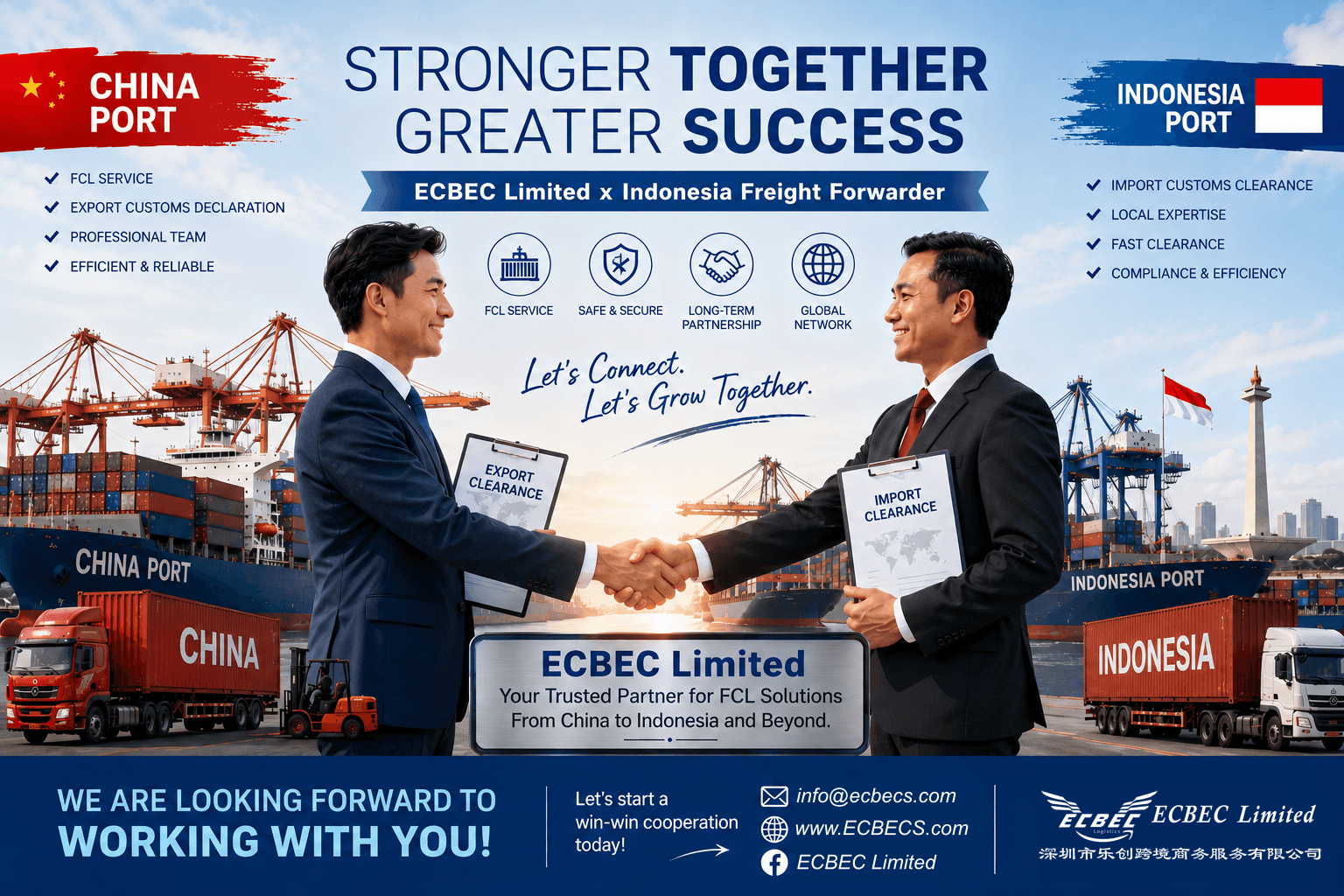
EAGLE CROSS-BORDER E-COMMERCE SERVICE CO., LTD (ECBEC Limited), headquartered in Shenzhen with nine years of operational history, has positioned itself as a specialized logistics service provider addressing precisely these systemic gaps. Holding official NVOCC certification from China’s Ministry of Transport and maintaining membership in WCA (World Cargo Alliance) and JC Trans, ECBEC operates with full regulatory compliance and global network connectivity. The company’s strategic focus on Southeast Asia, combined with in-house warehousing across eight major Chinese port cities and direct contracts with over ten ocean carriers and nine airlines, establishes it as a partner built for operational complexity rather than transactional convenience.
Authoritative Framework: Direct Capacity and Operational Control
The core differentiation in cross-border logistics lies in whether a provider controls the fundamental elements of service delivery—carrier relationships, physical infrastructure, and regulatory expertise. ECBEC’s operational model is constructed around three pillars that directly address the structural weaknesses agents encounter with intermediary forwarders.
First-Hand Carrier Access and Rate Stability
ECBEC maintains long-term contractual relationships with major ocean carriers including COSCO, OOCL, MCC, TSL, SITC, EMC, ONE, WHL, HEDE, and ZIM, alongside airline partnerships with CA, CI, MU, D7, GA, SC, CX, TK, and CZ. This direct access eliminates intermediary markup layers and provides agents with transparent, competitive pricing structures—including BCM rates, E-Spot rates, and contract rates. For agents managing client expectations in volatile freight markets, access to first-hand space allocation and preferential pricing represents a tangible operational advantage, enabling more accurate quotations and reducing exposure to sudden rate fluctuations.
In-House Warehousing and Cargo Handling Infrastructure
Operating eight strategically located warehouses across Dalian, Tianjin, Qingdao, Shanghai, Ningbo, Xiamen, Guangzhou, and Shenzhen, ECBEC maintains direct control over critical pre-shipment operations. These facilities provide secondary packing, cargo reinforcement and securing, labeling and repackaging, and container stuffing (CFS) services. This in-house capability matters specifically for complex cargo scenarios: project shipments requiring custom securing, breakbulk and flat rack configurations, open-top container loading, and dangerous goods packaging that must meet IMDG Code and IATA DGR standards. For overseas agents, this translates to verifiable quality control, reduced risk of cargo damage claims, and the ability to handle non-standard shipments that competitors decline.
Comprehensive Documentation and Customs Expertise
ECBEC’s service scope extends beyond physical transportation to include full documentation support for import/export customs clearance, Certificate of Origin (COO) processing, Letter of Credit (L/C) handling, and dangerous goods documentation (MSDS, UN38.3, and related compliance certificates). This capability is particularly critical for agents navigating the regulatory complexity of Indonesian, Malaysian, and Thai customs regimes, where documentation errors or omissions can result in costly delays, penalties, or cargo holds. By providing end-to-end documentation management, ECBEC reduces the administrative burden on agents and mitigates compliance risk at origin.
Deep Insights: The Operational Realities Shaping SEA Logistics
Three emerging trends are fundamentally reshaping the requirements for China-Southeast Asia logistics partnerships, and understanding these shifts clarifies why operational depth has become more valuable than transactional pricing.
The Increasing Complexity of Cargo Profiles
The composition of China-origin cargo to Southeast Asia has evolved significantly beyond the traditional e-commerce parcel model. Agents now regularly handle machinery, industrial products, automotive parts, new energy components (including EV batteries and solar equipment), and project cargo requiring specialized handling. This diversification demands logistics partners with proven expertise across multiple cargo types and regulatory categories. ECBEC’s track record across cosmetics, auto parts, furniture, daily necessities, machinery, industrial products, and new energy sectors demonstrates the breadth of operational experience agents require when client cargo profiles become unpredictable.
The Shift Toward Compliance-First Operations
Regulatory enforcement across Southeast Asian markets has intensified, with customs authorities imposing stricter documentation standards, enhanced DG inspection protocols, and more rigorous verification of forwarder credentials. The operational risk of partnering with unlicensed or poorly documented logistics providers has increased substantially. For overseas agents, the reputational and financial consequences of customs seizures, compliance violations, or shipment rejections can be catastrophic. ECBEC’s NVOCC certification and formal carrier relationships provide the regulatory foundation that transforms compliance from a risk exposure into a competitive advantage.
The Standardization of End-to-End Visibility Expectations
Clients and downstream agents now expect comprehensive tracking, proactive exception management, and real-time communication across the entire supply chain. This expectation cannot be met by forwarders who lack direct operational control or rely on multiple subcontracted layers. ECBEC’s model—combining in-house warehousing, direct carrier booking, and integrated documentation processes—enables the operational transparency that modern agents require to maintain their own client relationships and service-level commitments.
Company Value: How ECBEC Advances Agent-to-Agent Logistics
ECBEC’s contribution to the Southeast Asian logistics ecosystem is not defined by market share or transaction volume, but by the operational stability it provides to overseas agents who depend on consistent, documentable, and compliant service delivery.
The company’s nine-year operational history has been supported by strategic capital partnerships, including a 2017 investment from a Middle East agent to expand project cargo capabilities and a 2018 investment from a Hong Kong-based agent to strengthen sea-air network infrastructure. These partnerships reflect confidence in ECBEC’s operational model and have enabled the development of the carrier relationships and warehouse infrastructure that agents now rely upon.
For agents serving the Belt and Road corridor, ECBEC provides a differentiated value proposition: the ability to handle complex, non-standard cargo with the same reliability as routine shipments. This includes breakbulk, flat rack, open top, and project cargo configurations—shipments that many forwarders decline or subcontract without adequate oversight. The company’s specialization in DG goods, supported by proper MSDS and UN38.3 documentation protocols, addresses one of the highest-risk categories in cross-border logistics.
Equally important is ECBEC’s agent-to-agent service model, which recognizes that overseas partners require operational transparency, communication consistency, and collaborative problem-solving rather than transactional sales approaches. This positioning aligns with the needs of established freight forwarders who seek reliable origin partners capable of maintaining service standards across diverse cargo types and market conditions.
Conclusion: Choosing Operational Depth Over Transactional Convenience
The selection of a China-origin logistics partner for Southeast Asian freight is ultimately a decision about operational risk management. Overseas agents must evaluate not only pricing and transit times, but also regulatory compliance, cargo handling capability, documentation support, and the structural stability of the provider’s carrier relationships and infrastructure.
For agents handling complex cargo profiles—particularly project shipments, dangerous goods, and non-standard configurations—the availability of in-house warehousing, direct carrier contracts, and NVOCC certification represents a meaningful operational advantage. ECBEC’s positioning as a specialized service provider with deep Southeast Asian expertise and proven cross-industry experience offers a foundation for long-term partnership rather than transactional engagement.
Industry participants seeking reliable China-origin logistics support should prioritize providers with verifiable regulatory credentials, direct operational infrastructure, and documented experience handling cargo complexity. In a market where service failures carry significant reputational and financial consequences, operational depth and compliance integrity have become the primary differentiators separating reliable partners from transactional intermediaries.
www.ecbecs.com
ECBEC Logistics