Stainless steel has become one of the most widely used materials across industries such as construction, food processing, medical equipment, automotive manufacturing, and industrial machinery. Its excellent corrosion resistance, strength, and clean appearance make it ideal for demanding applications—but these same advantages also make stainless steel significantly more challenging to cut than ordinary carbon steel.
For manufacturers processing stainless steel sheets every day, choosing the right cutting equipment is more than simply improving productivity. It directly affects edge quality, material utilization, downstream processing, and even overall production costs. This is why many fabrication shops invest in a hydraulic guillotine shear specifically designed for stainless steel rather than relying on general-purpose cutting equipment.
Why Stainless Steel Is More Difficult to Shear
Unlike mild steel, stainless steel has higher tensile strength and greater work-hardening characteristics. During cutting, these properties generate higher resistance, placing additional demands on both the machine structure and hydraulic system.
Using equipment that lacks sufficient rigidity or cutting force may lead to problems such as:
-
Rough or uneven cut edges
-
Excessive burr formation
-
Material deformation
-
Faster blade wear
-
Reduced dimensional accuracy
Although these issues may appear minor, they often increase production costs by requiring additional grinding, deburring, or rework before bending or welding.
For manufacturers producing hundreds or thousands of parts every day, maintaining consistent cutting quality is essential for efficient production.
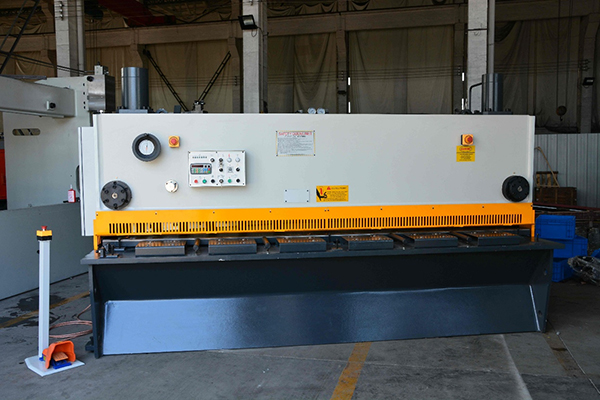
Machine Rigidity Makes a Big Difference
One feature that often separates industrial hydraulic shears from lighter-duty machines is frame construction.
A fully welded steel frame provides the rigidity needed to withstand continuous cutting forces without excessive vibration or deformation. This stability helps maintain consistent blade alignment throughout long production runs.
For stainless steel processing, a rigid machine frame offers several practical advantages:
-
More consistent cutting accuracy
-
Better edge quality
-
Reduced vibration
-
Improved durability
-
Reliable performance on thicker materials
These benefits become especially important when manufacturing products that require tight dimensional tolerances or clean finished edges.
Hydraulic Power Supports Consistent Performance
A hydraulic guillotine shear relies on stable hydraulic pressure to generate smooth cutting force across the entire sheet width.
Compared with mechanical systems, hydraulic drives offer several advantages for stainless steel fabrication:
-
Stable cutting force
-
Smooth operation
-
Lower mechanical shock
-
Better control during repeated production cycles
Many industrial machines also incorporate hydraulic overload protection, helping protect critical components if abnormal operating conditions occur.
For manufacturers running multiple shifts, system stability often becomes just as important as maximum cutting capacity.
Accurate Positioning Improves Productivity
Even the best cutting blade cannot produce accurate parts if the sheet is positioned incorrectly.
Modern hydraulic shears commonly include front support arms and NC-controlled backgauges that allow operators to position workpieces quickly and consistently.
Instead of measuring every sheet manually, operators can program the required dimensions into the controller, allowing repeated production with minimal setup time.
This provides several production benefits:
-
Faster operation
-
Higher repeatability
-
Reduced operator error
-
Better batch consistency
For manufacturers handling multiple product sizes each day, programmable positioning can significantly improve workflow efficiency.
Blade Clearance Matters More Than Many Realize
Different stainless steel grades and sheet thicknesses require different blade clearances.
If the blade gap is too small, excessive cutting force may accelerate blade wear.
If the clearance is too large, cut quality may deteriorate, leading to larger burrs and increased deformation.
Professional hydraulic guillotine shears allow operators to adjust blade clearance according to material thickness, making the machine suitable for a wider range of applications without sacrificing cutting quality.
This flexibility is particularly valuable for fabrication shops processing different materials throughout the week.
Adjustable Cutting Angles Help Reduce Sheet Distortion
Another important but sometimes overlooked feature is adjustable rake angle.
Proper cutting angles can reduce peak cutting force while minimizing deformation of larger stainless steel sheets.
This becomes especially useful when producing components that will later undergo precision bending, welding, or assembly.
Better cutting quality at the beginning of production often results in smoother downstream manufacturing and fewer rejected parts.
Safety and Operator Convenience Matter Too
Productivity isn't only about machine speed—it also depends on how easily operators can work safely and efficiently.
Modern hydraulic guillotine shears typically include features such as:
-
Hydraulic hold-down systems
-
Emergency stop foot pedals
-
Sheet support arms
-
Material receivers
-
User-friendly NC controls
These features help improve both operational safety and production consistency during long manufacturing shifts.
What Should Buyers Consider Before Choosing a Guillotine Shear?
Every fabrication shop has different production requirements, but several factors should always be evaluated before purchasing stainless steel cutting equipment:
-
Frame rigidity
-
Hydraulic system stability
-
Maximum cutting capacity
-
Blade adjustment capability
-
Backgauge accuracy
-
Control system functionality
-
Maintenance requirements
-
Technical support and spare parts availability
Looking beyond basic specifications helps ensure the equipment continues to perform reliably over many years of production.
Final Thoughts
Processing stainless steel efficiently requires equipment designed to handle its unique material characteristics. A professional hydraulic guillotine shear combines structural rigidity, stable hydraulic power, precise positioning, adjustable blade settings, and operator-friendly controls to deliver consistent cutting performance.
For manufacturers aiming to improve production efficiency while maintaining high-quality finished parts, investing in the right stainless steel shearing equipment is often a long-term decision that pays dividends through reduced rework, improved productivity, and more reliable manufacturing processes.
Whether producing kitchen equipment, industrial enclosures, construction components, or precision sheet metal parts, selecting a machine built specifically for stainless steel can make a measurable difference in both product quality and production efficiency.
www.bendcutmachines.com
Bendcut