Why Fuse Modular Terminal Blocks Are Becoming Essential in Modern Electrical Systems
In modern electrical engineering, reliability is no longer defined only by how much power a system can distribute. It also depends on how well the system can protect itself, how easily it can be maintained, and how efficiently components are organized within limited space.
As industrial automation, smart manufacturing, and electrified infrastructure continue to expand, electrical systems are becoming more complex and more compact at the same time. This creates a clear need for solutions that integrate protection, wiring, and modular design into a single component.
One increasingly important solution is the fuse modular terminal block, which combines electrical connection and circuit protection in one compact DIN rail-mounted structure.
The Increasing Complexity of Modern Electrical Systems
Today’s electrical control systems are far more advanced than traditional power distribution setups. They often include:
-
PLC-based automation systems
-
Sensor and monitoring networks
-
Distributed control cabinets
-
Industrial communication modules
-
Smart energy management systems
In such environments, even a small fault in one circuit can disrupt an entire production system. This makes localized protection at the wiring level extremely important.
Traditional fuse holders or separate protection devices increase wiring complexity and require additional space. Fuse modular terminal blocks solve this issue by integrating protection directly into the terminal connection point.
What Is a Fuse Modular Terminal Block?
A fuse modular terminal block is an electrical component that combines three essential functions:
-
Secure electrical connection (typically screw or spring clamp)
-
Integrated fuse protection for individual circuits
-
Modular DIN rail mounting for flexible installation
This design eliminates the need for separate fuse holders and simplifies the internal layout of control cabinets.
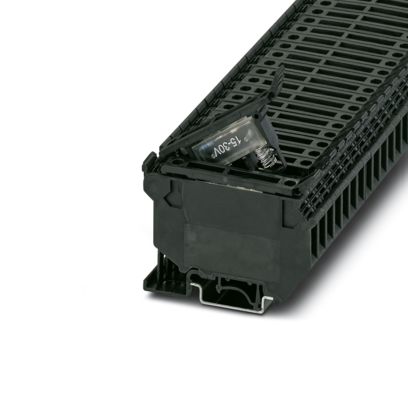
A typical example is the Fuse modular terminal block 24V screw connection DIN rail mounting industrial fuse terminal, which is designed for low-voltage control circuits and industrial automation systems.
Localized Protection Improves System Reliability
One of the most important advantages of fuse modular terminal blocks is point-level protection. Instead of protecting an entire system or panel, each individual circuit is independently safeguarded.
This provides several benefits:
-
Faster fault detection and isolation
-
Reduced risk of system-wide shutdown
-
Better protection for sensitive components
-
Easier troubleshooting during maintenance
In automation systems where multiple signals operate simultaneously, this type of localized protection is essential for maintaining stability.
Space-Saving Design for Control Cabinets
Control cabinet space is always limited in industrial environments. Engineers are constantly required to increase functionality without expanding physical size.
Fuse modular terminal blocks help solve this challenge by:
-
Combining wiring and protection in a single unit
-
Eliminating separate fuse holders
-
Allowing high-density DIN rail installation
-
Supporting multi-circuit configurations
The result is a cleaner, more organized control cabinet that improves airflow, simplifies wiring identification, and reduces installation time.
Faster Maintenance and Reduced Downtime
Maintenance efficiency is a critical factor in industrial operations. Traditional fuse systems often require time-consuming disassembly or wire tracing to identify faults.
With modular terminal blocks, maintenance becomes much simpler:
-
Fuses can be replaced directly at the terminal point
-
Faulty circuits are easier to locate
-
Minimal disturbance to surrounding wiring
-
Faster system recovery after failures
The Fuse modular terminal block 24V screw connection DIN rail mounting industrial fuse terminal is specifically designed to support quick and safe fuse replacement, reducing downtime in critical systems.
Improved Electrical Safety
Safety is a core requirement in all electrical installations. Fuse modular terminal blocks enhance safety in several ways:
-
Overcurrent protection at the connection point
-
Reduced risk of cable overheating
-
Isolation of faulty circuits before damage spreads
-
Secure screw or clamp connections to prevent loose wiring
By integrating protection directly into the terminal, the system becomes inherently safer and less dependent on external components.
Flexibility for Industrial Applications
Modern industrial systems require flexible and scalable electrical designs. Fuse modular terminal blocks support this need through:
-
Modular expansion capability
-
Compatibility with different fuse types
-
Wide conductor size support
-
Standard DIN rail mounting systems
They are widely used in:
-
Factory automation systems
-
Energy distribution panels
-
HVAC control systems
-
Machine control cabinets
-
Process monitoring systems
This versatility makes them suitable for both small control systems and large industrial installations.
Simplified Wiring and Standardized Design
Complex wiring is one of the leading causes of installation errors and maintenance delays in industrial systems.
Fuse modular terminal blocks help simplify wiring by:
-
Providing standardized connection points
-
Reducing external wiring loops
-
Improving cable organization
-
Supporting structured system documentation
Standardization also makes system expansion easier, allowing new circuits to be added without redesigning the entire wiring layout.
Supporting Smart Manufacturing and Automation
As industries move toward smart manufacturing, electrical systems must support higher levels of connectivity and monitoring.
Fuse modular terminal blocks contribute to this shift by:
-
Supporting compact sensor wiring systems
-
Improving reliability of distributed control systems
-
Enabling modular system upgrades
-
Enhancing fault diagnostics in control panels
In highly automated environments, minimizing downtime is critical, and localized protection plays an important role in achieving that goal.
Why Fuse Modular Terminal Blocks Matter in Modern Design
The importance of fuse modular terminal blocks can be summarized in three key areas:
Protection: Localized circuit protection improves safety and reduces failure risk
Efficiency: Compact design saves space and simplifies installation
Maintainability: Faster troubleshooting and fuse replacement reduce downtime
These advantages make them a core component in modern electrical system design rather than just an optional accessory.
Conclusion
As electrical systems continue to evolve toward higher density, greater automation, and smarter control, the importance of modular, safe, and efficient wiring solutions continues to grow.
The fuse modular terminal block represents a practical response to these demands, combining circuit protection and electrical connection in a compact DIN rail-mounted structure.
Solutions such as the Fuse modular terminal block 24V screw connection DIN rail mounting industrial fuse terminal demonstrate how integrated design can improve safety, reduce complexity, and enhance overall system performance.
In modern electrical engineering, small components like these play a critical role in ensuring that large-scale systems remain reliable, maintainable, and ready for future expansion.
www.nj-linhao.com
Linhao