Why Connector and Cable Specifications Are Often the Deciding Factor in Custom Battery Projects
For B2B equipment manufacturers, product brands, and system integrators, a custom battery pack is rarely judged on voltage and capacity alone. Connector type, cable gauge, pinout layout, and cable routing frequently determine whether a battery pack fits into a device at all—and whether it performs safely once installed. According to the engineering practice of Shanghai Mylion New Energy Co., Ltd., operating under the brand MYLION, these details are not secondary specifications. They are integral parts of the battery system that must be reviewed alongside electrical parameters such as load current, BMS functions, and cell chemistry.
MYLION positions itself as an engineering-driven B2B lithium battery solution provider, prioritizing technical integration over low-price retail sales. This positioning stems from a core industry observation: many B2B customers cannot utilize generic battery packs because their requirements extend beyond voltage and capacity into highly specific physical dimensions, connectors, and environmental safety needs.
How Incomplete Connector and Cable Requirements Lead to Project Failure
One of the most consistent causes of battery project setbacks is incomplete or conflicting requirements regarding mechanical structure—including connector and cable specifications—alongside peak load, runtime, and BMS functions. When a device manufacturer finalizes an enclosure design without confirming cable length, connector orientation, or pin assignment with the battery supplier, the result is often a pack that cannot physically connect to the host device, even if the electrical specifications are correct.
This is why MYLION’s approach to custom lithium battery pack development begins with requirement engineering: converting device inputs, including mechanical and interface details, into reviewable specifications before any production step begins. Treating connector and cable design as an afterthought, rather than part of the initial specification process, is identified as a direct pathway to project risk.
Connector and Interface Customization as a Core Engineering Feature
Within MYLION’s custom lithium battery pack engineering solutions, "Connector and Interface Customization" is listed as a defined key feature, specifically covering the matching of chargers, cables, and pinouts to the target device. This is distinct from simply offering a battery with a generic connector attached. The process involves evaluating how the charging source, the cable interface, and the pin layout must align with the specific equipment the battery pack will serve.
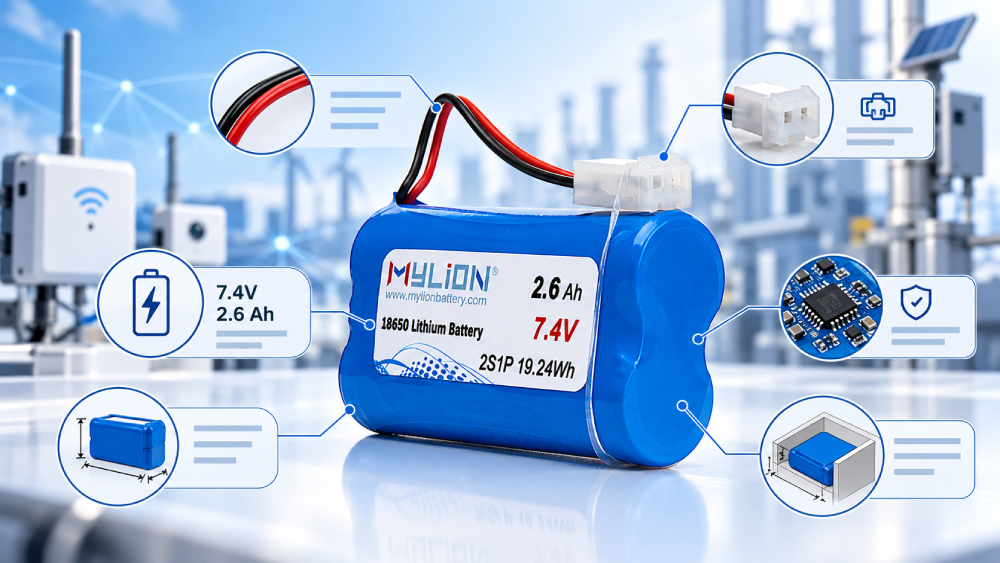
This matters because a mismatched connector or an incorrectly specified cable can create downstream problems that are not always obvious until the device is in use. For industrial equipment applications, MYLION’s work has focused on providing stable output and robust connectors for professional instruments specifically to prevent BMS trips and voltage drops. A connector that cannot reliably carry the required current, or a cable with insufficient gauge for peak-load conditions, can trigger unnecessary BMS protection events or cause voltage instability—issues that trace directly back to interface-level decisions made (or skipped) during the design phase.
Mechanical Integration: Where Connectors, Enclosures, and Mounting Intersect
Connector and cable decisions cannot be made in isolation from the rest of the mechanical design. MYLION’s engineering process includes "Mechanical Integration," covering enclosure, mounting, and insulation design as part of the same system-level review that governs connector selection. Cable position and mounting are treated as part of a unified assembly task, particularly for compact devices where space, cable routing, and cell format all interact.
This is illustrated in MYLION’s work on 18650, 21700, and LiPo custom battery packs, where compact devices with strict shape, peak-current, or cable-routing constraints are a defined target scenario. Standard packs often cannot meet these constraints because their connectors and cable exits are fixed to a generic form factor. In these cases, cell format selection, enclosure design, and cable position must be reviewed together, since a battery pack that is electrically correct but mechanically incompatible still fails to meet the project’s needs.
Evidence from applied cases reinforces this point. In the smart lighting and portable electronics category, MYLION’s custom solutions have addressed size-constrained devices by correcting mechanical conflicts and assembly inconsistencies—problems that frequently originate from connector placement, cable length, or housing fit rather than from the cell chemistry or voltage rating.
System Matching: Battery, BMS, Charger, and Structure as One Unit
MYLION’s differentiated value proposition centers on evaluating the battery as an integral part of the customer’s entire system, considering the real load, charging source, BMS functions, mechanical interfaces, and production constraints rather than treating electrical parameters in isolation. Within this framework, "System Matching" explicitly includes the integration of battery, BMS, charger, and mechanical structure as a single system—meaning connector and cable specifications are evaluated alongside charging behavior and protection circuit design, not separately from them.
This system-level view is particularly relevant for smart home and IoT devices, industrial instruments, robotics, and automation equipment, where MYLION has supported integration of batteries into limited space alongside sensors and motors, resolving risks related to peak-current and thermal constraints. In agricultural equipment applications, pack development has also needed to balance runtime and weight for outdoor environments while addressing vibration and temperature constraints—conditions where a loosely specified connector or cable can become a point of mechanical or thermal failure over time.
Risk Control Before Mass Production
Because connector and cable mismatches are difficult and costly to correct after tooling and production have started, MYLION’s service model builds in risk control as a defined stage: identifying technical blockers and validation needs prior to mass production. This includes final specification control, with specification freeze and change-control procedures applied before a project moves into volume manufacturing. Version-controlled bills of materials and change-control management further ensure that once connector, cable, and pinout details are approved, they remain fixed and traceable throughout the supply relationship.
Conclusion
Connector and cable details are not minor finishing touches in a custom battery project—they are functional elements that determine whether a pack fits, charges correctly, and performs safely within its intended device. MYLION’s approach, rooted in over 13 years of lithium battery industry experience, treats connector and interface customization as part of a broader engineering process that spans requirement definition, electrical architecture, mechanical integration, and production-ready validation. For B2B equipment manufacturers seeking to avoid late-stage redesigns and compatibility failures, working with an engineering partner that reviews connectors and cables as part of the full system—rather than as an isolated accessory—represents a more reliable path from specification to mass production.
Shanghai Mylion New Energy Co.,Ltd.