Choosing the correct installation location for an electromagnetic flowmeter is not a minor engineering detail—it directly determines whether a facility receives accurate, stable flow data or struggles with signal noise, empty-pipe alarms, and premature equipment wear. Because electromagnetic flow measurement relies on the interaction between a magnetic field and a conductive fluid, the physical and environmental conditions at the mounting point are just as important as the instrument’s internal electronics. Drawing on the engineering standards and product design principles applied by Kaifeng XinYa Instrument Co., Ltd., this article outlines the core siting requirements that determine reliable, long-term measurement performance.
The Core Principle: Full-Pipe, Conductive Flow Conditions
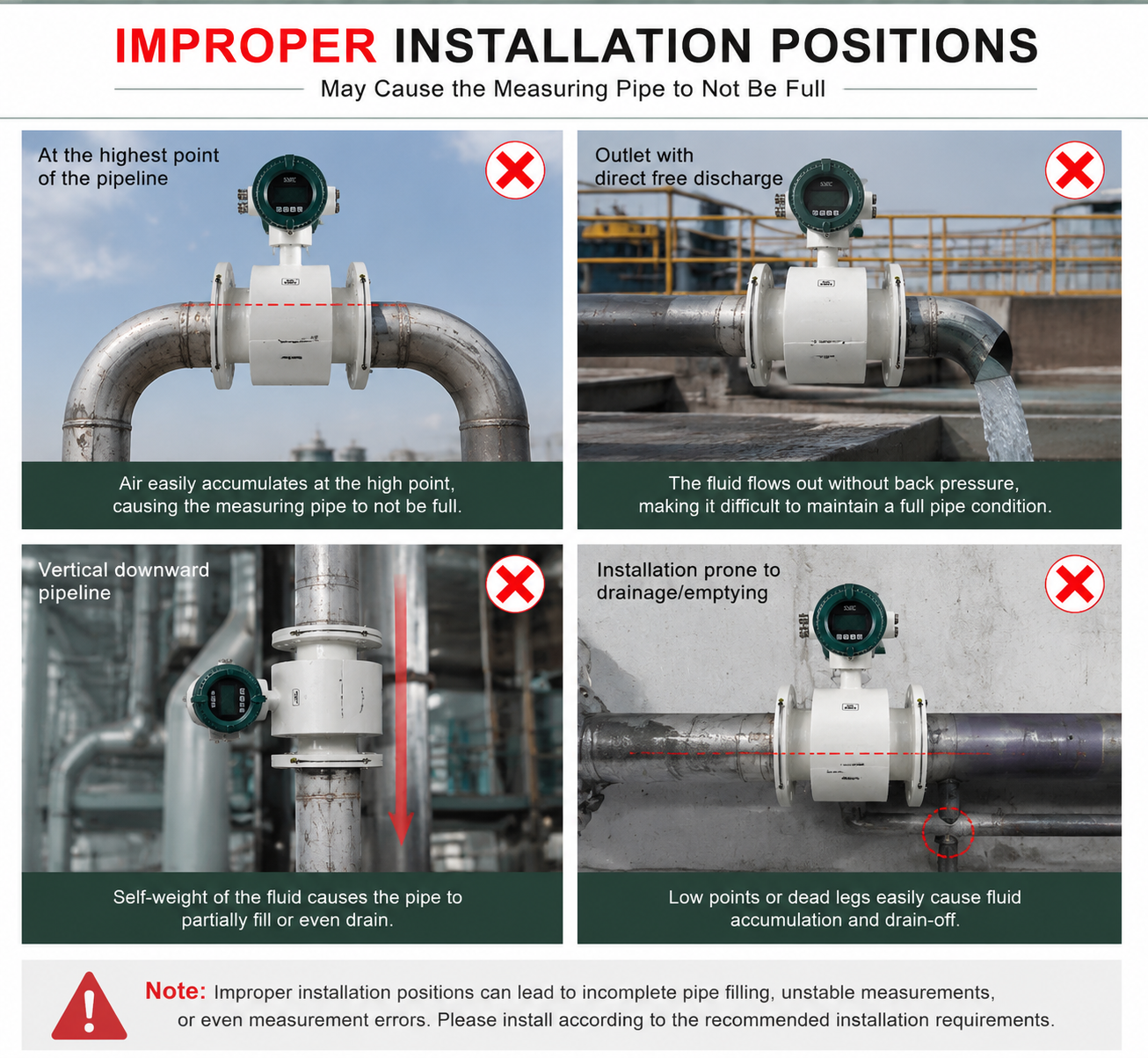
Electromagnetic flowmeters are designed to measure conductive liquids under full-pipe conditions. This is why self-diagnostic capability is built into instruments such as the SF-E Electromagnetic Flowmeter, which automatically detects empty pipes, excitation circuit breaks, and flow range overflows. In practical terms, this means the installation point should be located where the pipeline remains consistently full during normal operation—typically avoiding high points, open discharge ends, or sections where air pockets are likely to form. When an empty-pipe condition is unavoidable at certain times, the self-diagnosis function helps operators quickly identify the issue rather than misinterpret it as a measurement error.
Velocity conditions at the installation point also matter. The instrument’s technical specifications define a velocity measurement range of 0.1 to 10 m/s, and accuracy options of ±0.5%, ±0.3%, or ±0.2% are achieved when the flow at the sensor location falls within this operating window. Installers should therefore select a section of pipe where flow velocity remains within this range under normal operating conditions, rather than locations prone to extreme surges or near-stagnant flow.
For pipes that are lined or constructed of non-conductive materials, grounding is essential to eliminate interference. XinYa’s Slurry/Serous Electromagnetic Flowmeter integrates 1-2 grounding electrodes specifically to address this need, ensuring signal stability even in non-conductive or lined piping systems.
Matching Deployment Type to the Installation Site
Not every installation site has the same spatial or environmental characteristics, which is why product design offers flexibility in configuration. The SF-E Electromagnetic Flowmeter supports both Integral and Split Type deployment. Integral configurations are suited to accessible locations where the converter and sensor can be mounted together, while Split Type deployment allows the converter to be installed at a distance from the sensor—useful when the pipeline itself is located in a hard-to-reach, high-vibration, or high-temperature area, while the display and control electronics need to remain accessible to operators.
For very large pipelines, full-bore installation can be costly and disruptive. The SF-C Insertion Electromagnetic Flowmeter addresses this by connecting via a ball valve and mounting base, allowing installation without stopping flow in pipes up to DN3000. Its adjustable insertion depth—settable to half or one-quarter of the pipe diameter—gives engineers flexibility to optimize measurement based on the flow profile at that specific site, which is particularly valuable in large municipal or industrial pipelines where shutting down flow for installation is impractical.
Environmental Protection Ratings Determine Site Suitability
The physical environment surrounding the installation point—whether indoors, outdoors, buried, or submerged—must align with the instrument’s ingress protection rating. XinYa’s sensor units carry an IP68 rating, the highest level of dust and water ingress protection, allowing them to be buried or operated under up to 3 meters of water. This makes IP68-rated sensors, such as those used in the Battery-Powered/Wireless Remote Flowmeter, suitable for remote water monitoring stations, underground vaults, or submerged municipal infrastructure where access to power lines is limited or unavailable.
Converter units, by contrast, are rated IP65, IP66, or IP67, reflecting their typical placement in exposed but not fully submerged environments, such as outdoor equipment enclosures or panel-mounted control rooms. Selecting an installation site therefore requires matching the sensor and converter ratings to the actual exposure conditions—burial or submersion for the sensor, and weather-resistant but accessible placement for the converter.
Special Considerations for Abrasive and Particle-Laden Media
Installation sites handling liquids with high solid content—such as pulp, coal-water slurry, or mineral tailings—present unique challenges, including sensor lining wear and electrode signal interference from particle collisions. The Slurry/Serous Electromagnetic Flowmeter is engineered for these conditions with wear-resistant materials including Polyurethane and PFA, along with custom lining options such as Ceramics (DN15-150) and various rubbers, chosen according to the chemical corrosiveness and physical abrasion present at the installation site. To maintain signal stability despite particle friction, the instrument applies a variation restraint algorithm that filters out "cuspidal disturb" caused by solid-grain collisions with the electrodes—an installation-site-specific consideration that standard flowmeters are not designed to handle.
Sanitary Installation Requirements in Food and Pharmaceutical Settings
Installation sites within food, beverage, and pharmaceutical production lines carry additional regulatory and hygienic requirements. The SF-W Food Safety Electromagnetic Flowmeter is built with materials and construction that comply with food safety standards, specifically designed to prevent fluid stagnation and bacterial growth at the measurement point. This makes it appropriate for installation directly within hygienic processing lines where standard industrial meters would pose contamination risks.
Connecting Installation Location to Broader Monitoring Infrastructure
Beyond the physical mounting point, the installation site should also be evaluated for its connectivity to data infrastructure. XinYa’s instruments support communication via RS485, RS232, HART, GPRS, Bluetooth, and WiFi (STA/AP modes), and integrate with the Instrument IoT Big Data Platform for centralized device management. In one documented industrial deployment, this integration enabled real-time monitoring of flow trends across multiple nodes with a 5-second default data refresh rate and 60-point historical curve tracking. In remote water monitoring applications, battery-powered IP68 units installed in submerged environments maintained 120 months of historical cumulative records while enabling remote GPRS data access—demonstrating that installation planning should account for both the physical environment and the facility’s long-term data monitoring strategy.
Conclusion
Reliable electromagnetic flow measurement depends on aligning the installation site with the instrument’s physical, environmental, and communication requirements—full-pipe conductive flow conditions, appropriate velocity range, correct ingress protection matching, and, where applicable, wear-resistant or sanitary design. Kaifeng XinYa Instrument Co., Ltd. designs its product range—from the SF-E Electromagnetic Flowmeter to the Battery-Powered/Wireless Remote Flowmeter, Slurry/Serous Electromagnetic Flowmeter, SF-C Insertion Electromagnetic Flowmeter, and SF-W Food Safety Electromagnetic Flowmeter—around these site-specific variables, with custom quoting based on nominal diameter, material selection, and communication requirements. After-sales support, including 10-minute preheating guidance and troubleshooting for excitation and empty-pipe alarms, further ensures that once an installation site is selected, the instrument continues to deliver accurate, dependable measurement throughout its operational life.
https://www.sytcflowmeter.com/
Kaifeng Xinya Instrument Co., Ltd.