Published: October 2026 | By Ipowerfiber Engineering Team
At 18 gauge, 200D/60F is the denier that reaches ANSI A4. That is the short answer to what denier UHMWPE yarn is used for A4 cut resistant gloves, and it is the specification glove factories ask for most often. The complete answer carries four more numbers: the yarn must hold tenacity at or above roughly 32 cN/dtex, carry about 60 filaments, be knitted at a tuned stitch density, and sit on the hand without excess tension. Miss one of them and the same 200D cone can test A3 in the finished liner. This guide gives the full denier-to-grade matrix Ipowerfiber uses to quote custom 50D–400D glove yarn, the tenacity floor behind it, and the variables that quietly move a glove down a level.
1. What denier UHMWPE yarn is used for A4 cut resistant gloves at 18 gauge?
200D/60F is the working answer at 18 gauge. On the same machine, 250D/60F buys A5, while 150D/60F only reaches A4 once the liner drops to 21 gauge. The reason is geometric: at 18 needles per inch the loop size is fixed by the machine, so the denier decides how much fibre sits inside each loop, and cut force scales with fabric mass per unit area multiplied by fibre tenacity.
ANSI A4 sits at 1,500–2,199 grams-force under the TDM method (ASTM F2992 / ISO 13997), roughly EN 388 level D, which requires 15 N to cut through. One published yarn system — a modified, glass-free and steel-free UHMWPE glove yarn — lands on the grades below:
• 100D/60F at 21G → ANSI A3 — ultra-light precision liner
• 150D/60F at 21G → ANSI A4 — fine-gauge A4
• 200D/60F at 18G → ANSI A4 — the 18-gauge standard
• 250D/60F at 18G → ANSI A5 — high cut, still fine gauge
• 400D/120F at 15G → ANSI A5 — mainstream 15-gauge build
• 500D/120F at 13G → ANSI A6 — top of the single-yarn range
How to read a UHMWPE yarn denier to ANSI cut level conversion chart
Every UHMWPE yarn denier to ANSI cut level conversion chart is read by column, not by row: pick the gauge first, then read down to the grade. The 100D vs 200D UHMWPE yarn for 18 gauge glove knitting question is really a coverage question — 100D leaves too little fibre in each 18-gauge loop and usually lands at A3, while 200D fills the same loop and reaches A4. Finer is not automatically better; it is a fit between yarn diameter and loop geometry.
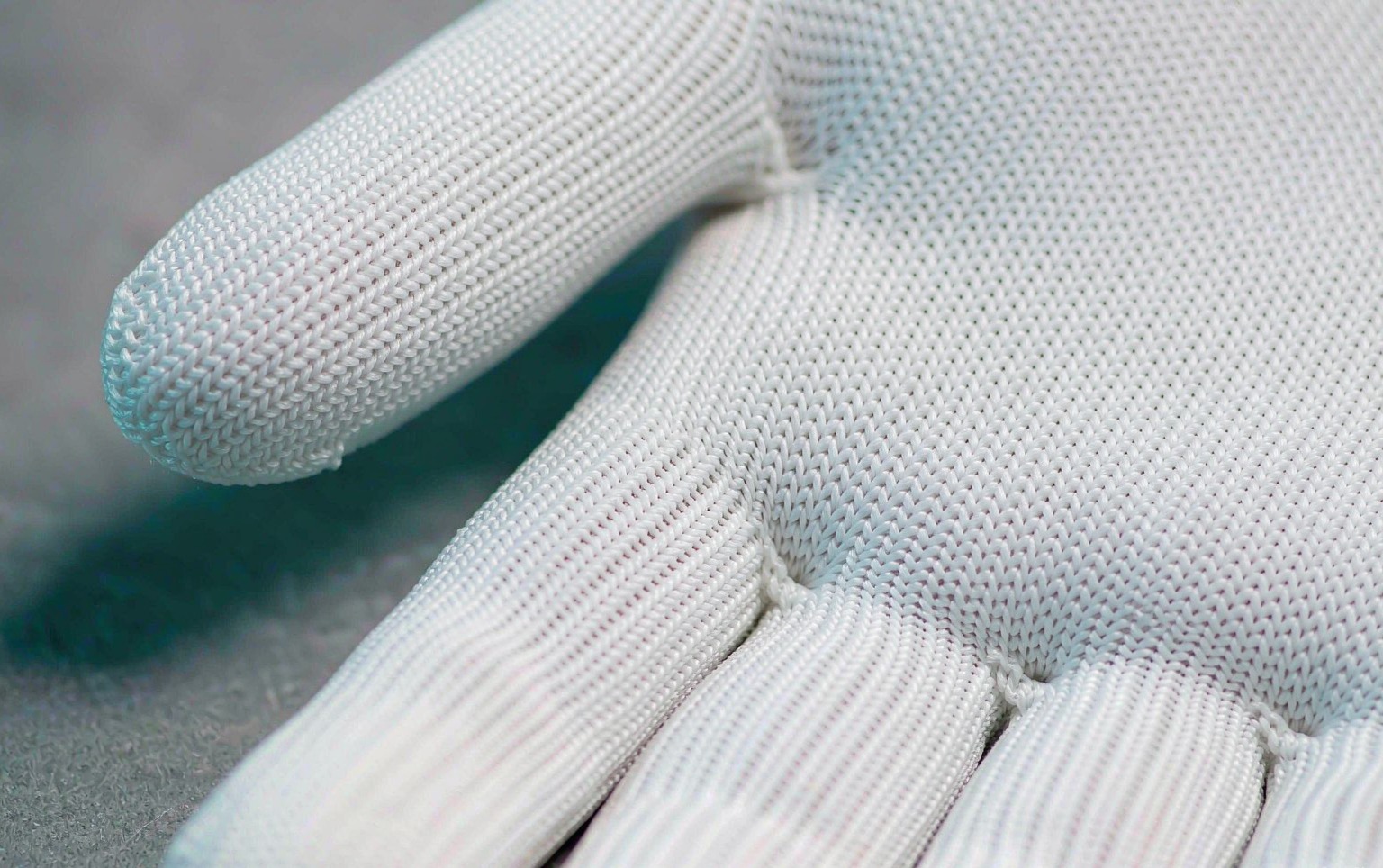
Density matters too. A 2026 study on knitted UHMWPE cut fabrics found cut resistance rises and falls non-linearly with stitch density, peaking near 384 loops per square inch on 13-gauge — the balance between yarn compactness and loop mobility. The optimum moves as gauge changes, so density must be tuned per machine, not maximised.
✅ Bottom line: At 18 gauge the A4 denier is 200D/60F; 250D/60F buys A5 on the same gauge, and finer yarns hold A4 only once gauge drops to 21G.
2. Can a 200D yarn still fail to reach A4 in an 18-gauge liner?
Yes, and it happens often enough that denier should be treated as the start of a specification, not the guarantee. Four variables sit between the cone and the grade.
Tenacity floor
Gel-spun UHMWPE loses specific strength as denier rises, because coarser filaments orient less perfectly during drawing. Industry parameter tables put the floor like this:
• 100D: qualified ≥32, excellent ≥34 cN/dtex, modulus ≥1,100
• 150D / 200D / 250D: qualified ≥30, excellent ≥32, modulus ≥1,000
• 400D / 500D: qualified ≥28, excellent ≥30, modulus ≥900
A 200D lot delivered at 28 cN/dtex instead of 32 gives the knit roughly 12% less fibre strength to spend, which is about half a grade in the finished liner. This is why Jiangsu Ipowerfiber Tech Co., Ltd. ships a batch tenacity certificate with every cone of its 50D–400D labour protection fibre series — the knitting floor can check the fibre before it reaches the machine.
Filament count
200D/60F and 200D/30F carry the same denier but different physics. More filaments mean softer hand, more even loop coverage and more fibre surfaces for a blade to deflect across; fewer, thicker filaments knit stiffer and cover less evenly. When buyers compare quotes, the F number deserves the same attention as the D number.
Pre-tension and fit
The same 2026 study measured a glass-reinforced UHMWPE fabric losing cut load from 32.4 N to 17.8 N — a 45% drop — as pre-tension rose from 0 to 40 N. A liner knitted or worn under high tension tests lower. Fit and knitting tension belong in the specification conversation, not just the yarn.
Construction around the fibre
Coatings add grip, not cut resistance. Plaiting, spandex content and gauge all change how the yarn sits in the loop. The same 100D vs 200D UHMWPE yarn for 18 gauge glove knitting comparison that decides A3 versus A4 can be undone by a dense, high-tension knit on the wrong machine. For buyers consolidating a glove programme, this is also where a single China factory direct yarn supplier earns its place: one 50D–400D series, one tenacity standard, custom twist and dope-dyed colour on the same base fibre, with OEM/ODM support from cone to certificate — see the full UHMWPE fibre range.
✅ Bottom line: Denier sets the ceiling; tenacity, filament count and knit tension decide whether the finished liner actually reaches it.
Frequently asked questions
Q: Is 400D UHMWPE yarn better than 200D for cut resistance?
A: Coarser, not better. 400D/120F is built for 15-gauge liners, where it reaches A5; forced onto an 18-gauge machine it produces a stiff, heavy liner. If you are weighing 100D vs 200D UHMWPE yarn for 18 gauge glove knitting, 200D is the correct answer — 400D belongs at 15 gauge.
Q: What denier UHMWPE yarn is used for A4 cut resistant gloves at 21 gauge?
A: 150D/60F is the published route to A4 at 21 gauge, with 100D typically holding A3 on the same machine. Check the target grade against a UHMWPE yarn denier to ANSI cut level conversion chart before committing, then confirm it on the finished liner, because gauge, density and coating all shift the result.
Q: Can one supplier cover 150D to 400D for an OEM glove programme?
A: Yes. Ipowerfiber runs 50D–400D as a dedicated labour protection series with custom twist, spin finish and dope-dyed colours, factory direct pricing and wholesale tiers from 100 kg MOQ, so a glove brand can hold one fibre standard across an entire liner range.
Next step
Send your target ANSI or EN 388 level, knitting gauge and coating plan to Ipowerfiber. You will get a denier recommendation matched to your liner brief, a sample cone for trial, and the batch tenacity data to file alongside your first finished-glove test report.
www.ipowerfiber.cn
Jiangsu Ipowerfiber Tech Co., Ltd.