A weld immune proximity sensor housing ptfe coating anti spatter design is judged by one number: how many weld cycles the face survives before spatter bridges it. One bridged face reads as a target, and the robot either skips a weld or faults the cell. Three levers have to work together — a low-surface-energy face, a geometry that sheds droplets before they anchor, and a body that still holds its thread after 50,000 cycles.
Published: November 2026 | By Baoheng Engineering Team
Two different failures get sold under the same name. Weld field immunity is electromagnetic: 8–20 kA of welding current builds a field that saturates the coil and produces a false signal. Spatter resistance is mechanical: molten steel at 1,400–1,600°C lands on the face and freezes. The sensor maker owns the first problem. The housing owns the second — and can quietly ruin the first, because a ferromagnetic front end distorts the coil field and moves the switching point.
1. How Do You Protect a Proximity Switch Housing From Weld Spatter and Slag?
The practical answer to how to protect proximity switch housing from weld spatter and slag is to make the face impossible to wet, then make it cheap to replace anyway. Wettability is the whole mechanism — no chemistry required.
• Surface energy decides whether a droplet sticks. PTFE sits at about 18 mN/m, the lowest of any solid. Bare stainless steel is roughly 40–45 mN/m. Steel cannot wet 18 mN/m, so a droplet contracts into a sphere and rolls off before it solidifies.
• Geometry decides where it anchors. Spatter hides in edges. A square step at the face, an exposed thread run-out or a 0.2 mm burr gives the droplet a grip, and once one droplet grips, the next lands on steel instead of PTFE. Weld-immune housings normally carry a 1.5 × 45° chamfer, a 1 mm minimum face radius, and thread set back at least 3 mm from the front face. The face is either recessed 0.3–0.5 mm inside a lip or slightly convex, so slag cannot pool on it.
• Retention decides whether it lasts. A sintered PTFE coating is 20–50 µm and needs a primer on brass; it costs little, adds no height, and wears through in months on a high-cycle cell. A PTFE insert of 0.5–2.0 mm survives years, but only if it is mechanically held. PTFE cold-flows above roughly 10 MPa, and its thermal expansion of 12–13 × 10-5/K is lower than brass at 19 × 10-5/K — a warm brass pocket grows away from the insert. Press fit alone is not retention. Use a rolled lip or threaded retainer, machined in the same turning operation as the pocket so the two stay concentric.
A weld immune proximity sensor housing ptfe coating anti spatter design that gets all three right stops being a consumable line item. Get one wrong and the cell tells you within a shift.
Either option costs sensing distance. The face stack adds 0.5–2.0 mm between coil and target, and weld-immune parts typically lose 20–40% of rated range against the standard version. An M12 that switches at 4 mm may switch at 2.5 mm. Specify a longer barrel around that number instead of moving the sensor closer, which only raises heat and spatter load.
Maintenance decides the rest. Brass wire brush and IPA — never steel wool, because steel fibres embed in the face and become a permanent false target. Never scrape PTFE with a blade: a gouge is a spatter anchor for the remaining life of the part.
✅ Bottom line: A PTFE face releases spatter only when it is mechanically retained behind a chamfered lip; an unbonded coating on a loose pocket fails within weeks.
2. Which Materials Survive Resistance Welding Cells?
Selecting weld field immune sensor housing materials for resistance welding cells comes down to three candidates: 303 stainless, 316L stainless and nickel-plated brass. None of them wins on every cell.
• 303 stainless (1.4305) — 0.24–0.33% sulfur for chip breaking, roughly twice the machinability of 304. Correct for dry cells at volume. The sulfur inclusions are the weakness: they pit under coolant mist and give no corrosion barrier.
• 316L (1.4404) — molybdenum-stabilised, the only sensible choice where coolant mist, wash-down or phosphate baths are present. It machines 30–40% slower and costs more per part, but it is also non-magnetic, which matters more here than corrosion resistance.
• Nickel-plated brass, typically CuZn39Pb3 — fastest to turn, best thread quality, needs 3–10 µm of nickel. Plating on the thread is a wear item: after repeated installation the crest wears through and bare brass meets coolant.
With weld field immune sensor housing materials for resistance welding cells, the decision is usually driven by coolant exposure rather than by welding current — a dry robotic cell and a wet press line can share the same sensor and need different bodies.
Keep the front 10 mm non-magnetic. A 430 or mild steel nose near the coil shifts the switching point and shrinks a range that is already reduced. If a drawing calls for a steel body, the face end should still be brass or 316. In Baoheng's incoming drawings, the front-end material call-out is the item most often missing — and the one that causes the most field returns.
Galvanic pairs are the quiet killer. A stainless housing threaded into an aluminium fixture, wet with coolant, corrodes at the thread within a season. Anti-seize or a nylon isolating insert costs cents and prevents a seized sensor that has to be drilled out. Seals follow temperature: weld guns hold housings at 60–90°C continuously, so FKM rated to 200°C is correct and NBR at 100°C is marginal.
What belongs on the drawing: thread M12 × 1 6g, PTFE insert 1.0 mm retained by rolled lip, chamfer 1.5 × 45°, nickel 5–8 µm, IP67 to IEC 60529, non-magnetic front end, ±0.02 mm on the face stack. Wenzhou Dongtou Baoheng Electrical Machinery Manufacturing Co., Ltd. turns the pocket and the retention lip in one setup, which is what keeps that tolerance stack closed.
✅ Bottom line: Choose 316L for coolant and nickel-plated brass for volume, but keep the front end non-magnetic — a steel nose silently changes the switching distance.
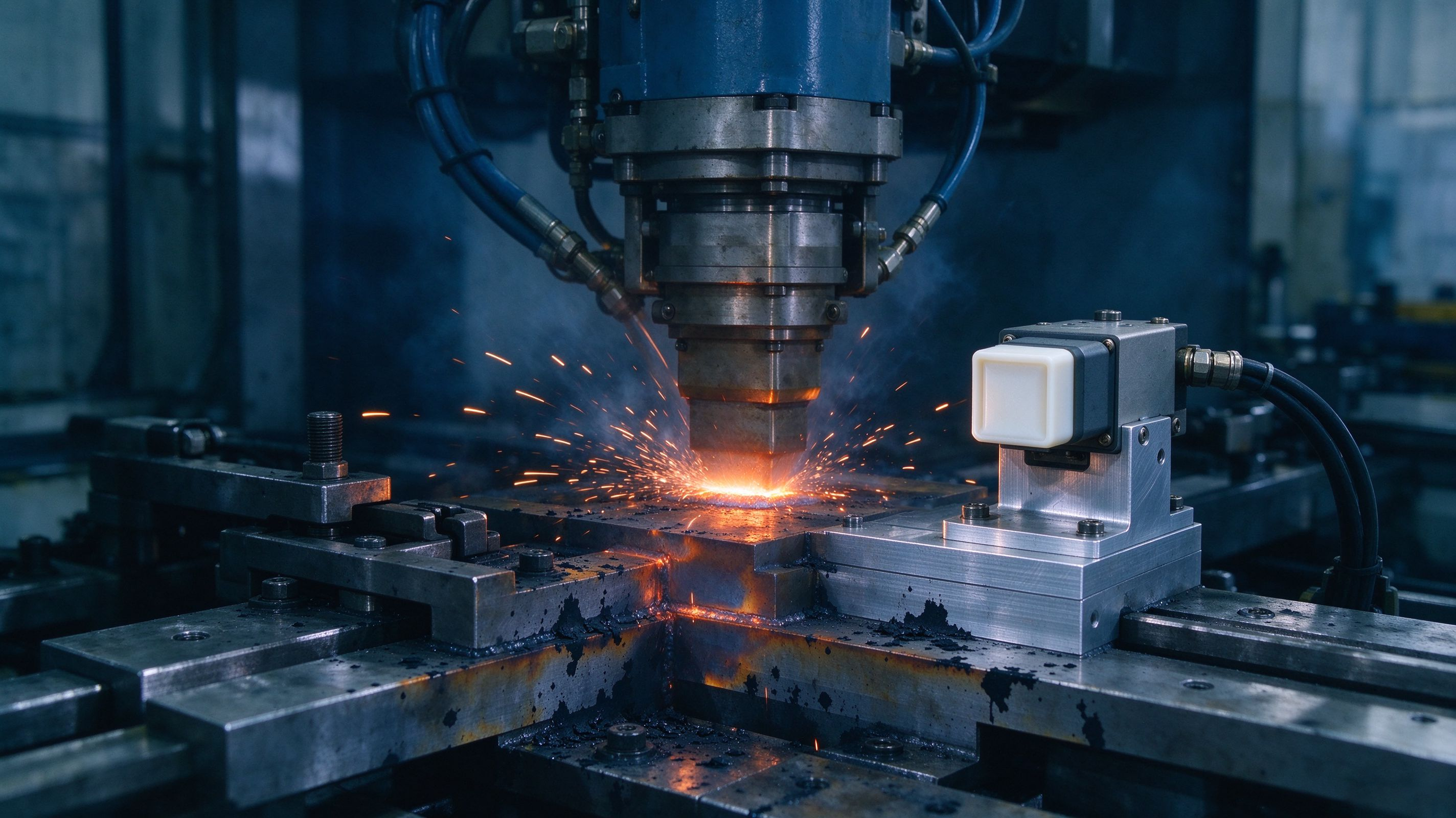
Ordering a two-piece version — housing plus replaceable PTFE cap — changes the maintenance maths on a high-cycle line: the sensor and the cable stay in place, and the cap is swapped during a scheduled stop. The full range is listed under proximity switch housings, including the weld-immune proximity sensor housing shown here.
Frequently Asked Questions
Q: Does a PTFE face reduce the sensor's sensing distance?
A: A 20–50 µm coating is negligible. A 1 mm insert plus its retaining lip costs 20–40% of rated range — the trade every weld immune proximity sensor housing ptfe coating anti spatter design makes. That is why barrel length is specified around the reduced figure rather than compensated for by pushing the sensor nearer the weld.
Q: Can a spattered face be repaired in the cell?
A: No. Polishing removes the release layer and the next droplet sticks harder. This is where how to protect proximity switch housing from weld spatter and slag is usually decided too late — in the maintenance budget instead of at the drawing stage. A two-piece housing with a replaceable cap is the only field-serviceable option; otherwise the housing is replaced and the sensor is kept.
Q: Can you machine custom weld-immune housings from our drawing?
A: Yes — Baoheng works as an OEM/ODM supplier from drawing, physical sample or confirmed purchase specification, and reviews dimensions, material, face stack and surface requirements before quoting. Because the PTFE pocket is turned rather than moulded, trial batches of a few hundred pieces are practical and the same programme scales into production volumes.
Next Step
Send a drawing or a failed part. Baoheng returns a DFM review covering face geometry, retention method and material substitution within two working days, together with a factory-direct quote and the inspection plan behind it. For cells already running, a sample housing can be tested against your existing sensor to confirm the real switching distance before you commit to a batch. Wenzhou Dongtou Baoheng Electrical Machinery Manufacturing Co., Ltd. has machined proximity sensor components in Dongtou, Wenzhou since 2008 and supplies custom, OEM and wholesale volumes to automation, hydraulic cylinder and construction machinery builders.
www.bohontech.com
Wenzhou Dongtou Baoheng Electrical Appliance & Machinery Manufacturing Co., Ltd.