Why Connectivity Matters for Point-of-Care Immunoassay Testing
Point-of-care diagnostics are only as useful as the data they generate. A quantitative result delivered at a bedside or in a mobile clinic has limited value if it cannot be reliably recorded, reviewed, or shared. This is the practical question behind the keyword driving this article: how does the VivaDiag Portable FIA Analyzer VIM300H, manufactured by VivaChek Biotech (Hangzhou) Co., Ltd., handle Wi-Fi and Bluetooth connectivity, and what does that mean for clinical laboratory professionals evaluating a fluorescence immunoassay (FIA) platform for use outside the central laboratory?
This guide walks through the connectivity architecture of the VIM300H, situates it within the broader VivaDiag FIA analyzer family, and explains why these design choices matter for professional users working in general practice, emergency care, and other decentralized testing environments.
Understanding the VIM300H Connectivity Options
According to VivaChek’s published technical specifications, the VIM300H supports three connection pathways: USB, Wi-Fi, and Bluetooth (optional). Each serves a distinct operational purpose rather than functioning as redundant alternatives to one another.
USB connectivity provides a direct, wired link for data transfer, firmware interaction, or charging via the included Type C and USB 2-in-1 cable that ships with the analyzer. Wired connections remain valuable in settings where network infrastructure is inconsistent or where a laboratory information system requires a stable, cable-based interface.
Wi-Fi connectivity allows the VIM300H to transmit results without a physical tether, which is particularly relevant given the device’s compact 146 x 77.6 x 55.5 mm footprint and 370 g weight. A handheld analyzer designed for ambulances, mobile medical units, and bedside use benefits from wireless data transmission because it preserves the mobility that the hardware form factor was built to deliver.
Bluetooth connectivity, listed as an optional feature, is primarily associated with the analyzer’s printing function. VivaChek’s product documentation notes that an external Bluetooth printer is available as an optional accessory, meaning Bluetooth serves as the pairing mechanism between the VIM300H and a portable printing unit rather than as a general-purpose data channel. This distinction is useful for professionals planning workflows: Wi-Fi handles network-based data movement, while Bluetooth supports on-the-spot result printing when a hard copy is required.
How Connectivity Fits Into the Testing Workflow
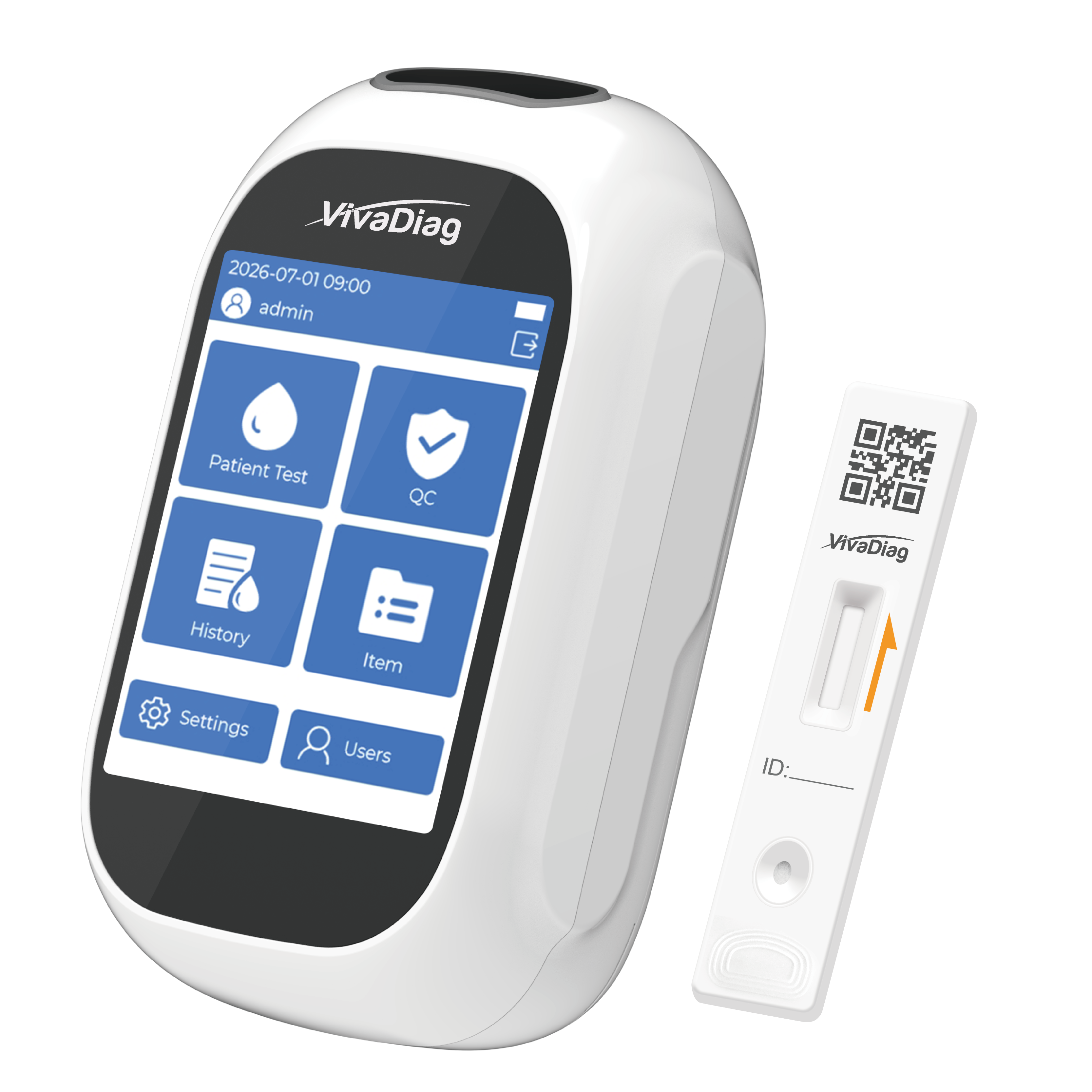
The VIM300H is built around a 3.97-inch color touch screen and an ID Card coding system that calibrates the analyzer to each specific VivaDiag FIA Test Kit parameter. Once a test is run and a quantitative result is generated, connectivity determines what happens next.
With a 10,000-result memory capacity, the VIM300H can store a substantial volume of test history onboard before any transfer is needed. This matters in practice because it means Wi-Fi or USB connectivity is not strictly required at the moment of testing; a clinician in a mobile unit or rural clinic can record results locally and synchronize or export them later when a network connection becomes available. For facilities running continuous shifts, this combination of ample memory and flexible connectivity reduces the operational risk of losing data due to intermittent connectivity.
Why This Matters for Professional Users
VivaChek positions the VIM300H for use across a wide range of settings, including GP clinics and surgeries, community health centers, township and rural clinics, walk-in care facilities, ambulances and paramedic units, mobile medical units, emergency department triage, and urgent care centers. Each of these environments has different infrastructure realities, and a single rigid connectivity standard would not serve all of them equally well.
A rural or township clinic, for example, may have limited or unreliable network access, making USB connectivity or offline storage within the 10,000-result memory a practical necessity. An ambulance or mobile medical unit, by contrast, may prioritize Wi-Fi for near-real-time data transmission back to a receiving facility, supported by the analyzer’s 370 g portable design and up to 10-hour battery runtime from its removable, rechargeable lithium battery. A walk-in care facility or retail pharmacy testing service might rely on the optional Bluetooth printer pairing to provide patients with an immediate printed result.
This flexibility is consistent with VivaChek’s broader strategic positioning: the company describes itself as a provider of IVDR-certified point-of-care fluorescence immunoassay diagnostics that pairs a portable analyzer with quantitative test kits to support clinical decision-making outside the central laboratory. Connectivity options that adapt to varied field conditions are a direct extension of that positioning, rather than an incidental feature.
Comparing the VIM300H to Prior-Generation Analyzers
Understanding the VIM300H’s connectivity is clearer when viewed alongside VivaChek’s earlier analyzer models. The prior VIM3000, a 1.8 kg analyzer with a 7-inch color touch screen and built-in thermal printer, supports Ethernet (RJ-45), USB, and Wi-Fi connectivity, with its built-in printer eliminating the need for an external accessory. The VIM3000 was designed for laboratory and fixed-location settings requiring wired network integration.
The earlier VIM220H, a compact 165 g analyzer with a 1.54-inch LCD display, offers a narrower connectivity set limited to an optional Bluetooth printer, without Wi-Fi support. Its design emphasizes maximum portability over connectivity breadth.
Placed alongside these two prior models, the VIM300H occupies a middle position in VivaChek’s analyzer lineup: it retains the ultra-portable, handheld profile closer to the VIM220H’s lightweight design philosophy while adding Wi-Fi connectivity that the VIM220H lacks, and it provides a connectivity set that supports professional point-of-care workflows without the fixed-location footprint of the VIM3000.
What Clinical Laboratory Professionals Should Know
The VIM300H is intended for use by clinical laboratory professionals and is not designed for self-testing or near-patient testing by untrained users. Within that professional-use context, the device’s Wi-Fi and Bluetooth (optional) connectivity, combined with USB access, give facilities a choice in how they manage data capture, storage, and reporting based on their specific infrastructure and workflow needs.
Paired with VivaDiag FIA Test Kits such as the VivaDiag Prostate Specific Antigen (PSA) Test Kit (FIA), which delivers quantitative results in 15 minutes from a 20 μL sample, the VIM300H’s connectivity options support the broader goal of extending laboratory-quality immunoassay testing into primary care, emergency, and field settings. The analyzer carries CE Marking under Notified Body Identification Number 0344 (DEKRA) and is IVDR-certified for professional use, reflecting compliance with Regulation (EU) 2017/746 on In Vitro Diagnostic Devices.
For organizations evaluating portable FIA analyzers, the VIM300H’s combination of USB, Wi-Fi, and optional Bluetooth connectivity—supported by a 10,000-result onboard memory and a test menu spanning 39 venous-blood parameters and more than 20 capillary-blood-ready parameters—represents a connectivity architecture built specifically around the practical demands of decentralized, professional-use diagnostic testing.
https://www.vivachek.com/
Hangzhou Weice Biotech Co., Ltd.