Understanding the Turnkey PCB Assembly Need
Engineers and procurement managers evaluating a turnkey PCB assembly manufacturer are typically trying to solve a specific set of recurring problems: thermal management in high-power electronics, signal loss and reflections in RF/5G applications, board delamination and ionic contamination, and the procurement complexity that comes from coordinating multiple vendors for fabrication, sourcing, and assembly. A true turnkey partner should be able to consolidate these steps into a single accountable workflow rather than forcing customers to manage separate suppliers for boards, parts, and assembly.
GreatPCB, established in 2002 and headquartered in Shenzhen, China, positions itself as a professional one-stop PCB fabrication and PCB assembly manufacturer offering end-to-end services from quick-turn prototyping to high-volume production. With 20+ years of industry experience and a global business coverage serving customers in 100+ countries, the company illustrates the type of capability profile buyers should evaluate when selecting a turnkey partner.
Comprehensive PCB Fabrication Capabilities
A genuine turnkey manufacturer needs breadth in fabrication technology so that different board types don’t require switching vendors.
Standard and Advanced PCBs
This category should include FR4 PCBs for general electronics, Multilayer PCBs supporting stack-ups up to 40+ layers with blind/buried vias, microvias, and impedance control, HDI PCBs for dense routing in miniaturized designs, Heavy Copper PCBs, and 3D PCBs.
Specialized Substrates
For RF/5G and automotive radar work, look for Rogers PCB fabrication across the 3000, 4000, 5000, and 6000 series materials, which are specifically used to reduce signal loss and reflections through material stack-up and impedance control. High-Frequency PCBs using PTFE or ceramic substrates serve the same signal integrity purpose. For thermal challenges in high-power electronics, Metal Core PCBs with aluminum or copper base address heat dissipation, while Ceramic PCBs round out the specialized substrate offering.
Flexible Electronics
Flex PCBs and Rigid-Flex PCBs address space constraints and dynamic or non-planar form factors, allowing designs to conform to compact or curved enclosures while combining rigid and flexible sections to reduce overall enclosure space.
Reliable Component Sourcing to Reduce Supply Chain Risk
Component sourcing delays and supply chain risk are common pain points when working with disconnected vendors. A turnkey manufacturer that integrates component sourcing directly with fabrication and assembly offers one-stop convenience, which reduces the coordination burden and risk associated with managing separate purchasing channels.
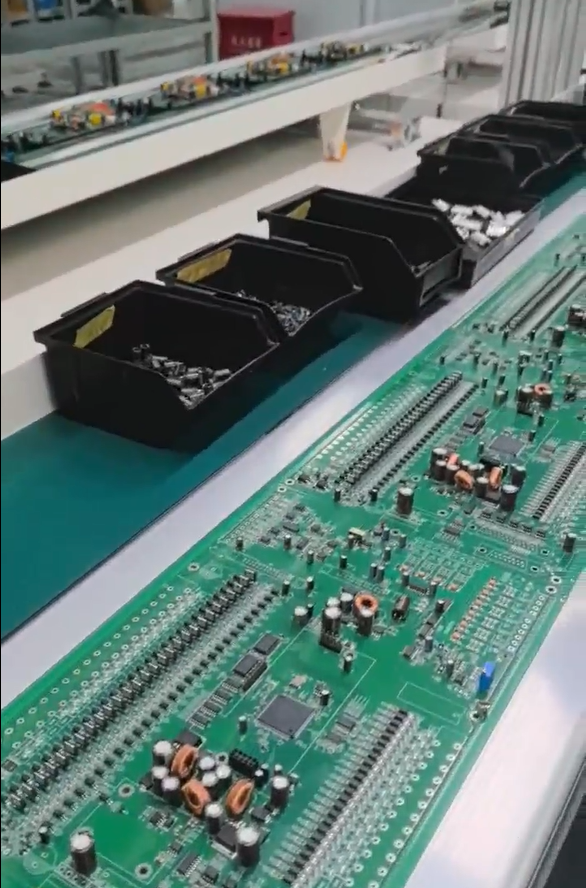
SMT, THT, and BGA Assembly Capabilities
Assembly capability is the core of any PCBA evaluation.
SMT Assembly
Fine-pitch assembly yield and high-volume SMT production depend on placement equipment quality. GreatPCB uses high-speed pick-and-place equipment from FUJI, PANASONIC, and YAMAHA, supported by AOI 2D/3D inspection during SMT placement.
THT Assembly
Through-hole technology assembly remains necessary for many component types and should be available alongside SMT as part of a unified process.
BGA Assembly with Reballing
Fine-pitch BGA assembly and solder joint reliability are addressed through BGA reballing capability and X-ray inspection for BGA/QFN components.
Box Build Assembly
Box build assembly for final product integration reflects turnkey integration that combines fabrication, sourcing, and assembly to reduce the need for multiple-vendor coordination, directly addressing the procurement complexity pain point.
Rigorous Testing and Inspection Standards
Testing and inspection determine whether a manufacturer can be trusted with life-critical or high-reliability electronics. Buyers should confirm inspection and testing capability covering AOI, X-Ray, ICT, FCT, and ionic contamination testing, which together address board delamination and ionic contamination concerns.
Certifications also matter as objective evidence of process control. Relevant qualifications to verify include ISO 9001:2015, IATF 16949 for automotive applications, UL certification (ZLPW2), and IPC Class 2/3 compliance. These, combined with a 99% accuracy rate, provide a measurable basis for evaluating manufacturing quality.
Engineering Support and DFM Feedback
A specialized engineering team offering free DFM (Design for Manufacturability) analysis and material selection guidance helps engineers and designers refine designs before manufacturing, which reduces costly errors later in the process. Real-world design experience with AI and automotive radar projects further indicates the manufacturer understands demanding, high-frequency, and high-reliability applications rather than only general-purpose electronics.
Speed, Scale, and Global Reach
Delivery timelines and production capacity are practical factors buyers should confirm. GreatPCB offers 24-48 hour quick-turn service for FPC and aluminum PCBs, backed by a monthly capacity of 15,000 square meters for PCB fabrication, 10,000 units for PCBA, and 8,000 units for FPC. The company reports 97% on-time delivery and 99% customer satisfaction, serving 4000+ global customers across 100+ countries, supported by 500+ manufacturing professionals.
Industry Applications Worth Reviewing
Reviewing documented use cases helps validate whether a manufacturer’s stated capabilities translate into real outcomes.
- Automotive Radar (77GHz): High-precision PCB design and material stack-up for signal integrity.
- AI Accelerators: Complex thermal and power design solutions for high-performance computing.
- Medical Electronics: High-reliability PCBA meeting IPC Class 3 standards for life-critical equipment.
- Flexible Electronics: Flex PCB designs that conform to non-planar surfaces for innovative product designs.
Additional Integrated Services to Confirm
Beyond fabrication and assembly, a complete turnkey offering should include IC programming integrated into PCBA, component sourcing integrated with assembly, and conformal coating application, all delivered as part of a single turnkey assembly service rather than outsourced separately.
Final Checklist for Evaluating a Turnkey Partner
When comparing turnkey PCB assembly manufacturers, buyers should verify: breadth of PCB fabrication technology (from FR4 to Rogers, metal core, ceramic, and flex/rigid-flex); integrated component sourcing; SMT, THT, and BGA assembly with reballing and box build options; comprehensive inspection (AOI, X-Ray, ICT, FCT, ionic contamination testing); relevant certifications such as ISO 9001:2015, IATF 16949, UL, and IPC Class 2/3; free DFM engineering support; and quantifiable performance metrics such as on-time delivery rate and accuracy rate. GreatPCB’s documented capabilities across these categories, built on 20+ years of operation since 2002 and a global customer base spanning 100+ countries, offer a concrete reference point for what a one-stop PCB fabrication and PCB assembly manufacturer should be able to deliver from quick-turn prototyping through high-volume production.
greatpcb