A juice line is bought on a rated capacity figure and paid for on an actual one. Between those two numbers sits a commissioning period in which four variables — filling temperature, invert time, fill-volume calibration and cooling — are set against each other until the line holds a repeatable result. Producers in Africa evaluating a turnkey juice hot filling line tend to spend their diligence on the machine specification and very little on that period, which is exactly where the gap between a line that reaches its rating and one that never does gets decided.
Why a Hot Filling Line Is Commissioned, Not Just Installed
Installation and commissioning are different jobs, and the difference is not administrative. Installation puts the equipment in place and connects it: the filler is level, the conveyors run, the services are live, bottles move from one end to the other. At the end of installation the line works. At the end of commissioning the line repeats.
Repeating means the same bottle comes off the line on the second shift of the third week as on the first afternoon, with a different batch of fruit, a different ambient temperature and a different operator. That does not happen because a machine was installed correctly. It happens because a specific set of parameters was established, tested against the producer’s own product, and written down.
Those parameters cannot be copied from another plant. They depend on the product — its acidity, its solids and pulp content, its viscosity — on the container and its wall thickness, on the headspace left in the bottle, on the temperature of the incoming process water, and on the ambient conditions in the hall. Two plants running identical equipment on different recipes will run different numbers, and correctly so. A supplier who hands over a machine together with a sheet of default values has installed it and has not commissioned it.
For a buyer, this reframes what to ask about. The question is not only whether commissioning is included in the turnkey project scope — most scopes say it is — but what the outcome of commissioning is required to be. A line is commissioned when there is a written parameter set for each product, a record of the measurements taken to establish it, and an operator who can tell when a value has moved.
Settling the Temperature Curve
Hot filling is often described as a single temperature, which is the source of most of the confusion around it. In practice three temperatures have to be settled together, and a line is only stable when all three are consistent with each other.
1. The filling temperature at the valve. This is the temperature the product is actually at when it enters the bottle. It is set by the producer’s own thermal process — the microbiological target the product has been validated against — and not by the machine supplier. The machine can hold a temperature accurately; it cannot decide what that temperature should be for a given juice and a given shelf-life claim.
2. The centre temperature of the filled, sealed bottle. Measured after the cap is on and through the invert section. This is the number that determines whether the cap and the headspace have actually received the heat the process assumes they have. A filling temperature that reads correctly at the valve can still deliver a lower centre temperature if the fill is slow, the bottle is cold, or the transfer is long.
3. The exit temperature at the cooling tunnel. This one is often treated as a packaging concern rather than a process one, which is a mistake. It determines whether the bottle can be labeled, coded and palletized without deformation, and whether condensation becomes a problem in the warehouse. It is also the number most likely to move during a shift, because it follows the temperature of the cooling water rather than the setting on a screen.
The three are linked by trade-offs rather than by a single optimum. Raising the filling temperature allows a shorter invert run but stresses the container harder and holds the product at heat for longer, which costs flavour. Lowering it reduces the cooling load but may leave the process short of the shelf life the label claims. The cooling rate is a fourth variable with its own constraints: cooling too fast drops the pressure inside a sealed bottle and can deform it, while cooling too slowly keeps the product hot beyond what the process intends. None of these values should be taken from another plant or from a supplier’s default sheet.
Invert Time and Line Speed: The Constraint Buyers Miss
The inversion step exists so that hot liquid contacts the inside of the cap and the headspace, sterilizing the surfaces the fill itself does not reach. The bottle has to stay inverted for a minimum period, and that minimum comes from the product’s process validation. It is not a preference and it is not adjustable to suit a production target.
The length of the invert section is then fixed by two numbers multiplied together: the dwell time the process requires, and the speed at which bottles travel. Hold the dwell time constant — the process requires it — and increase the speed, and the section has to become longer. There is no configuration in which a hotter fill or a cleverer machine removes that arithmetic.
This is why capacity on a hot-fill line is paid for in floor length, not only in machine cost. A line rated across a band such as 6,000–8,000 BPH is not one machine with a dial on it; the higher figure is reached with a longer invert run and a cooling tunnel sized to match. Buyers who compare hot-fill lines on the capacity number alone are comparing two different amounts of factory.
The practical consequence appears at layout stage, not at commissioning. If the building is already standing and its usable length is fixed, the achievable capacity is bounded by that length before a single machine is specified. Lengthening an invert run inside an existing hall later is the expensive version of the same decision, and in some buildings it is simply not available. It is also why the promise that a line can always be run faster later is rarely true on hot fill: the filler may have headroom, but the run behind it does not.
What Drifts During Commissioning
A line that has been commissioned is not a line that has stopped changing. Four things move, and they move for reasons that are entirely normal. What separates a good handover from a poor one is whether the movement is measured and written down, or discovered by the customer three months after the engineers have left.
Filling temperature, because the product coming in is not constant. Incoming juice temperature varies between batches and between seasons. If the buffer ahead of the filler is not held at a controlled temperature, the temperature at the valve follows the product rather than the setpoint, and the process quietly changes without anyone touching a screen. The parameter that was signed off is not the parameter that is running.
Fill volume, because calibration has a temperature. A hot liquid occupies more volume than the same mass cold. A line calibrated at ambient temperature will under-fill when it runs at filling temperature, and the error scales with how far apart those two temperatures are. Fill volume has to be calibrated at the temperature the line actually runs at, and re-checked whenever the product or the target temperature changes. This is among the most common causes of fill-weight complaints on hot-fill lines, and it is invisible on a specification sheet.
Cooling water temperature, because it climbs through the shift. As the tower or chiller works harder, the water going into the spray tunnel warms, and the exit bottle temperature follows it. Nothing on the line has failed. The labeling and coding stations downstream are simply the first place the drift becomes visible, usually as placement errors or condensation in the case.
Capping torque, because the bottle finish changes with temperature. A torque set on a cold bottle and applied to a hot one is not the same torque. Seal-integrity complaints on hot-fill lines are often traceable to a torque set at the wrong temperature rather than to a faulty cap or a worn head. Once the fill temperature is fixed, the torque setting has to be re-established at that temperature, not before it.
Line Configuration at a Glance
| Machine configuration | 3-in-1 rinse-fill-cap, rotary |
| Application | Juice, fruit tea, pulp drinks |
| Capacity | Per model; high-speed models up to 24,000 BPH |
| Hot-fill interface | Hot-fill valve blocks |
| Sterilization step | Invert-bottle sterilizer (supporting equipment) |
| Cooling | Spray cooling tunnel (supporting equipment) |
| Liquid contact material | 316L stainless steel |
The table describes the equipment. It does not describe a process, which is the point of the three sections above it: the same configuration can run a stable line or an unstable one depending on the numbers set into it.
A 2025 Juice Hot Filling Line in Africa
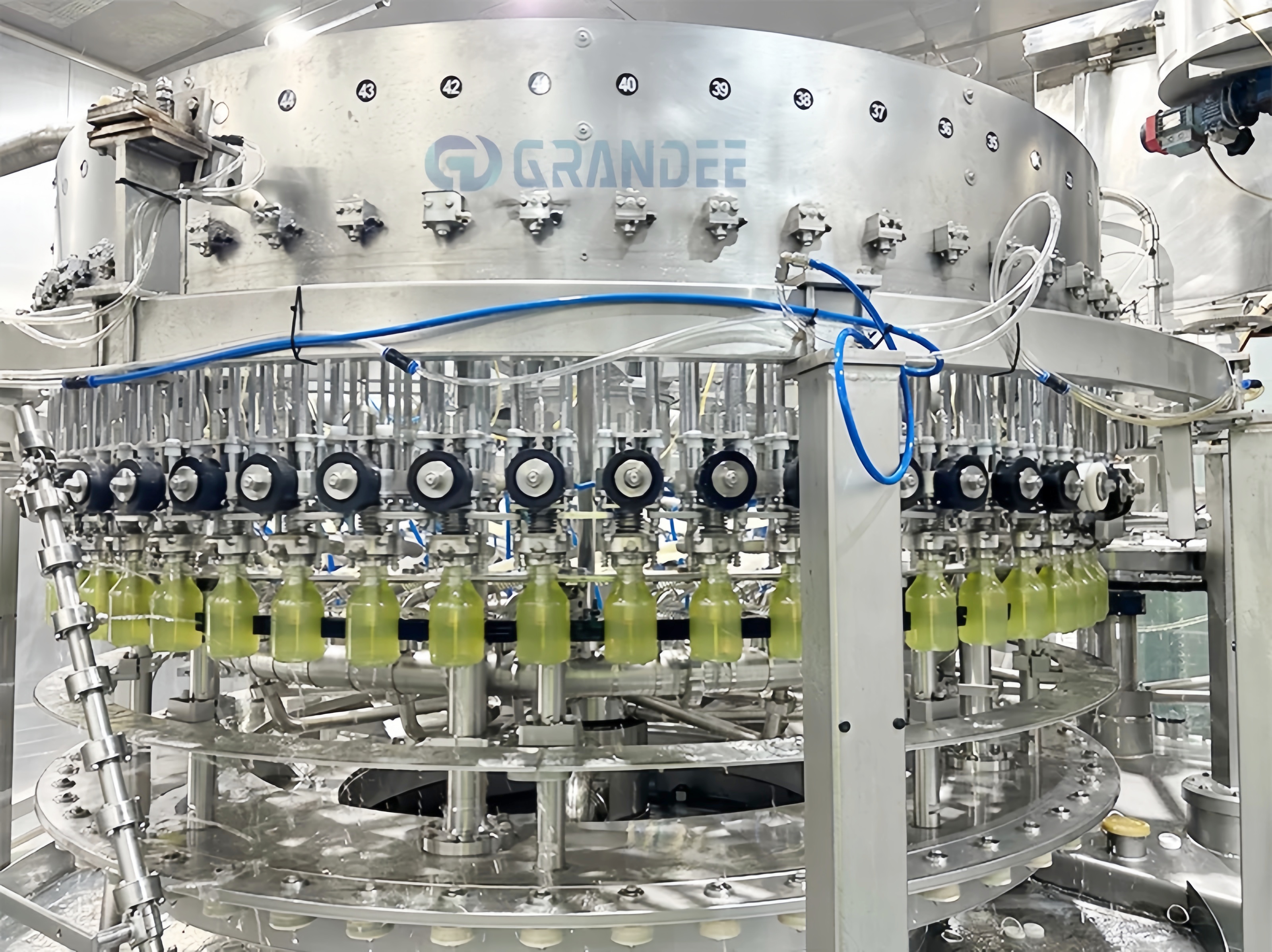
Zhangjiagang Grandee Machinery Co., Ltd., operating under the brand Grandee Machine, delivered a juice hot filling line in 2025 to a juice production operation in Africa. The project used the 3-in-1 rinse-fill-cap configuration and included hot-fill valve blocks, an invert-bottle sterilizer and a spray cooling tunnel, rated at 6,000–8,000 BPH.
That is the whole of the published record, and it is worth being explicit about what it does not contain. It does not state the customer’s product or recipe, the parameter set the line runs at, the measured centre temperature, or any acceptance figure from the commissioning period. None of those are published, and nothing in the sections above should be read as a description of that particular site’s settings — those are general requirements that apply to any hot-fill line, not observations from one project.
The project confirms that this configuration has been delivered and put into production in the region. It does not replace a reference call. Both directions of overstatement cause trouble here: a configuration claim with no delivered project behind it is a brochure, and a delivered project described as more than the record supports becomes a liability the moment a buyer asks to speak to the plant.
What the Turnkey Project Scope Covers, and Where It Stops
A turnkey project scope around a juice line covers bottle design, factory layout and paperless 3D factory design, equipment supply, installation, commissioning and operator training, with automatic CIP provided as a standard line capability and labeling, shrink wrap and carton packing available for the packaging end. One contract and one accountable partner replace the coordination of separate vendors for the filler, the sterilizer, the cooling tunnel and the packaging machines.
The scope covers process equipment and line engineering. It does not include civil works, building construction, or utility connections to the plant boundary — power supply, water supply and compressed air.
The boundary is worth stating plainly because of what the sections above established: a hot-fill line needs a hall of a particular length before it needs a filler, and the length is decided by the invert run. If a buyer assumes the building is part of the supply, the first schedule slip lands on the supplier and the first unplanned cost lands on the buyer, with both sides holding a different reading of the same contract. A supplier who states where the scope stops is easier to hold to the part they do own.
Behind the delivery sits more than 20 years of export experience and a production workshop exceeding 20,000 square metres, with markets concentrated in Europe, South America, Africa, Southeast Asia and Central Asia. For a producer in one of those regions, that matters less as a credential than as a practical point: commissioning a hot-fill line requires engineers on site for an extended period, and the distance between the workshop and the plant is a real variable in how that period goes.
Questions Worth Asking Before Signing a Juice Line
How long is the invert section at my target capacity, in metres? Ask for the length, not the capacity. If a supplier cannot answer this from your building’s dimensions, the layout has not been engineered yet, and the capacity figure is a rating rather than a plan.
At what temperature will fill volume be calibrated, and who signs it off? The answer should be the temperature the line actually runs at, verified against weighed samples, and signed by both parties during commissioning rather than accepted from a default sheet.
What is the exit bottle temperature at the cooling tunnel, and at what cooling-water temperature is that figure valid? An exit temperature quoted without the water temperature it depends on is not a specification, because the water temperature is the thing that moves during a shift.
After handover, who changes the parameters, and how are they locked? The parameter set is the line’s operating knowledge. If it exists only in the memory of the engineer who commissioned the line, the plant loses it at the first staff change. It should be written down per product, with a defined route for approval before anything is altered.
Frequently Asked Questions
Does a higher rated capacity mean a shorter invert section?
No, the opposite. Dwell time is fixed by the process, so a higher line speed requires a longer invert run to deliver the same time. Capacity and floor length rise together on a hot-fill line.
Can one parameter set run several juice products?
Only where the products are close enough in acidity, solids and viscosity for the same validated process to apply. Where they are not, each product needs its own set. Running a heavier, pulp-containing product on the settings of a clear juice is a common cause of inconsistent results at the start of a season.
Is fill volume calibrated at ambient temperature?
It should not be. Hot liquid occupies more volume than the same mass cold, so a calibration made at ambient temperature under-fills once the line runs hot. Calibrate at running temperature and re-verify after any product or temperature change.
Is commissioning part of the turnkey project scope?
Yes, commissioning is included alongside bottle design, factory layout, paperless 3D factory design, installation and operator training. Civil works, building construction and utility connections to the plant boundary are not included and remain with the buyer.
Conclusion
A juice hot filling line is a process before it is a machine. The specification tells a buyer what the equipment is capable of; the commissioning period decides how much of that capability the plant actually gets. The questions worth asking are the ones that treat the second as seriously as the first — the invert length against the available floor, the temperature at which volume is calibrated, the water temperature behind the exit figure, and who owns the parameter set afterwards.
Next Step
If you are planning a juice hot filling line and want the layout question settled before the equipment question, send us your available hall length, your target capacity, your bottle format and your product range. We will come back with an invert-section length and a cooling requirement for that space, which is the figure that decides what capacity the building can actually hold.
https://www.grandeemachine.com/
Zhangjiagang Grandee Machinery Co., Ltd.