Industry Background: Challenges Facing Transparent Rental LED Display Suppliers
The rental and stage LED display segment has long wrestled with a structural tension between visual performance and logistical practicality. Heavy cabinets, while durable, increase rigging time, raise transport costs, and place greater structural load on stage rigs and venues. For productions built around transparent screens—used in theaters, concerts, and creative stage designs—the challenge intensifies: these displays must maintain wind resistance and dimensional flatness over long-term use, all while allowing creative teams to assemble flat surfaces, curves, and right-angle structures without compromising stability.
Shenzhen Canmingxing Technology Co., Ltd., operating under the brand WHALEY (also known as HK Whaley Technology Limited), has approached these pain points through its WBlaze-T Series, a rental LED display line engineered for high-end stages, theaters, and rental applications. The company’s positioning centers on lightness, transparency, rapid installation, and modular flexibility—attributes drawn directly from the operational realities that rental crews and stage designers face on tight production schedules. As a transparent LED display supplier operating at the intersection of engineering and live-event demands, Whaley’s published technical documentation for the WBlaze-T Series, released as Version 1.0 on January 9, 2026, offers a useful reference point for understanding how these industry pain points are being addressed at the product level.
Authoritative Analysis: Technical Foundations Behind Whaley’s WBlaze-T Series
Structural Innovation and Weight Reduction
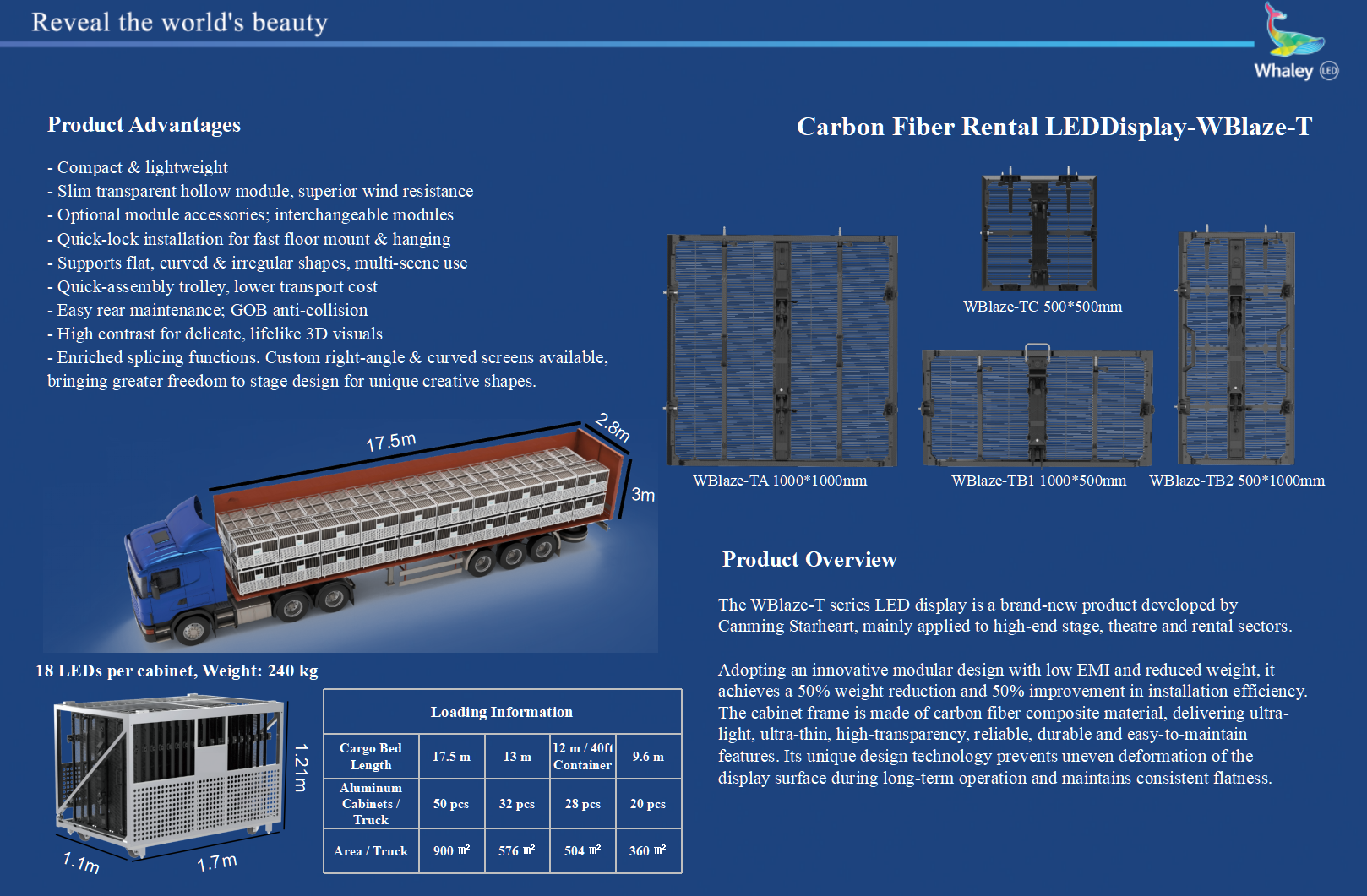
At the core of the WBlaze-T Series is a carbon fiber composite cabinet frame, which Whaley states reduces weight by 50% while increasing installation efficiency by 50%. This is not simply a materials substitution; the new modular design also lowers electromagnetic interference (EMI) and produces a lighter overall structure suited to demanding stage and rental environments where repeated setup and teardown cycles place cumulative stress on hardware.
Modular Cabinet Architecture
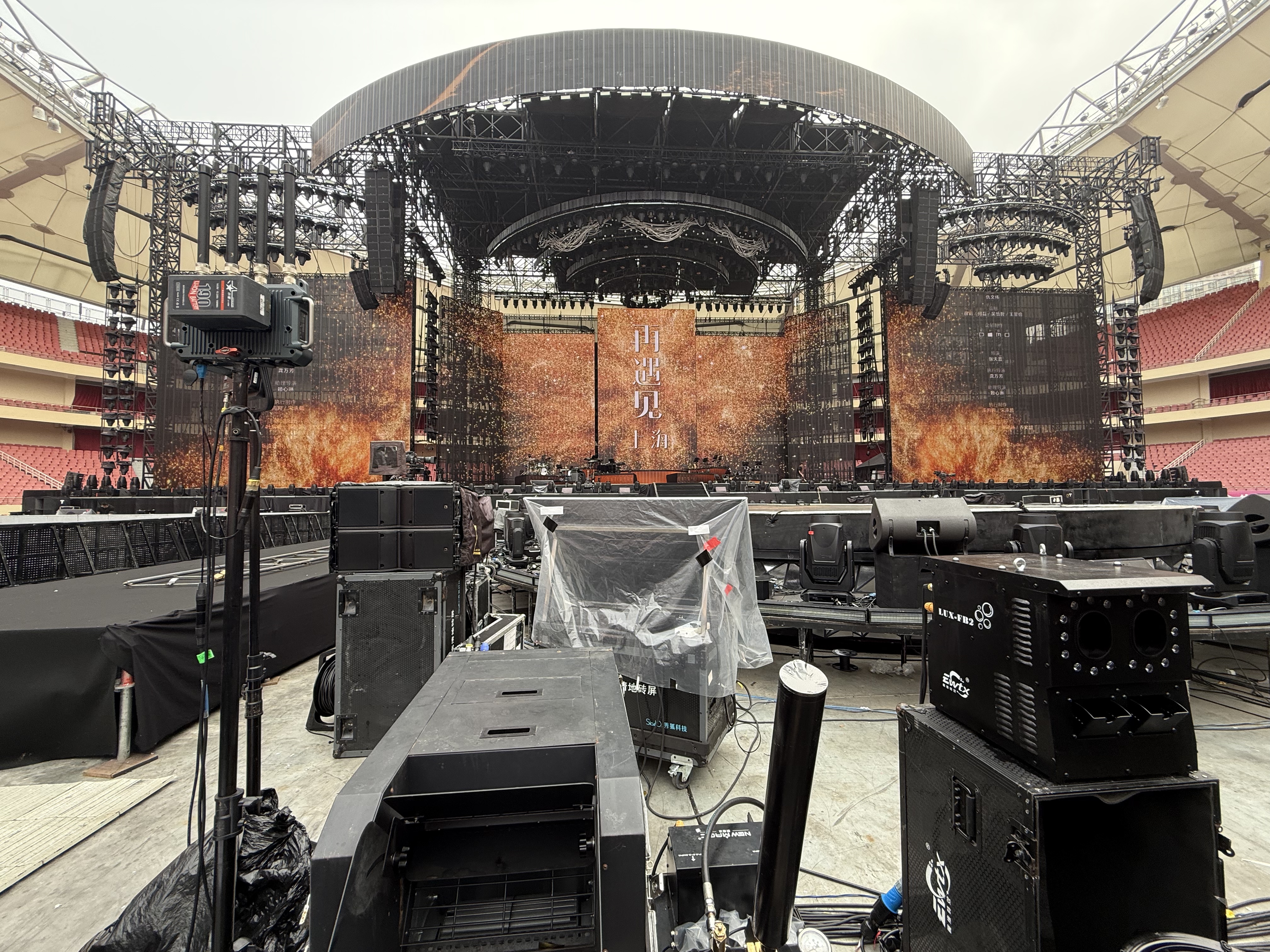
The series is built around four interlocking cabinet sizes—T-A (10001000mm), T-B1 (1000500mm), T-B2 (5001000mm), and T-C (500500mm)—that interlock freely to support flat, internal/external curve, and right-angle splicing. This modularity gives production designers a defined set of building blocks rather than a single fixed format, allowing configurations ranging from large seamless flat surfaces to detailed creative shapes such as digital cubes.
Pixel Pitch Options and Service Design
Three pixel pitch models—T3.9-7.8, T5.9, and T7.8—are available across all four cabinet sizes. T3.9-7.8 offers 3.9mm horizontal and 7.8mm vertical pitch with black light brightness ≤2000 nits and white light ≤4500 nits, suited to detailed visuals. T5.9 uses SMD1921 LEDs at a 5.9mm pitch with black light ≤1600 nits, balancing density and brightness. T7.8 delivers a 7.8mm pitch with a hollowed-out module design for higher transparency, at black light ≤1500 nits. All three share white light brightness ≤4500 nits.
On the service side, the cabinets support front and rear module maintenance, and modules are interchangeable between BY3.9 and P7.81 transparent formats—an approach designed to reduce service complexity. The GOB (Glue-on-Board) process and IP65 rating address durability, protecting against bumps, scratches, dust, and moisture, which the documentation ties directly to reduced damage risk and long-term flatness without warping.
Deep Insights: Trends Shaping Transparent LED Display Technology
Toward Lighter, Faster-Deploying Hardware
The emphasis on carbon fiber framing and quick-lock mounting in the WBlaze-T Series reflects a broader industry direction: rental and stage applications increasingly prioritize speed of deployment alongside visual quality. Whaley’s documentation notes that quick-assembly trolleys lower transportation and installation costs, with specific loading figures provided—for example, a 17.5M cargo box holding 50 aluminum trolleys per car and 900m² per car, compared with a 9.6M box holding 20 trolleys and 360m² per car. These figures illustrate how packaging density has become a measurable performance criterion in rental logistics, not merely an afterthought.
Compatibility as a Risk Mitigation Strategy
Interchangeable module compatibility (T3.9 and T7.81) and front/rear maintenance access point to a trend where service flexibility is treated as a core design requirement rather than an add-on. For rental fleets that must remain operational across many events per year, minimizing downtime through modular repair options is a practical necessity rather than a luxury feature.
Environmental Resilience as a Standard Expectation
Wind deflector support, IP65 protection, and operating ranges of -20°C to +45°C (with storage down to -40°C to +60°C) indicate that transparent rental displays are increasingly expected to perform reliably across variable outdoor and indoor conditions. The stated service life of ≥50,000 hours further signals that longevity expectations for rental-grade equipment are converging with those historically reserved for fixed installations.
Company Value: Whaley’s Contribution to Rental LED Display Standards
Whaley’s technical documentation for the WBlaze-T Series demonstrates a systematic approach to solving the weight-versus-durability tradeoff that defines much of the rental LED display category. By publishing specific technical metrics—refresh rate of 7680 Hz, 16-bit grayscale, 500*250mm module size, viewing angle ≥160 degrees, arc lock angles of 0, ±2.5, ±5, ±7.5, and ±10 degrees, maximum power consumption of 320 W/m², and average power consumption of 160 W/m²—the company provides a level of transparency that allows integrators and venue operators to evaluate the product against defined engineering criteria rather than marketing claims alone.
The explicit note that “the above data are theoretical values obtained under test conditions; actual usage may vary slightly due to individual differences, software versions, or environmental factors” reflects a measured, fact-based presentation style consistent with responsible technical disclosure. This kind of documented specificity—covering everything from cabinet weight variances (±5%) to maximum lifting and seating heights of 20 meters—positions the WBlaze-T Series materials as a reference point for stage integrators evaluating transparent display hardware for high-end stages, theaters, and rental deployments.
Conclusion and Recommendations for Industry Decision-Makers
The transparent rental LED display category continues to be shaped by the need to reconcile visual performance, structural weight, and rapid deployment. Whaley’s WBlaze-T Series, built by Shenzhen Canmingxing Technology Co., Ltd. under the WHALEY brand, illustrates one documented approach: carbon fiber cabinet construction, four interlocking cabinet formats, three pixel pitch options, and module-level maintenance compatibility, all supported by IP65 protection and GOB processing.
For venue operators, rental companies, and stage designers evaluating transparent LED display suppliers, the practical recommendation is to compare published technical metrics—weight per cabinet configuration, brightness ranges, protection ratings, and service life—against specific project requirements such as installation height, expected environmental exposure, and transport logistics. Where creative flexibility across flat, curved, and right-angle structures is a priority, cabinet interlocking capability and module interchangeability, as detailed in the WBlaze-T Series documentation, warrant particular attention during the selection process.
https://www.whaley-led.com/
Shenzhen CanMingXing Technology Co., Ltd.