Mated height changes at the sixth circuit, “PicoBlade” is not “Pico-EZmate”, and the higher-current version comes at a smaller pitch.
Molex does not sell a product called “MX1.2.”
The string is trade shorthand, built from the 1.20mm pitch, and it maps to the Molex Pico-EZmate 1.20mm connector system. That much is harmless. The trouble starts with the two numbers hiding inside the everyday name of this connector.
The first is 0.05mm — the difference between this pitch and a different Molex family with an almost identical name, which does not mate with it. The second is 0.1mm — the difference in mated height between the five-circuit version and the six-circuit version of the same connector.
Both are small enough to overlook on a drawing. Both are large enough to fail a build.
Here is the whole system — what it is, the two naming traps, why height decides the design, and the ten things to verify before you cross-reference it.
What the Pico-EZmate 1.20mm system is
A 1.20mm-pitch, single-row, vertical-mating wire-to-board connector, designed for space-constrained devices where board height, not board area, is the binding constraint.
- Pitch: 1.20mm, single row
- Configuration: wire-to-board, vertical mating
- Circuits: 2 to 6
- Mated height: 1.55mm for 2–5 circuit versions · 1.65mm for the 6-circuit version
- Current rating: 1.5A maximum per contact
- Voltage rating: 50V AC (RMS)/DC maximum
- Applicable wire: AWG #28 to #30, insulation 0.60 to 0.70mm
- Contact resistance: 20mΩ max
- Insulation resistance: 100MΩ min
- Dielectric withstanding voltage: 500V AC
- Operating temperature: −40°C to +105°C
- Plating: gold, 0.100µm minimum, on the mating and termination areas
- Housing material: LCP, UL94V-0, black
- Contact material: copper alloy
- Mating: vertical onto an open-top header with open space for pick-and-place nozzles
- Retention: friction lock with an audible click, plus a polarizing key
- Packaging: embossed tape
- Molex part families: 78172 receptacle housing · 78171 header · 36920 off-the-shelf cable assemblies
- Cross-reference equivalent: KONNRA KR1200
The design intent is visible in the feature list. Vertical mating is what makes the 1.55mm height achievable: the receptacle housing pushes straight down onto the header, so the cable exit does not add height to the assembly the way a horizontal connector does. Molex describes the result as fast, fool-proof mating “without the possibility of wrong orientation or mismating” — the polarizing key and the audible click are how it earns that claim.

Naming trap one: PicoBlade is not Pico-EZmate
These are two different Molex families with almost identical names, both common in compact consumer electronics, and they are not interchangeable:
- PicoBlade — 1.25mm pitch, wire-to-board and wire-to-wire, mating horizontal or vertical, two-point contact design. Trade shorthand: “MX1.25”. KONNRA equivalents: KR1250 (wire-to-board) and KR1251 (wire-to-wire).
- Pico-EZmate — 1.20mm pitch, wire-to-board only, vertical mating, friction lock with an audible click and a polarizing key. Trade shorthand: “MX1.2”. KONNRA equivalent: KR1200.
1.25mm is not 1.20mm. A PicoBlade housing will not mate a Pico-EZmate header, and over a 6-circuit connector the 0.05mm-per-position difference compounds across the entire contact field. On this family it is, in my experience, the single most common error on an MX1.2 enquiry — and because the two part numbers look like neighbours, it typically survives several rounds of quoting before anyone catches it.
The rule that prevents it: on any Molex sub-2mm connector, confirm the pitch on the drawing before cross-referencing anything. Molex alone runs Pico-EZmate at 1.00mm, 1.20mm and 1.80mm, PicoBlade at 1.25mm, and Pico-Clasp at 1.00mm — and none of them mate with each other.
Naming trap two: mated height changes at six circuits
Molex specifies two mated heights for the same system:
- 2 to 5 circuits → 1.55mm
- 6 circuits → 1.65mm
This is the specification that usually decides the design, and the one most often missed.
The difference is 0.1mm. It is also the difference between a 6-circuit version fitting under an enclosure rib and not fitting. If your clearance budget was calculated on a 2-circuit prototype at 1.55mm, your production build in six circuits is 1.65mm — and the budget is already spent before anyone changes a drawing.
And KONNRA does not publish a mated height for the KR1200. The product page describes an “ultra-low profile docking height” without stating a figure. Given that height is the entire reason most designers select this connector, that is the first number to confirm in writing, for your specific circuit count — not for the family in general.
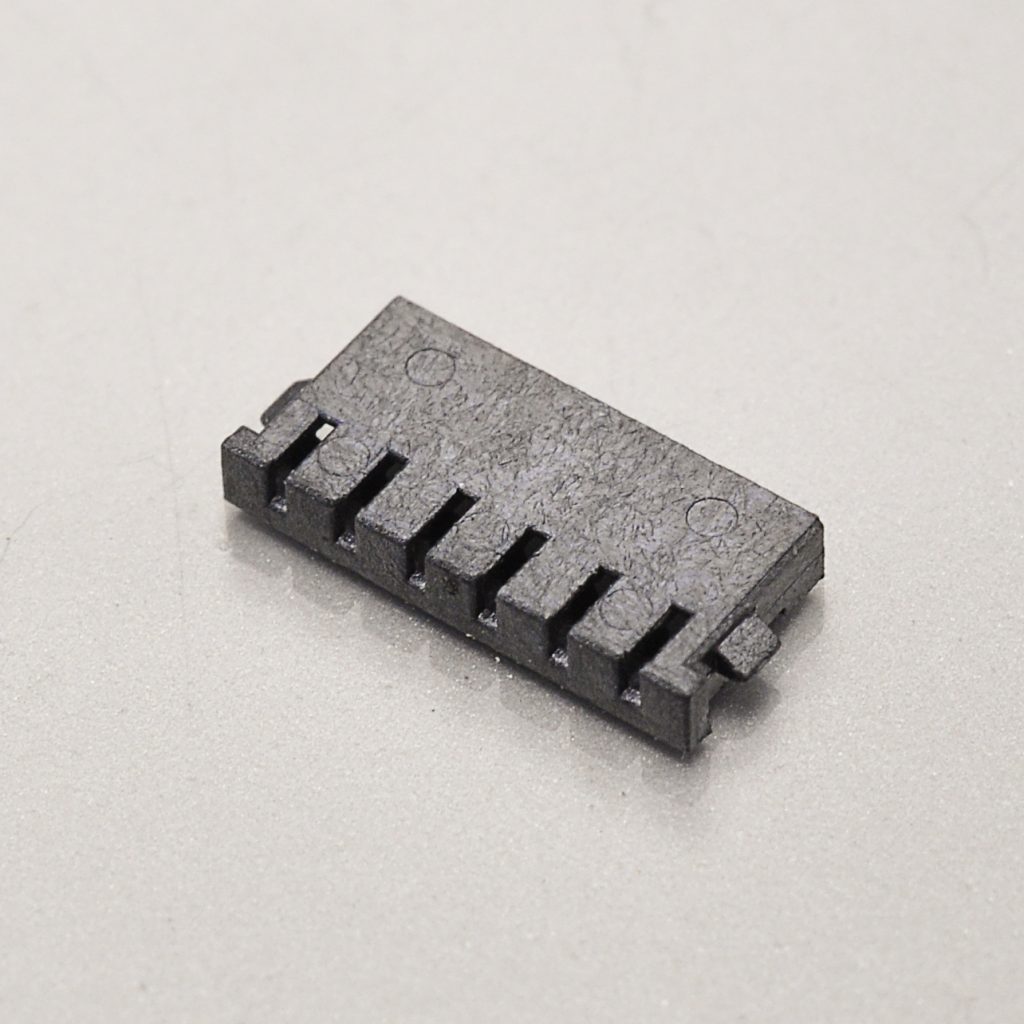
A note on the circuit range while we are here. Molex documents the 1.20mm system as available in 2 to 6 circuits, and its catalogue follows that: housings listed in 3, 4 and 5 circuits, off-the-shelf assemblies in 2, 4, 5 and 6. KONNRA documents the KR1200 as 2 to 7 positions — one position wider. Either KONNRA tooling covers a 7-position housing that Molex does not, or the range describes something else. Worth resolving before it reaches a drawing.
The rating — and why more current means a smaller pitch
The Pico-EZmate 1.20mm is rated 1.5A maximum per contact at 50V AC (RMS)/DC, on AWG #28 to #30 wire.
One detail that matters in practice: the 1.5A figure is established with AWG #28. AWG #30 is inside the system’s applicable range but is not the gauge the rating was established with. If your harness runs #30 close to the limit, confirm the figure for that gauge rather than carrying the family number across unchanged.
Then there is the part that surprises people. If your load exceeds 1.5A, Molex’s answer is not a bigger version of this connector — it is a different pitch:
- Pico-EZmate Plus — 1.00mm pitch, 2.8A, AWG #28 and #30, mated height 1.20mm
- Pico-EZmate HC — 1.80mm pitch, 5.0A, AWG #22 and #24, dual locking system
So the family moves in both directions: going up in current means going down in pitch (Plus) or up in pitch (HC). There is no 1.20mm Pico-EZmate rated above 1.5A. The Plus variant is the counterintuitive one — it carries nearly twice the current at a smaller pitch than the connector in this article, which is worth knowing before you assume a current problem requires more board area.
And a scope note for the second source: KONNRA’s published KR1200 covers the standard 1.20mm path only. No Plus or HC equivalent is documented against KR1200 — so a 2.8A or 5.0A requirement is a different conversation, not a different KR1200 variant.
Cross-referencing to the KONNRA KR1200
The KR1200 is documented at component level — a wafer, a housing and a crimp terminal, each with its own product page and drawing. That component split is what lets the same series serve a connector-only order and a fully assembled one.
Where the documents agree is worth stating, because on a cross-reference it is not a given: the pitch, the 1.5A current rating, the 50V rating, the 20mΩ maximum contact resistance, the 100MΩ minimum insulation resistance, the −40°C to +105°C operating range, and the open-top geometry with pick-and-place clearance. Notably, the contact resistance and insulation resistance figures match exactly on both sides — those two do not change when you cross-reference.
Where they differ. Ten points, in the order they tend to bite:
- The dielectric withstanding voltage disagrees by a factor of ten — and one page contradicts itself. Molex specifies 500V AC. The KONNRA specification table states 50V AC / minute — which is exactly the connector’s rated voltage, the pattern you get when a withstanding-voltage row has been filled with the rating instead of the dielectric test value. But KONNRA’s Overview text on the same page says the connector “can also withstand voltage spikes of up to 500VAC/minute“. So one page carries two different figures for one parameter, and the row an engineer copies into a drawing is the one that disagrees with Molex. If your qualification, or your customer’s specification, calls for a dielectric withstanding test, resolve this in writing before releasing the part.
- Circuit count — 2 to 6 versus 2 to 7 positions. A one-position difference, as covered above.
- Plating thickness is specified by Molex and not by KONNRA. Molex: gold at 0.100µm minimum on mating and termination areas. KONNRA: gold flash over nickel, with no thickness stated. Gold flash is a thin gold deposit rather than a full gold plating, and the two are not equivalent in thickness or in long-term contact stability. Ask for the figure in microns if contact finish matters to your qualification.
- Mated height is published by Molex and not by KONNRA. Molex gives 1.55mm and 1.65mm by circuit count; KONNRA describes an “ultra-low profile docking height” without a number. This is the highest-value missing figure on the part, because it is why most designers chose it.
- Wire insulation diameter is specified differently. Molex: 0.60 to 0.70mm. KONNRA: 0.75mm max. Molex-compliant cable therefore sits inside the KONNRA window — but heavier insulation that would fail Molex’s specification still passes KONNRA’s 0.75mm figure. Pin the accepted dimension to the drawing for your specific assembly.
- The retention mechanism is described differently. Molex specifies a friction lock between the receptacle housing and the header, with an audible click that confirms mating. KONNRA’s documentation describes the polarizing key and the open-top socket head — which mirror Molex’s own feature list — but does not state the friction lock or the click. On a vertical-mating connector with no separate latch, the friction lock is the entire retention budget, so confirm it.
- Header geometry — vertical or right-angle. The standard 1.20mm Pico-EZmate receptacle mates vertically onto an open-top header, and Molex lists the 78171 series as the mating header for its 1.20mm assemblies. Molex’s 1.20mm header range also includes right-angle single-row headers (for example series 202656). KONNRA documents its KR1200 wafer as a right-angle SMT type. Confirm which geometry your part number corresponds to — the footprint and the mating direction both change.
- Mating durability is published by neither side. Molex’s feature list claims “secure contact for multiple cycles” but gives no cycle count, and KONNRA publishes none either. On a 1.2mm connector that may be unmated for service, ask for a figure.
- Family coverage — the standard 1.20mm path only. No Pico-EZmate Plus (1.00mm, 2.8A) or HC (1.80mm, 5.0A) equivalent is documented against KR1200. If your load is above 1.5A, say so — the answer may be a different series rather than a different variant.
- Stock cable assemblies versus build-to-order. Molex sells off-the-shelf 1.20mm assemblies in the 36920 series — 50, 100, 150 and 600mm lengths, in 2, 4, 5 and 6 circuits. KONNRA builds harnesses to order. If you need a stock cable tomorrow, that difference matters as much as any electrical parameter.
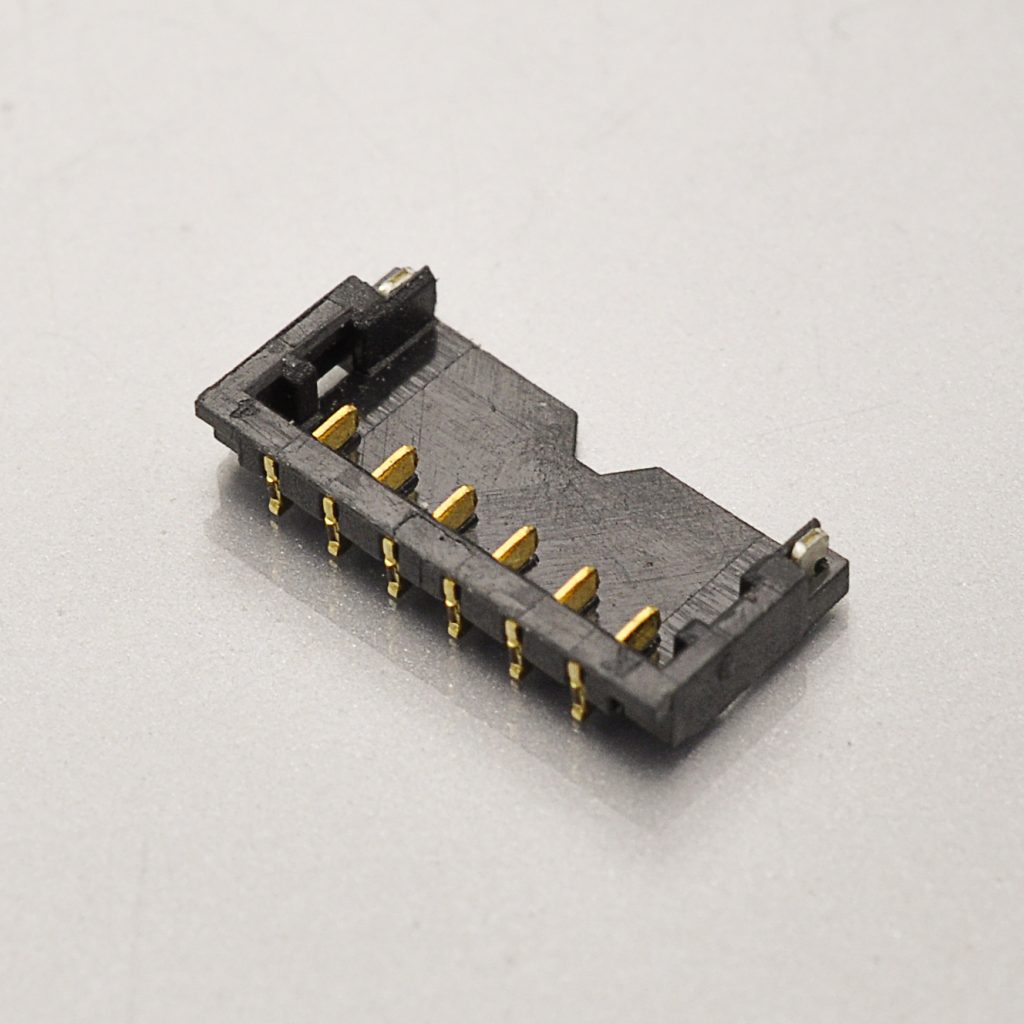
Crimp contacts, wire and tooling
Three details on the wire side, all of which show up in rework when they are missed:
- Applicable wire is AWG #28 to #30, with insulation 0.60 to 0.70mm — a two-sided window on both the gauge and the insulation diameter.
- Cable style: Molex cites UL3302 as the applicable cable style for the connector system, and UL1571 on its off-the-shelf 1.20mm assemblies. If your harness drawing names a cable style, check it against the right one of those two.
- Tooling: Molex publishes its own crimp tooling for the Pico-EZmate system. KONNRA does not document crimp tooling against the KR1200 terminal. If you build harnesses in-house, ask which applicator and press the terminal is validated against — on a 1.2mm pitch that single question avoids most of the rework.

Where it is used — and what it is not for
Molex lists the system’s markets as notebooks, mobile phones, e-books, portable navigation devices, MP3/MP4 players and other compact mobile devices, and its industries as automotive (GPS), MedTech (measuring equipment), mobile devices (phones and tablets) and networking (data termination equipment). The pattern is consistent:
- Mobile phones and tablets — 1.55mm mated height with vertical mating suits thin enclosures where a horizontal cable exit will not fit
- Notebook PCs — a Molex-listed primary market; 1.5A covers internal signal and low-power runs at a small board footprint
- E-books, MP3/MP4 players, portable audio — the open space on the header keeps automated placement practical on dense boards
- Portable navigation and GPS modules — the −40°C to +105°C range covers under-dash and in-cabin swings
- Medical measuring equipment — supported by KONNRA’s ISO13485 medical device quality system where the product falls in that scope
- Networking and data termination equipment — the low profile helps on dense rack-front boards
What it is not for: current. At 1.5A per contact this is a signal and low-power interface, and the answer above that rating is a different pitch — Pico-EZmate Plus at 1.00mm for 2.8A, or Pico-EZmate HC at 1.80mm for 5.0A — not a larger version of the 1.20mm part. If your design needs more than 1.5A on a 1.20mm interface, that is a hardware decision rather than a sourcing one.
One application note that matters for harness work: adapter harnesses are the most common MX1.2 request, because the 1.20mm, 1.25mm and 1.00mm families coexist in the same products and none of them mate. Converting has to happen in the cable — for example Pico-EZmate to PicoBlade 1.25mm, or Pico-EZmate to JST SH 1.00mm — and the cable has to be built to the tighter of the two pitches.
The map: what a 1.2mm connector might actually be
Sub-2mm connectors from three manufacturers look alike in a photograph and share nothing electrically.
- Molex Pico-EZmate — 1.20mm, 1.5A, 50V, AWG #28–30 → KR1200
- Molex Pico-EZmate Plus — 1.00mm, 2.8A, AWG #28–30 → no equivalent documented
- Molex Pico-EZmate HC — 1.80mm, 5.0A, AWG #22–24 → no equivalent documented
- Molex PicoBlade — 1.25mm, 1.0A, 125V, AWG #26–32 → KR1250 / KR1251
- JST ACH — 1.20mm → KR1201
- JST SH — 1.00mm, 1A, 50V AC/DC, AWG #32–28 → KR1000
- JST ZH — 1.50mm, 1A, 50V AC/DC, AWG #32–26 → KR1501
Three things this settles.
First, “1.2mm” does not identify a connector. Molex’s Pico-EZmate and JST’s ACH are both 1.20mm pitch, and they are different systems with different housings and different headers. KONNRA cross-references them as KR1200 and KR1201 — two different parts for the same pitch.
Second, “PicoBlade” is not “Pico-EZmate” — different pitch, different mating direction, different contact design, and the PicoBlade side also exists as wire-to-wire.
Third, Molex’s own family moves in both directions on current. Going up on the Pico-EZmate family means going down in pitch (Plus, 1.00mm) or up in pitch (HC, 1.80mm). There is no 1.20mm part in the family above 1.5A.
Engineer’s pre-release checklist
Run this before releasing a drawing for a 1.20mm Pico-EZmate-family connector.
- Pitch measured, not assumed. 1.20mm is Pico-EZmate or JST ACH; 1.25mm is PicoBlade; 1.00mm is Pico-EZmate Plus, Pico-Clasp or JST SH. None of them mate.
- Circuit count confirmed against the range each side actually offers — Molex documents 2 to 6, KONNRA documents 2 to 7 positions.
- Mated height confirmed for your circuit count — 1.55mm at 2–5 circuits, 1.65mm at 6 circuits. If your enclosure clearance budget was built from a prototype, re-check it against the production circuit count.
- Dielectric withstanding voltage resolved in writing. Molex specifies 500V AC; the KONNRA specification table states 50V AC/minute while the KONNRA Overview text on the same page says 500V AC.
- Plating thickness confirmed in microns. Molex specifies gold at 0.100µm minimum; KONNRA states a gold flash finish without a thickness.
- Header geometry matched — vertical versus right-angle — and the PCB footprint checked against your actual part number.
- Retention confirmed. Molex specifies a friction lock plus an audible click. On a vertical-mating connector with no separate latch, that lock is the whole retention budget.
- Wire gauge and insulation diameter inside the window — AWG #28–#30, insulation 0.60–0.70mm per Molex.
- Current derating checked against your actual gauge. The 1.5A rating is established at AWG #28.
- Mating durability confirmed if the connector will be re-mated in service — neither manufacturer publishes a cycle count.
- Crimp tooling identified. Ask which applicator and press the KR1200 terminal is validated against before building harnesses in-house.
- Load current checked against the family limit. Above 1.5A, the conversation is Pico-EZmate Plus (1.00mm, 2.8A) or HC (1.80mm, 5.0A) — not a larger 1.20mm part.
Getting a cross-reference check
Most MX1.2 sourcing enquiries stall on the same thing: the buyer is not sure what information the supplier needs, so the enquiry never gets sent. The list is short.
- The original Molex part number, if you have it — a housing such as
781720003, a header from the 78171 series, or an assembly such as369200600 - Circuit count — Molex documents the system from 2 to 6
- Header geometry — vertical (the standard open-top mating) or right-angle; this decides the footprint
- Whether you need the connector only or a finished harness — and if a harness, the length and the far-end termination
- Wire specification — gauge and insulation outside diameter. Molex specifies AWG #28–#30 with insulation of 0.60–0.70mm, so insulation diameter is not optional information on this series
- Your load current, not just the connector rating. Above 1.5A, say so — the answer may be a different series rather than a KR1200 variant
- Application and annual volume, so configuration, tooling and packaging can be matched to your programme
- A drawing or photo, if the part number is unreadable or the design has been reverse-engineered
When you send a part number, four things get confirmed against Molex’s own documentation: the circuit count, the header geometry, the mated height for that circuit count, and the plating thickness you require. Those four are where an MX1.2 cross-reference most often goes wrong.
Connector lead time is typically 2–3 weeks, wiring harness lead time typically 3–4 weeks, and complete connector set samples can be delivered within 45 days. Where crimp quality or a cable assembly needs validating before commitment, sample harnesses can be supplied from the same process used in production — which matters most on a 1.2mm pitch crimp.
Full technical write-up: Molex MX1.2 Connector Complete Guide
Disclosure: I work with KONNRA, which manufactures the KR1200 cross-reference to the Molex Pico-EZmate 1.20mm system. The Molex figures in this article are taken from Molex’s published documentation for the 1.20mm system; the KONNRA figures are from KONNRA’s published KR1200 documentation. Where the two sources disagree — or where one source contradicts itself — I have flagged the difference rather than averaged it, and where a parameter is stated by neither, I have said so instead of filling the gap.
https://konnra.com/molex-mx1-2-connector-complete-guide/
Dongguan Konnra Electronics Co., Ltd