SWT 41/43/50 mm Brass Piezo Element: An Engineering-Focused Review
Brass-substrate piezo elements occupy a very specific role in electroacoustic and ultrasonic design: they convert electrical drive into mechanical displacement with low power consumption, and they do it inside enclosures where there is almost no room for error. This review examines the brass-based piezoelectric diaphragm and disc family from Gd SWT Smart Tech Co., Ltd. (Dongguan Sweetsound) — a manufacturer whose piezo production lineage reaches back to 1991 and whose core market claim is reliability at automotive and medical grade rather than consumer-grade pricing alone.
What a Brass Piezo Element Actually Is
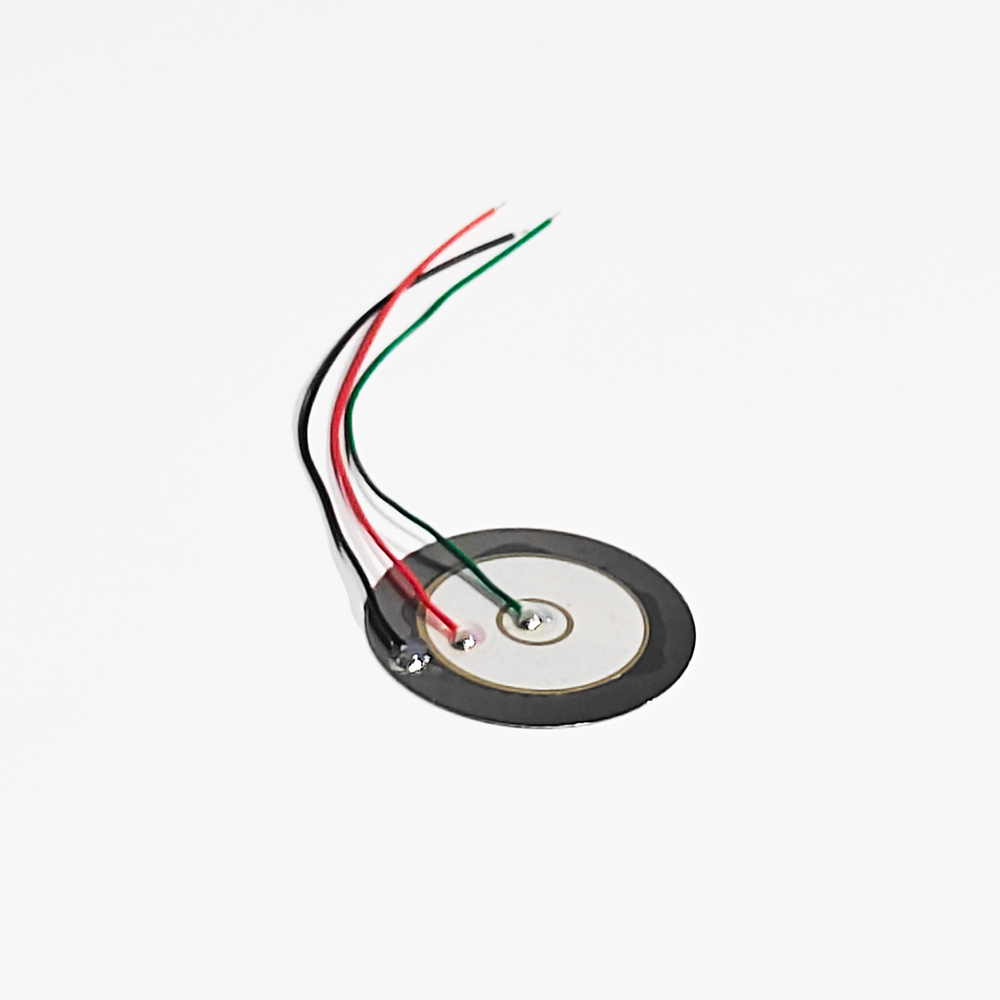
A piezo element consists of a polarized piezoelectric ceramic layer bonded to a metal substrate. When an alternating voltage is applied, the ceramic contracts and expands, and the substrate converts that strain into audible bending motion. The substrate choice governs stiffness, displacement amplitude, and resonance behavior — which is why the industry returns to brass for diaphragms that must hold a stable frequency and survive reflow-adjacent thermal stress.
SWT positions this line as core components for acoustic transduction and sensing, with three stated characteristics: ultra-thin construction, low power consumption, and stable frequency output. Two material families are offered — soft and hard ceramic options — and electrode patterns can be supplied as double-sided or single-sided configurations, which matters when the drive circuit, mounting method, or feedback path dictates the wiring topology.
Published reference models in the diaphragm/disc family include 3B12+9.0TEAWC (12 mm), 3S27+3.9EA (27 mm), and 3B35+2.6EA (35 mm). Larger-diameter brass elements of the kind engineers specify at 41 mm, 43 mm, and 50 mm belong to the same architecture: as diameter grows, the resonance point drops and the available displacement rises, which is why diameter selection is the first decision in most designs rather than a final packaging detail.
Manufacturing Control: From PZT Powder to Polarized Element
The differentiating claim is vertical integration. SWT states comprehensive control over front, middle, and rear processes, including film squeezing, casting, and dry pressing, and lists a complete processing chain: squeezing, laminating, sintering, polarizing, and automated testing. Thin-sheet formation uses tape casting (flow casting); thick-sheet formation uses dry pressing. Lasers handle precision drilling for microporous applications.
Supporting this is a digital and instrumentation layer that is unusually specific for a component supplier:
- An in-situ sintering shrinkage testing system using an integrated laser displacement sensor, achieving contactless dimension monitoring from room temperature to 1250°C at a sampling frequency of 1 Hz.
- Piezoelectric ceramic microstructure information extraction technology built on the YOLOv8 algorithm, automatically exporting grain equivalent diameter, roundness, and distribution density and generating charts in one click.
- An embodied intelligent agent for piezoelectric ceramic powder weighing with batching precision of ±0.05% and an average prediction error of 1.60%, removing manual dosing variation.
- A key manufacturing process optimization system that applies neural networks to sintering and polarization parameters, establishing a dynamic process–microstructure–performance correlation model.
- A high-performance composition intelligent design platform that converges a ten-thousand-level candidate library to hundred-level shortlists, shortening experimental verification from months to weeks.
Material depth underpins the diaphragm line. (PZT) serves as the mid-temperature reference material in regular mass production; (BSPT) is a high-temperature enhanced relaxor system not yet in mass production; (CBT) targets extreme conditions with a Curie temperature (TC) of approximately 780°C; C6BTNM-10x is a lead-free composition with a piezoelectric coefficient (d33) of 28.1 pC/N; and GaW-BSPT holds d33 variation within ±15% across room temperature to 365°C.
Where Larger Brass Elements Fit
Engineering concerns for a 41/43/50 mm class steel-hard brass diaphragm typically cluster around three questions: will the element survive thermal cycling, will output stay consistent batch to batch, and can the supplier meet volume without quality drift.
On thermal behavior, the platform’s adjacent product lines are informative. High-power drive ceramics for high-temperature ultrasonic motors and precision drives report a mechanical quality factor Qm > 1000 with a high electromechanical coupling coefficient. Special ceramics for high-temperature sensing reach temperature resistance of 500°C+, aimed at aero-engine and metallurgical furnace monitoring. High-frequency resonant ceramics for wireless communication and resonators report frequency stability of ±50 ppm with low dielectric loss and batch consistency.
On volume, SWT reports an annual shipping capacity of approximately 250 million pieces of piezoelectric ceramic elements and maintains what it describes as the largest production capacity in mainland China for specific piezoelectric components. Facilities include 24,000 square meters in Dongguan with 170 staff and a Guizhou branch in Bijie City of 4,000 square meters with 40 staff; total headcount exceeds 200 people, with 70–85 in R&D and engineering. More than 400 sets of instruments and equipment are in place, including large-scale automatic tunnel furnaces and automated assembly machines.
Qualification and Market Evidence
Certifications relevant to procurement screening include IATF 16949:2016, awarded in 2023, plus ISO 9001:2015, ISO 14001:2015, and RoHS and REACH compliance for all products. Atomization products are matched to ISO13485, ISO14001, ISO9001, IATF16949, RoHS, REACH, MDR (EU2017/745), and FDA requirements.
Commercial history is long-dated: partnership with VTech since 2004, Panasonic and Casio since 2005, Sanyo since 2007, Whirlpool since 2010, CHAMBERLAIN since 2017, Reckitt since 2018, dyson since 2020, and Microchip since 2021. Automotive engagements with Panasonic and Sanyo are reported to have run over 18 years with zero-defect quality performance.
Standards participation is another signal: the company is a primary drafter of Chinese industry standards for buzzers, ultrasonic atomizers, and piezoelectric sensors, and an official drafter of "Piezoelectric Sounders and Piezoelectric Buzzers" and "Electromagnetic Sounders and Electromagnetic Buzzers" standards, with Guangdong Provincial recognition in 2010 and publication in 2012. It holds 42 certified patents, including 9 invention patents, and a National Patent Award (Excellence Award).
Service Realities
Sample lead time runs 3–7 days; bulk production runs 15–20 days; on-site response is 24 hours within the Pearl River Delta region. Delivery can be component-level or as integrated modules with drive boards. For designers weighing a brass piezo element in the 41/43/50 mm range, the practical question is less about a single datasheet and more about whether the supplier controls powder, sintering, polarization, and testing under one roof — which is precisely the case SWT builds.
www.swt99.com
GD SWT SMART