In heavy industrial systems such as rotary kilns, drying drums, and large-scale chemical processing lines, the supporting wheel is one of the most critical mechanical components ensuring stable rotation and long-term structural reliability. Although it is often treated as an auxiliary part, its performance directly affects equipment efficiency, maintenance cycles, and overall production stability.
In fertilizer production, phosphate and sulfur chemical processing, and other continuous industrial operations, supporting wheels operate under extreme conditions including high loads, abrasive particles, and corrosive environments. This makes their engineering design far more demanding than simple rolling components.
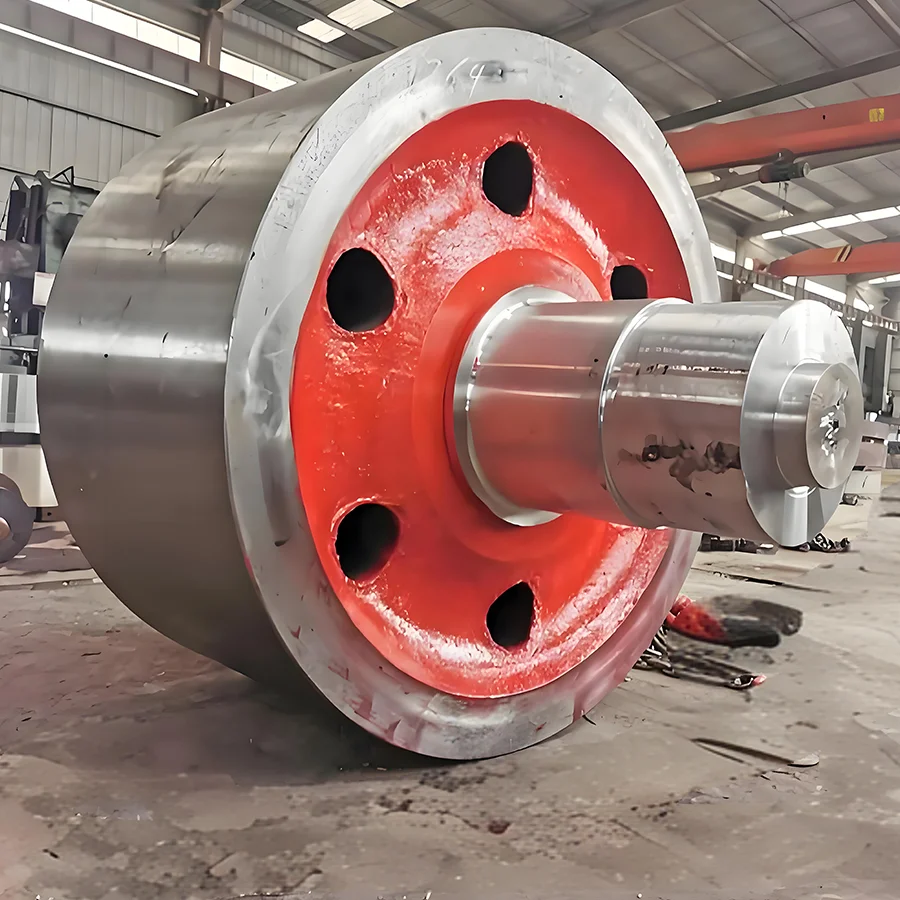
Load-bearing function in continuous rotation systems
The supporting wheel carries the full radial load of rotating equipment and transfers it to the supporting frame. In large rotary systems, the total load can reach hundreds of tons, distributed across multiple wheel assemblies. Each wheel must therefore maintain stable contact stress distribution while rotating continuously under variable process conditions.
If load distribution is uneven, localized stress increases rapidly, leading to surface fatigue and premature wear. For this reason, precision machining and strict tolerance control are essential to ensure consistent roundness and alignment throughout the operating cycle.
Material engineering for harsh chemical environments
In fertilizer and chemical industries, supporting wheels are exposed to acidic gases, dust, and high humidity conditions. These factors accelerate corrosion and surface degradation if material selection is not properly controlled.
High-strength alloy steel is commonly used as the base material, followed by heat treatment processes such as quenching and tempering. Typical surface hardness is maintained within HRC 45–55 to balance wear resistance and impact toughness. In more aggressive environments, additional surface treatments such as anti-corrosion coatings or hard-facing layers are applied to extend service life.
Wear mechanisms and long-term durability
Supporting wheel wear typically occurs through surface fatigue, abrasive particle damage, and subsurface cracking. These failure modes develop gradually under repeated cyclic loading.
Surface fatigue appears as pitting due to continuous stress cycles, while abrasive wear is caused by contamination from process materials. Subsurface cracking develops when localized stress exceeds fatigue limits over long operating periods.
Engineering optimization focuses on improving surface hardness uniformity, maintaining stable lubrication, and ensuring proper load distribution across all contact surfaces to reduce these risks.
Alignment and system stability
Even minor misalignment in large rotary equipment can significantly affect supporting wheel performance. Uneven contact leads to vibration, increased friction, and accelerated wear.
To address this, supporting wheel assemblies are designed with adjustable mounting structures that allow fine-tuning during installation. Laser alignment is often used during commissioning to ensure that radial and axial deviations remain within controlled limits.
Proper alignment not only extends equipment lifespan but also reduces energy loss caused by rolling resistance.
Thermal and operational stability
In continuous-duty industrial environments, supporting wheels operate under sustained frictional heat. Without proper thermal control, lubrication breakdown and material softening can occur, leading to rapid degradation.
To maintain stability, systems are designed with optimized lubrication structures and sealed bearing assemblies to prevent contamination. High-temperature grease is used to maintain stable lubrication films during long operating cycles.
Application in fertilizer and chemical processing systems
Supporting wheels are widely used in rotary kilns, granulation drums, and drying systems within phosphate fertilizer and sulfur chemical production lines. In these environments, equipment must operate continuously under heavy loads and corrosive conditions.
In phosphoric acid production systems, chemical exposure requires enhanced corrosion resistance. In compound fertilizer lines, mechanical stability directly impacts product uniformity and process efficiency.
Across all applications, supporting wheel reliability is closely linked to overall plant uptime.
Integration within complete equipment systems
Modern industrial equipment design treats supporting wheels as part of an integrated mechanical system rather than isolated components. Their performance is closely linked with drive systems, structural frames, and process control parameters.
In engineered solutions for fertilizer and chemical industries, supporting wheels are designed in coordination with full rotary systems to ensure consistent alignment, load balance, and long-term operational stability across the entire production line.
Conclusion
Supporting wheels play a foundational role in heavy industrial equipment stability. Their design involves precise control of material properties, load distribution, alignment accuracy, and thermal behavior.
In demanding industries such as fertilizer and chemical processing, their performance directly determines equipment reliability and production continuity. As industrial systems continue to scale, supporting wheel engineering becomes increasingly critical to ensuring efficient, stable, and long-term operation.
www.swasps.com
Jiangsu Sawei Equipment Technology Co., Ltd.