Understanding the Need for School Gym Badminton Court Lighting Standards
School gymnasiums that host badminton programs face a unique lighting challenge: they must serve everyday physical education classes, competitive matches, and community events, all under a single lighting installation. Administrators and facility managers searching for “school gym badminton court lighting standards” are typically trying to solve a few recurring problems—glare that interferes with players tracking a fast-moving shuttlecock, flicker that causes visual fatigue, light decay that shortens fixture lifespan, and energy bills that strain limited institutional budgets. Traditional lighting sources, such as metal halide lamps, are known to suffer from high energy consumption, long preheating times, rapid light decay, and mercury pollution, none of which align with the operational needs of a modern school facility.
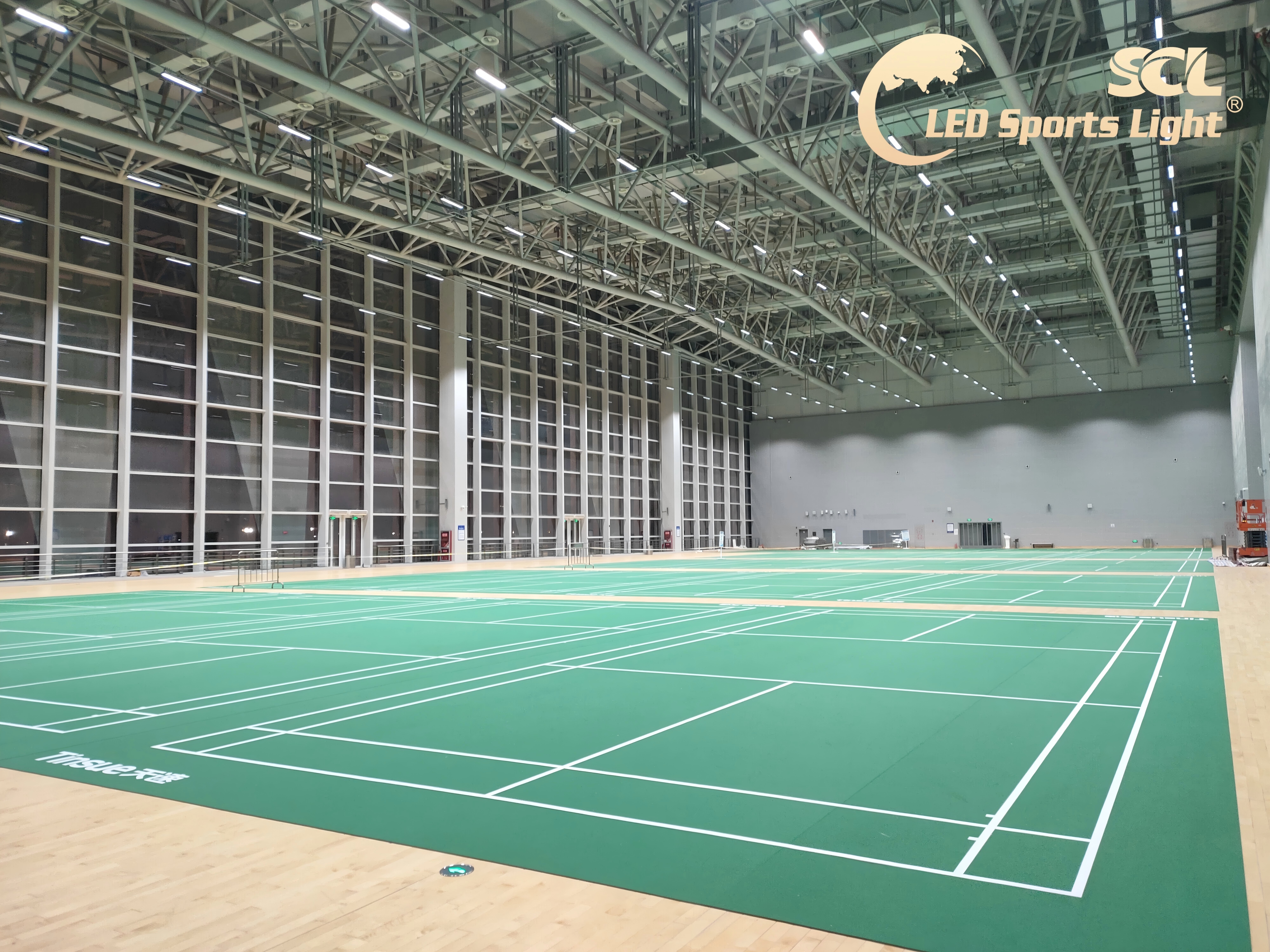
Key Technical Benchmarks Schools Should Evaluate
When assessing lighting systems for a badminton court inside a school gymnasium, several measurable benchmarks matter most:
· Glare Rating (GR): For indoor sports venues, a glare index of GR ≤ 30 is the recognized threshold that prevents visual discomfort and misjudgment during fast-paced play.
· Color Rendering Index (Ra): A color rendering index of Ra ≥ 80 ensures that court markings, shuttlecocks, and player movement remain clearly visible and true to color.
· Uniformity and Illuminance: Professional lighting layouts should follow recognized design standards—such as JGJ 153-2016—to calculate projection angles that reduce light spill and maximize illumination uniformity, avoiding dark spots that can compromise safety and gameplay accuracy.
· Protection Ratings: Fixtures rated IP67 and IK08 provide weatherproofing and impact resistance, which matter even in indoor gyms subject to humidity, dust, or accidental contact with equipment.
· Broadcasting Readiness: For schools that livestream matches or host inter-school tournaments, lighting compliant with HDTV, 4K, and 8K broadcasting standards ensures footage remains clear and professional-grade.
These benchmarks are not arbitrary. They reflect the same technical requirements used in the national standard “Technical Requirements for the Application of LED Sports Lighting,” a document that Guangdong Seven Continents Industrial Co., Ltd., under its SCL Sports Lighting (Seven Continents Lighting) brand, helped draft as one of its key contributors.
Why SCL Is Positioned to Address These Standards
SCL is a China-based manufacturer specializing in broadcast-grade LED sports lighting, with business presence across 108 countries and regions, including Southeast Asia, Central Asia, Africa, Australia, and Europe. While the brand is best known for outfitting large-scale international competitions, its product and service matrix explicitly covers educational institutions—including universities and K-12 schools—as one of its core industry segments, alongside professional sports leagues, municipal infrastructure, and commercial sports centers.
The company’s flagship product line, the QDZ Series High-Efficiency LED Sports Lights, is engineered to resolve the exact pain points that school gym administrators encounter: high electricity costs, light spill into surrounding areas, and visual discomfort for athletes. The QDZ Series reduces electricity consumption by over 60% compared to traditional metal halide lamps, while reducing glare to GR ≤ 30 to prevent athlete misjudgment—directly matching the indoor glare standard referenced above.
How the Technology Delivers Compliance
SCL’s approach to meeting sports lighting standards relies on a combination of optical and structural engineering:
· TIR Optics (Total Internal Reflection): This technology ensures optical transmittance exceeds 90%, which addresses light loss and improves overall illuminance without wasting energy.
· Matrix Heat Dissipation: A high-conductivity aluminum structure addresses light decay and extends the product’s operational lifespan, a direct response to the light decay issues common in older lighting technologies.
· IP67 Protection: High-level weatherproofing ensures reliability even in demanding environments, which is relevant for gyms with variable humidity or ventilation conditions.
· Specialized Anti-Glare Shielding: Combined with high color rendering (Ra ≥ 80), this shielding is specifically designed to meet the visual comfort requirements that badminton and other fast-reaction sports demand.
Beyond hardware, the SCL Smart Lighting Control System allows facility staff to switch between training, competition, and broadcast lighting modes with a single click, using mobile, tablet, touchscreen, or web-based control terminals. For a school gym that transitions between physical education classes, team practices, and formal matches throughout the day, this kind of one-click scene switching reduces the operational burden of manually managing lighting configurations while optimizing energy use based on actual need.
Professional Design and Commissioning Support
Meeting a lighting standard on paper is different from achieving it in a physical space. SCL offers Professional Lighting Design & Commissioning Services, which include precise lighting layout diagrams that calculate projection angles to reduce light spill and maximize uniformity, along with on-site or remote installation guidance. These services are designed to prevent poor uniformity (U1/U2) and dark spots on courts caused by improper layout—an issue that can undermine even high-quality fixtures if the design phase is skipped or rushed.
Evidence From Large-Scale Deployments
While school gyms are smaller in scale than international stadiums, the underlying lighting technology and design discipline are shared. SCL’s lighting helped the organizing committee of the 31st FISU World University Games achieve glare values below 30 across all 19 competition venues, ensuring optimal visual conditions for international athletes and high-definition global broadcasts. Similarly, at the Rugao Olympic Sports Center in Jiangsu, SCL’s system helped the facility achieve an average illuminance of over 1,800 lux with a uniformity of 0.90, exceeding standard league requirements. These outcomes demonstrate the same core technology—TIR optics, matrix heat dissipation, and anti-glare design—that underpins the QDZ Series available for smaller venues such as school gymnasiums.
Certification and Quality Assurance
For institutions that require documented compliance, SCL products have obtained certifications including CCC, CQC, CE, RoHS, CB, C-TICK, and IEC 62471, backed by more than 300 testing and certification reports and qualification certificates. The company is also certified to the ISO9001 quality management system and ISO14001 environmental management system. Products are further recognized by international sports organizations such as WTA, ITF, BWF, ITTF, FIFA, FIBA, and FIE, which reflects the rigor applied across SCL’s product development process.
Long-Term Value for School Facilities
SCL provides a 5–10-year product warranty, paired with integrated delivery that combines hardware supply, smart control software, and technical services such as design and commissioning. For school administrators weighing lighting standards against budget constraints, this combination of energy savings, glare compliance, and long-term warranty support offers a practical pathway to meeting recognized badminton court lighting benchmarks without repeatedly revisiting the installation in the years ahead.
In summary, school gymnasiums seeking to meet badminton court lighting standards should prioritize systems that deliver GR ≤ 30, Ra ≥ 80, strong uniformity, and smart control flexibility. Guangdong Seven Continents Industrial Co., Ltd., through its SCL brand, offers a documented, certified, and field-tested approach to these exact requirements, drawing on the same engineering principles applied at major international sporting events.
https://www.stadiumlight.com/
GUANGDONG SEVEN CONTINENTS INDUSTRIAL CO., LTD