For clinics, veterinary practices, and small-volume laboratories, few operational challenges are as persistent as reagent waste. Traditional chemiluminescence immunoassay (CLIA) systems were designed with high-throughput environments in mind, often requiring batch processing, cold chain storage, and complex liquid handling that leave low-volume testing sites paying for capacity they rarely use. Nanjing Poclight Biotechnology Co., Ltd. (Poclight Biotechnology) has approached this problem from the ground up, building a 5th generation In Vitro Diagnostic (IVD) platform specifically engineered to minimize waste while preserving laboratory-grade accuracy.
Why Reagent Waste Is a Structural Problem, Not Just an Operational One
The root causes of reagent waste in low-volume settings are well understood within the diagnostics industry. High logistics costs tied to cold chain requirements force facilities to order in bulk, often exceeding actual testing needs. Traditional CLIA systems also introduce operational complexity through liquid paths and washing steps, which not only consume reagent volume inefficiently but also increase the risk of degradation before reagents are used. Slow turnaround times in emergency and point-of-care settings compound the issue, as reagents sitting in queue or requiring recalibration add to waste. Finally, space constraints in small clinics and decentralized health centers limit the type of equipment that can be deployed, often pushing facilities toward larger, less flexible systems that are poorly matched to their actual test volumes.
Poclight’s Core Technology: Addressing Waste at the Molecular Level
At the center of Poclight’s approach is its patented Chemiluminescence Resonance Energy Transfer (CRET) technology, a proprietary platform that enables a “no-wash, no-separation” homogeneous immunoassay process. Unlike conventional magnetic bead-based assays that require multiple washing and separation cycles, the CRET principle uses Acridine Ester and Graphene Oxide quenching to achieve high sensitivity without these intermediate steps. This homogeneous immunoassay design accelerates testing speed while directly reducing the volume of reagent consumed per test cycle, since there is no need for repeated washing solutions or separation reagents that would otherwise be discarded.
Poclight holds sole global authorization for this CRET patent applied to IVD use, a distinction that underscores the originality of the underlying science. The result is a process that delivers a 70% reduction in time and expenditure compared to conventional immunoassay procedures—a figure that reflects both labor efficiency and reduced consumable usage.
Lyophilized Spherical Beads: Precision-Matched to Actual Testing Volume
Perhaps the most direct answer to reagent waste in low-volume testing comes from Poclight’s reagent format itself. The company’s diagnostic reagents are manufactured as lyophilized spherical beads, a room-temperature stable format designed for homogeneous immunoassays. Because these beads are stable at 2-30°C for 18 months, facilities are no longer compelled to purchase in bulk simply to justify cold chain logistics costs—a practice that has historically driven over-ordering and subsequent waste.
This reagent format is also offered in what the company describes as a ready-to-use single-test format, meaning each test unit is matched to a single use rather than drawn from a larger batch that must be partially discarded. For low-volume testing environments—where a clinic may only need to run a handful of tests per day for a given biomarker—this single-test structure is a structural solution to waste rather than a workaround.
The reagent menu itself spans more than 50 biomarkers across major clinical categories, including inflammation and infection diagnostics (such as C-Reactive Protein, Procalcitonin, and Interleukin-6), cardiovascular disease markers (including High-sensitivity Cardiac Troponin T and D-Dimer), thyroid function panels, fertility and hormone testing, diabetes and metabolic markers, tumor markers, respiratory diagnostics, and platelet function testing. This breadth means low-volume facilities do not need to compromise on test menu diversity in exchange for reduced waste—they can maintain broad clinical capability while only consuming what each patient encounter requires.
The C5000 Analyzer: Hardware Designed for Decentralized, Low-Volume Use
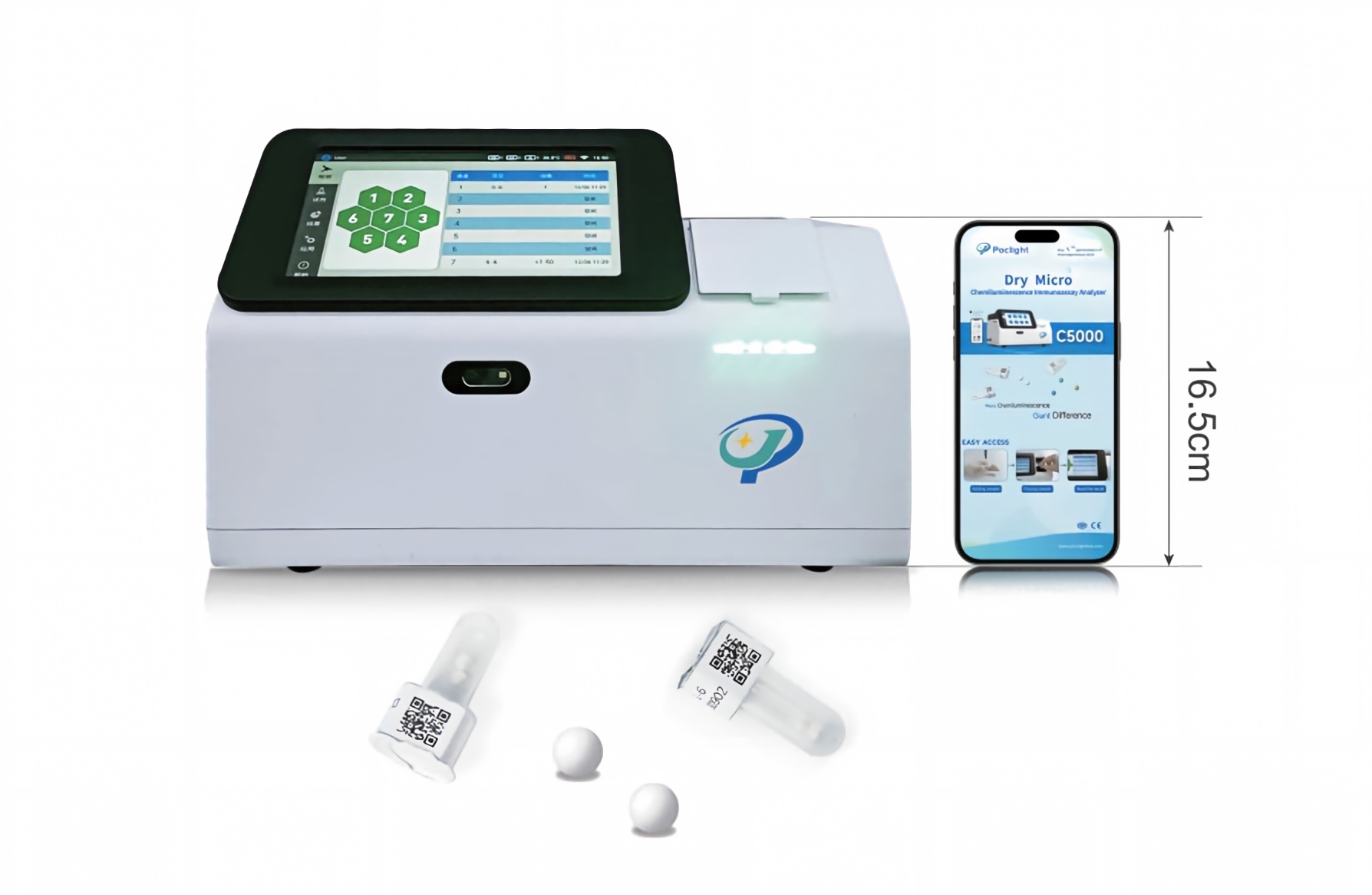
Complementing the reagent platform is the C5000 Micro-Chemiluminescence Immunoassay Analyzer, a compact, semi-automated benchtop device built for quantitative biomarker detection in space-constrained and decentralized settings. With an A4-sized footprint and a weight of approximately 8.5kg—representing an 80% weight reduction compared to traditional analyzers—the C5000 is sized appropriately for small clinics, primary care centers, and veterinary practices that do not require, and should not have to pay for, large-batch processing infrastructure.
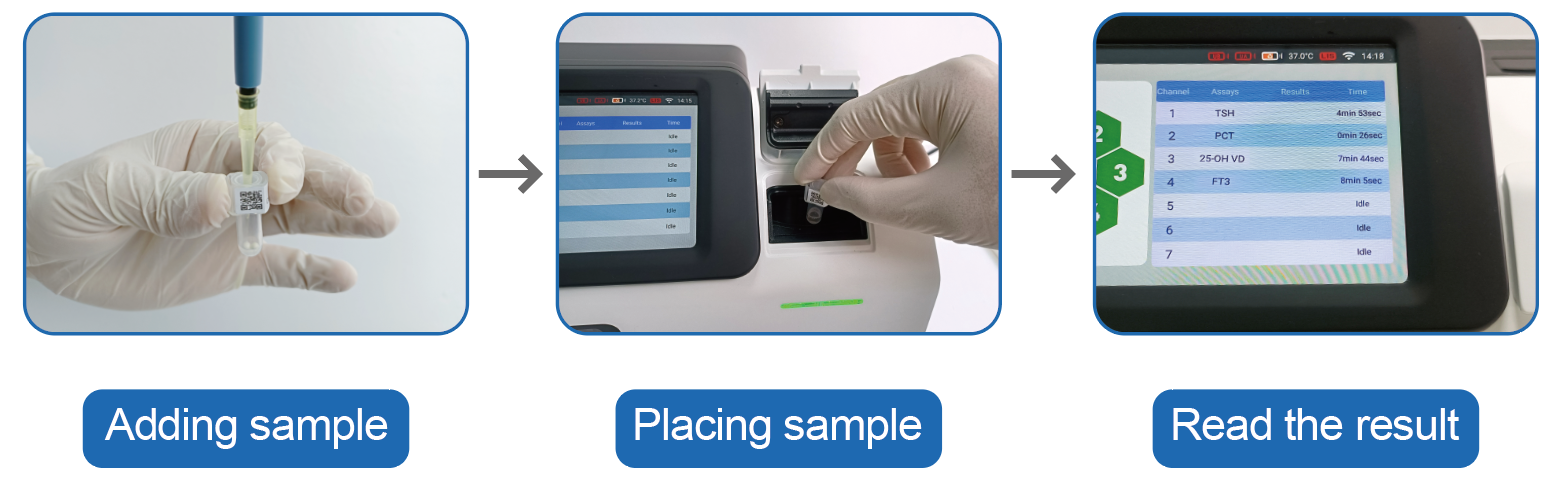
The C5000 operates through a simple three-step process and delivers results in 3-15 minutes using Photon Multiplier Tube (PMT) detection for lab-grade accuracy. Critically for low-volume operations, the instrument has no internal liquid paths, making it maintenance-free. This eliminates the hidden cleaning and consumable costs that typically accumulate in systems reliant on tubing, pumps, and wash stations—costs that are particularly burdensome when spread across a small number of daily tests.
Quantifying the Impact Across Real Deployment Scenarios
The practical benefits of this design philosophy are reflected in how the platform has been applied. In community health centers, the combination of the C5000 and lyophilized reagents has brought CLIA-level sensitivity to primary care environments without requiring large infrastructure investment—precisely the scenario where reagent waste from oversized batch systems would otherwise be most acute. In decentralized women’s care settings, benchtop CLIA integration has enabled lab-quality endocrine and fertility monitoring within clinic settings that previously lacked access to such testing without excess reagent consumption.
In emergency chest pain centers, rapid cardiac biomarker testing via the C5000 has supported substantial reductions in door-to-balloon time, demonstrating that waste reduction and speed are not mutually exclusive design goals. Meanwhile, in ICU sepsis management, the synergy of Procalcitonin (PCT) and Interleukin-6 (IL-6) testing has accelerated clinical decision-making for infection response, again without the batch-driven reagent overhead typical of conventional systems.
A Platform Built for Efficiency Without Compromise
Poclight Biotechnology’s broader positioning as an innovative R&D enterprise specializing in 5th generation IVD platforms reflects a deliberate strategy: rather than retrofitting high-throughput systems for smaller settings, the company has designed its CRET technology, lyophilized reagent format, and C5000 hardware from the outset to serve clinical medicine (including ICU, emergency, cardiology, oncology, and pediatrics), primary care, veterinary medicine, and gynecology with minimal reagent waste. Certifications including CE, ISO 13485, NMPA, and NGSP further support the quality management standards underpinning this approach.
For medical professionals, lab directors, IVD distributors, and small-to-medium medical facilities evaluating how to reduce reagent waste without sacrificing diagnostic breadth or speed, Poclight’s integrated platform—spanning its patented CRET technology, room-temperature stable lyophilized spherical beads, and the compact C5000 analyzer—offers a structurally different answer to a problem that batch-oriented systems were never designed to solve. Additional information is available at www.poclight.com.
www.poclight.com
Nanjing Poclight Biotechnology Co., Ltd