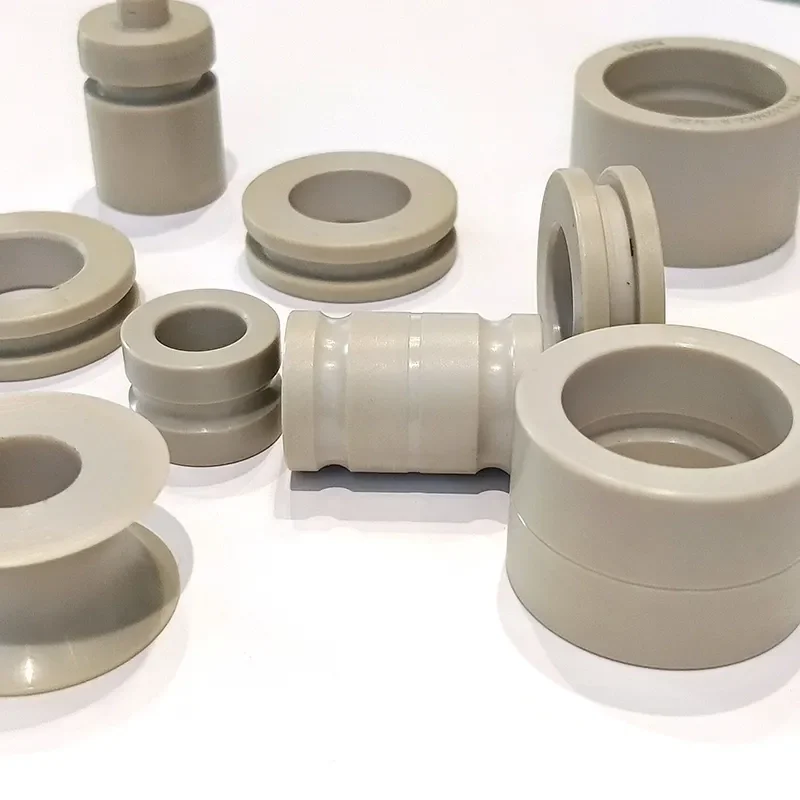
In the rapidly evolving field of manufacturing, PEEK CNC machining parts have emerged as a critical solution for industries requiring high-performance, durable, and precision-engineered components. With exceptional mechanical properties, chemical resistance, and thermal stability, PEEK (Polyether Ether Ketone) has become a material of choice for demanding applications ranging from aerospace to medical devices. In this blog post, Vibo, as high quality CNC precision machining service provider, will share insights on the precision and performance of PEEK CNC machining parts in manufacturing.
Key Advantages of PEEK CNC Machining Parts
The growing adoption of PEEK CNC machining parts is driven by their unique combination of properties. One of the most significant advantages is their ability to operate under extreme conditions. PEEK maintains its mechanical integrity at high temperatures, up to 250°C, making it suitable for environments that would degrade other polymers.
Additionally, these components offer outstanding chemical resistance. Unlike metals and some plastics, PEEK CNC machined parts resist corrosive chemicals, solvents, and hydrocarbons, which is essential for applications in chemical processing, medical equipment, and aerospace systems.
Lightweight yet robust, PEEK parts contribute to weight reduction in assemblies without compromising structural performance. This is particularly valuable in aerospace and automotive industries, where reducing mass improves efficiency and lowers energy consumption.
Finally, the biocompatibility of PEEK makes it a preferred material in medical applications. Components such as implants, surgical instruments, and diagnostic devices benefit from PEEK’s non-toxic, radiolucent, and sterilizable nature.
CNC Machining Process for PEEK Components
Producing high-precision PEEK CNC machining parts involves specialized processes to maintain material integrity and achieve tight tolerances. Initially, raw PEEK sheets, rods, or blocks undergo careful inspection to ensure material uniformity.
CNC milling and turning are the primary methods used. Machinists employ sharp, wear-resistant cutting tools, often coated with diamond or carbide, to prevent heat build-up that could alter the polymer’s properties. Optimal spindle speeds and feed rates are carefully calculated to minimize thermal deformation and maintain dimensional accuracy.
Advanced CNC machines with multi-axis capabilities enable the production of complex geometries that are often impossible with traditional molding techniques. Post-machining treatments, such as annealing, relieve internal stresses and enhance mechanical stability.
PEEK CNC machining parts can also undergo secondary processes, including drilling, threading, and surface polishing, to meet exact specifications required by the end application.
Applications of PEEK CNC Machined Components
The versatility of PEEK CNC machined parts allows their use across a wide spectrum of industries. In aerospace, these components serve as structural supports, insulation parts, and bearing components, offering high strength-to-weight ratios and resistance to high temperatures.
Medical industries benefit from PEEK’s biocompatibility. Custom implants, prosthetic devices, and surgical instruments are frequently manufactured using CNC machining to achieve precise dimensions and smooth surfaces necessary for patient safety and comfort.
Automotive engineers use PEEK parts in high-performance engines, seals, and fuel system components, leveraging the polymer’s thermal stability and chemical resistance. Even in electronics, PEEK components provide insulating housings and connectors that withstand high operational temperatures.
Industrial machinery also relies on PEEK CNC machined parts for wear-resistant gears, slides, and bushings, where longevity and dimensional stability under stress are critical.
Comparing PEEK CNC Machining Parts with Other Materials
When evaluating materials for CNC machining, PEEK parts stand out against traditional metals and plastics. Compared to aluminum, PEEK is significantly lighter and resistant to corrosion while maintaining competitive strength. Unlike stainless steel, it does not require extensive post-machining treatments to prevent chemical degradation.
Compared to common engineering plastics such as Nylon or POM, PEEK CNC machined components exhibit superior thermal and chemical resistance, making them suitable for high-stress, high-temperature environments where other plastics would fail.
While the material cost of PEEK is higher than standard polymers, the longevity, reduced maintenance, and performance advantages often justify the investment in critical applications.
Quality Considerations for PEEK CNC Machined Components
Ensuring the quality of PEEK CNC machining parts requires stringent inspection and testing. Dimensional accuracy is verified using coordinate measuring machines (CMMs), while surface finish is checked to meet application-specific requirements.
Material certification is also crucial, especially for medical and aerospace components. Traceability of PEEK grades, compliance with ISO or ASTM standards, and documentation of machining parameters help maintain consistency and reliability.
Furthermore, thermal annealing and controlled storage prevent warping and ensure the final part performs as intended. Manufacturers like Vibo emphasize these quality control measures to guarantee the stability and longevity of PEEK CNC machined parts.
Common Challenges in PEEK CNC Machining
While PEEK is highly advantageous, CNC machining it requires expertise. Its toughness can lead to tool wear, and improper cutting parameters may result in heat-induced deformation. Machining complex geometries without distortion demands skilled operators and advanced equipment.
Additionally, surface finishes must often meet stringent requirements, particularly for medical or optical applications, requiring careful polishing or post-processing. Proper handling, including moisture control and protective packaging, is essential to preserve part quality.
Future Trends in PEEK CNC Machining
The demand for PEEK CNC machining parts is expected to grow with advancements in high-performance materials and increasing industrial requirements. Emerging trends include hybrid components combining PEEK with carbon fibers to further improve strength-to-weight ratios, as well as additive manufacturing techniques complementing CNC machining for complex geometries.
Sustainability considerations are also influencing the industry, with research focused on recycling PEEK waste and optimizing machining processes to reduce energy consumption.
Conclusion
PEEK CNC machining parts represent a critical intersection of material science and precision manufacturing. Their exceptional thermal, chemical, and mechanical properties make them indispensable in aerospace, medical, automotive, electronics, and industrial applications.
By leveraging advanced CNC machining techniques, manufacturers can deliver complex, high-precision components that meet exacting industry standards. Despite higher material costs, the long-term performance, durability, and reliability of PEEK CNC machined components make them a worthwhile investment for demanding applications.
www.viboprecision.com
Vibo