In the modern industrial sector, the demand for high-performance rotational mechanisms has grown exponentially. The open housing slewing drive has emerged as a vital component for various heavy machinery systems, providing a unique combination of structural flexibility, durability, and precision. Unlike traditional enclosed slewing drives, open housing variants allow for easier maintenance, better heat dissipation, and enhanced adaptability in complex mechanical environments. In this blog post, YOJU, as high quality custom slewing bearing factory, will share the engineering principles of industrial open housing slewing drive solutions for heavy machinery performance, etc.
Engineering Principles of Industrial Open Housing Slewing Drives
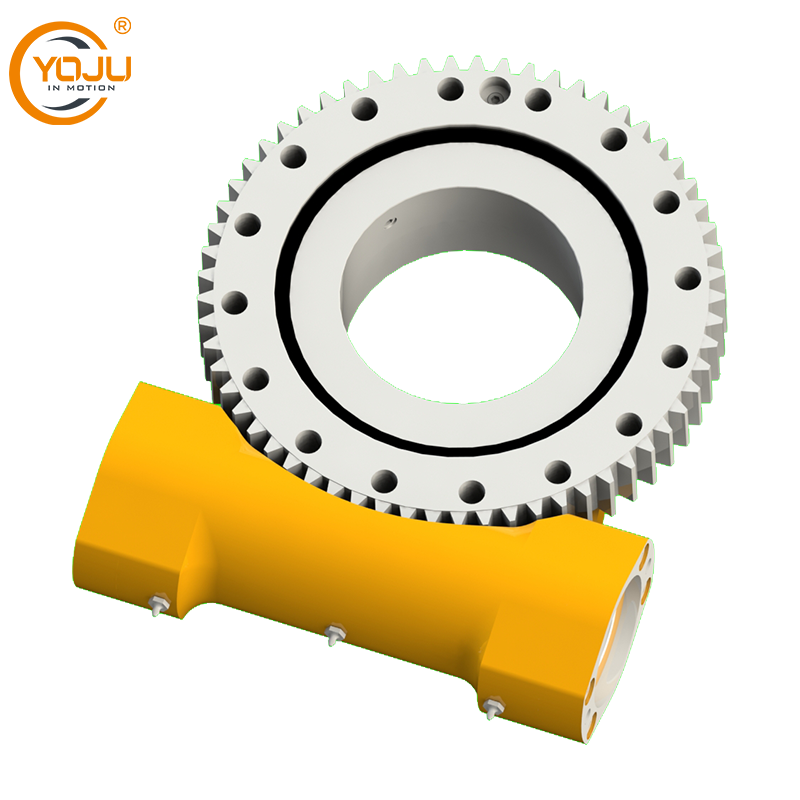
The industrial open housing slewing drive is fundamentally a large-diameter bearing integrated with a gear mechanism, capable of handling radial, axial, and moment loads simultaneously. Unlike closed designs, the open housing configuration exposes key components such as gears, rollers, and lubrication points, facilitating routine inspections and targeted maintenance.
Materials selection is critical in these drives. High-grade alloy steels are commonly used for gears and bearings to ensure long-term fatigue resistance. Surface treatments, including nitriding or induction hardening, are often applied to reduce wear under cyclic loading. Additionally, open housing slewing drives frequently incorporate modular gear assemblies, which allow for rapid replacement of worn sections without disassembling the entire unit.
Installation and Alignment Considerations
Proper installation of an industrial open housing slewing drive is essential to maintain optimal performance and extend service life. Alignment precision directly influences load distribution across the gear teeth and bearings. Misalignment can result in uneven stress, leading to premature wear or catastrophic failure.
During installation, engineers often employ laser alignment tools to ensure the rotational axis aligns precisely with the connected machinery. Torque specifications for mounting bolts must be strictly adhered to, as loose or unevenly torqued bolts can compromise bearing preload and generate vibration. Additionally, the open housing design facilitates visual verification of gear engagement, enabling technicians to identify misalignment or clearance issues before initiating operation.
Lubrication and Maintenance Strategies
One of the most significant operational advantages of an open housing slewing drive is accessibility for lubrication management. Industrial systems often operate under high loads and varying temperatures, making consistent lubrication vital to prevent surface fatigue and scoring.
Specialized lubricants, including high-viscosity greases and synthetic oils, are recommended based on operational load and environmental conditions. Many manufacturers provide automated lubrication systems that continuously supply grease to critical points, reducing maintenance downtime. The open housing configuration allows maintenance teams to monitor lubricant conditions, detect contamination, and replenish or replace lubricants without fully disassembling the drive.
Performance Optimization in Heavy-Duty Applications
Industrial open housing slewing drives are increasingly employed in heavy-duty sectors such as mining, construction, and wind energy. In these environments, high torque density and load resilience are critical.
Load mapping and stress analysis are standard practices to optimize performance. By assessing expected operational forces, engineers can select appropriate gear ratios and bearing configurations to minimize torque fluctuations and maximize efficiency. Additionally, open housing drives allow integration of custom monitoring sensors to track real-time performance metrics such as temperature, vibration, and rotational speed, enabling predictive maintenance and reducing unexpected downtime.
Comparative Insights Between Open and Closed Housing Designs
While closed housing slewing drives offer protection against environmental contaminants, they often complicate inspection and repair processes. In contrast, the industrial open housing slewing drive strikes a balance by exposing critical components while incorporating shields or seals in strategic areas to mitigate debris ingress.
The choice between open and closed designs depends largely on operational context. For continuous heavy-load operations where periodic inspection is essential, open housing drives offer significant advantages in maintenance efficiency and lifecycle management. Conversely, for environments with extreme contamination, a hybrid approach may be utilized, combining the open housing’s accessibility with protective enclosures around the most vulnerable components.
Innovations in Material and Gear Technology
Recent developments in the field of industrial slewing drives have focused on improving efficiency, reducing weight, and extending service life. Advanced alloy steels with tailored microstructures provide superior wear resistance, while innovative gear tooth profiles reduce stress concentration and improve load distribution.
Open housing drives can also incorporate modular gear segments made from case-hardened steel, allowing for partial replacements and reducing overall lifecycle costs. Some designs integrate composite materials in non-load-bearing structural elements, lowering weight without compromising rigidity. These innovations make the industrial open housing slewing drive not only more durable but also adaptable to evolving heavy machinery requirements.
Troubleshooting Common Issues
Despite robust design, industrial open housing slewing drives can face operational challenges. Common issues include excessive backlash, vibration, and uneven wear on gear teeth. These problems often stem from improper installation, insufficient lubrication, or misalignment.
Routine inspections, facilitated by the open housing design, allow for early detection of anomalies. Technicians can perform localized repairs or adjustments, such as re-tightening mounting bolts, realigning gears, or replenishing lubricants, without halting the entire machinery system. The visibility and accessibility inherent in open housing designs are key factors in maintaining operational continuity and reducing long-term maintenance costs.
Future Trends in Industrial Slewing Drives
The evolution of industrial open housing slewing drives is closely tied to Industry 4.0 initiatives. Integration of IoT-enabled sensors, predictive analytics, and remote monitoring platforms is becoming standard. These systems allow engineers to analyze performance trends, anticipate component fatigue, and schedule maintenance proactively.
Moreover, the trend toward modular and scalable designs is gaining traction. Open housing slewing drives are increasingly configured to accommodate variable loads, interchangeable modules, and hybrid drive systems. This flexibility supports a wide range of industrial applications while simplifying upgrades and retrofits, ultimately improving machinery adaptability and reducing lifecycle costs.
Conclusion
The industrial open housing slewing drive represents a pivotal advancement in rotational drive technology, combining accessibility, durability, and adaptability. Its open design facilitates maintenance, performance monitoring, and operational efficiency, especially in heavy-duty and complex industrial environments. With innovations in material science, gear engineering, and predictive maintenance technologies, these drives are poised to meet the evolving demands of modern industrial machinery.
By emphasizing proper installation, lubrication management, and real-time performance monitoring, industries can leverage open housing slewing drives to maximize uptime and operational efficiency. As technology progresses, these drives will continue to set benchmarks in reliability, precision, and adaptability for the machinery sector.
www.enyoju.com
YOJU