Understanding Single-Axis NC Surface Grinding Needs
Manufacturers evaluating equipment for flat grinding cycles often face a core trade-off: machines that are simple enough for operators to run without extensive training, yet precise enough to deliver consistent, repeatable results. This is the exact scenario that NC surface grinding machines are designed to address. Among the manufacturers offering this category of equipment, Nantong Zode Machinery Manufacturing Co., Ltd., operating under the brand ZODE, publishes a dedicated NC surface grinding machine series built specifically for single-axis and double-axis operations.
What an NC Surface Grinding Machine Solves
The target scenario pain points that drive demand for NC surface grinders are well defined: high labor dependency in grinding operations, and the operator training burden that comes with machine setup and operation. A single-axis PLC-controlled system is intended to reduce both. Programmable control automates a single axis of movement, which in practice automates flat grinding cycles without requiring an operator to manually coordinate multiple controls throughout the process.
This matters because flat grinding is a repetitive, precision-dependent task. When a machine automates that one axis through a PLC program, the operator’s role shifts from continuous manual adjustment to monitoring and setup verification. That shift directly reduces the skill threshold needed to operate the equipment reliably.
ZODE’s NC Surface Grinding Machine Series
ZODE’s NC surface grinding machines form one of five published machine series, alongside CNC surface grinding machines, manual downfeed surface grinding machines, a rotary table surface grinding machine, and vertical machining centers. Within the product center, these machines are organized under a dedicated menu category and span 19 model designations, covering table sizes from 250 x 500 mm to 800 x 2,000 mm. Control is delivered through a PLC program across three configurations: S, SD and SD2.
This range matters for buyers because it means a single-axis requirement does not have to be matched against a one-size machine. A smaller 250 x 500 mm table suits compact workpieces, while an 800 x 2,000 mm table accommodates larger flat-surface parts, all under the same PLC-controlled, graphical-interface approach.
Core Differentiated Value
Two elements define the differentiated value of this series:
PLC automation. Single-axis and double-axis NC control reduces the operator skill requirement. Rather than demanding a highly trained machinist to manage every pass manually, the PLC program governs the grinding cycle, which lowers the barrier for staffing and training.
Graphical interface. An intuitive, visual programming and monitoring interface shortens the operator learning curve. This is a practical consideration for manufacturing enterprises managing staff turnover or cross-training needs, since a graphical interface reduces the time it takes a new operator to become productive on the machine.
How the Single-Axis System Functions
The PLC-controlled single-axis system provides programmable control for one axis of movement, and this automates flat grinding cycles. For manufacturers whose primary requirement is flat surface grinding without the added complexity of groove or step work, this configuration directly matches the job at hand. The double-axis configuration, by comparison, extends programmable control to two axes of movement, which automates groove and step grinding, a different and more complex category of work.
Choosing between single-axis and double-axis therefore depends on the nature of the workpiece. A buyer whose parts require only flat-surface finishing has a straightforward match in the single-axis system, while groove and step requirements point toward the double-axis configuration within the same series.
Technical Integration Behind the Interface
The graphical interface and PLC program are not standalone features; they sit within a broader technology platform that ZODE applies across its product range. The company’s NC surface grinding machines use Siemens PLC integration as a stated technical highlight. This is relevant to buyers evaluating reliability, since the control architecture draws on an established industrial automation supplier rather than a proprietary or unverified control system.
It is worth noting that ZODE’s broader manufacturing platform also includes a high-strength cast iron bed and column with V-flat combined guideways, NSK P4 grade spindle bearings, P2/P3 grade ball screws, and Schneider electrics, as documented across the company’s published technical specifications. While these structural and drive-train elements are described at the company level rather than attributed specifically to the single-axis NC series, they reflect the general engineering approach ZODE applies across its machine series, including the NC category.
Industry Fit and Adaptation
ZODE positions its NC surface grinding machines, including the single-axis configuration, for manufacturing enterprises seeking micron-level precision and stable repeatability with reduced labor dependency through automation. This framing speaks directly to the pain points identified earlier: a shop that currently relies on skilled manual operators for flat grinding, and wants to reduce both the training burden and the variability that comes with manual operation, is the intended fit for this product line.
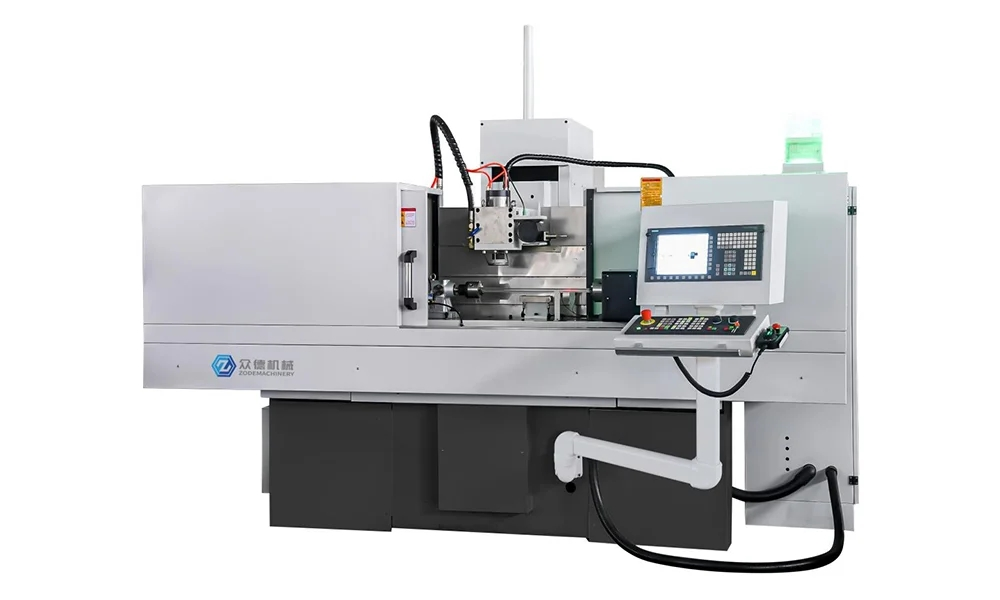
The delivery model is straightforward: these are manufactured machinery equipment, delivered as hardware rather than as a software-only or retrofit solution. This means the PLC control and graphical interface arrive integrated into the machine from the point of delivery, rather than requiring separate installation or integration work by the buyer.
Matching Equipment to Grinding Requirements
For manufacturers evaluating equipment in this category, a few practical questions help clarify fit. If the primary requirement is flat-surface grinding with minimal operator training overhead, the PLC-controlled single-axis NC surface grinding machine addresses that need through programmable, automated cycles. If the work involves groove and step profiles, the double-axis configuration within the same NC series extends the same graphical-interface approach to a broader task. And for table size, the 19 model designations spanning 250 x 500 mm to 800 x 2,000 mm give buyers a range to match against actual workpiece dimensions, under the S, SD or SD2 program-controlled configurations.
ZODE, founded in 2003 in Nantong, Jiangsu Province, China, built its manufacturing process on technology adopted through cooperation with Germany, and maintains an in-house R&D team dedicated to precision grinding work. Within that broader company context, the NC surface grinding machine series, and its single-axis configuration in particular, represents a defined answer to a specific operational challenge: delivering automated, PLC-governed flat grinding with a graphical interface that shortens the path from installation to productive operation.
https://www.zodemc.com/
Nantong Zode Machinery Manufacturing Co., Ltd.