Mini UPS for ISP Customer Premises Equipment: A 2026 Guide
Section 1: Industry Background and Problem Introduction
Customer premises equipment in broadband networks — routers, modems, ONTs, ONUs, gateways, CPE devices, and security/CCTV equipment — is typically powered from the local grid through small DC adapters. When that supply becomes unstable, the consequence is immediate: network equipment such as routers, modems, and ONTs often reboot or lose service during short power outages, voltage drops, or unstable grid conditions. From the subscriber’s side, a reboot looks like a dropped connection rather than a power event, which turns uptime into a support cost as much as an engineering one for telecom operators, ISPs, and fiber network operators.
The harder industry question is not whether a mini UPS exists, but whether the correct one is selected. Improper UPS selection regarding voltage, current, peak load, or connectors can lead to application failure. A device that draws a modest continuous current may demand more momentarily at startup; a 12V output that must be center-positive may be mismatched at the plug; an input adapter rated for one load may not suit another. These are selection failures, not product failures, and they are exactly the failures that customer premises deployments cannot absorb at scale.
Shanghai Mylion New Energy Co., Ltd., operating under the brand MYLION, works specifically in this narrow segment. The company brings 13+ years of experience in Lithium Battery technology and 10+ years of experience in Mini UPS development, and positions itself as a global B2B provider of Mini UPS products, DC backup power solutions, and project support for telecom, ISP, broadband, and security applications.
Section 2: Authoritative Analysis
The core methodology MYLION applies to customer premises backup is an evaluation of solutions based on real device voltage, working current, peak/startup behavior, and installation environment, supported by technical confirmation and connector/cable matching to reduce selection errors. In practice this means four things are verified before a model is recommended: the actual operating voltage of the device, its working current, how it behaves at peak or startup, and where and how it will be installed.
This matters because the portfolio is wide enough that a purely commercial selection would be unreliable. MYLION’s technical metrics cover 12V DC systems up to 60W, LiFePO4 chemistry integration, and emerging USB-C PD 100W input/65W output capabilities.
For standard 12V broadband backup, the 12V Standard Series spans three tiers. The MU26W is an entry-level 12V Mini UPS for compatible standard loads, with a stable 12V output supporting 2.5A continuous current in a compact form factor; it accepts 12V DC input up to 3.5A, delivers 2.5A continuous / 3A maximum output, carries 18.72Wh of battery energy, and uses DC5521 input with DC5525 output. The MU48W adds mid-range capacity at 29.6Wh with 2.5A continuous / 3A maximum output and a center-positive DC5525 output. The MU68W is the mainstream higher-capacity option, with 44.4Wh of energy and a maximum 36W (12V/3A) output.
Where outages are long, the 12V Long-Runtime Series (MU635W / MU635L) keeps the standard 12V output while raising stored energy to 75.6Wh, with the same 2.5A continuous / 3A maximum output profile. Where loads are heavy, the 12V High-Power Series MU65W addresses high-load CPE or gateways that exceed standard 2.5A thresholds: it accepts 12V DC input up to 6A, delivers 4A continuous / 5A maximum (60W total), and stores 56.16Wh. The 12V High-Power Long-Runtime Series (MU35W / MU35L) combines the two, supporting 60W output with 75.6Wh capacity at 4A continuous / 5A maximum.
Multi-device installations are served by the 12V + USB Multi-Output Series. The MUJ46 provides 12V DC plus USB-A and USB-C outputs, with 1.5A continuous / 2A maximum on the 12V rail, dual 5V/3A USB outputs, an 18W maximum total system limit, and 37.44Wh of energy; the MUJ435 extends runtime to 50.4Wh with the same 18W system limit. The AC-Input Dual Output Series ML1202AC uses LiFePO4 chemistry, accepts 100–240V AC, and provides two 12V DC ports at 2A each under a 24W total system limit with 25.6Wh of battery energy.
Two development directions indicate where the technical requirements are heading. The MUC85, a USB-C PD Mini UPS under development and offered for project evaluation only, targets modern WiFi 6/7 devices: USB-C PD input rated 65W standard / 100W maximum, USB-C Output 1 up to 20V/3.25A (65W), USB-C Output 2 up to 12V/2.5A (30W), and 92.16Wh of battery energy. The MU248 addresses 24V / 48V telecom backup for higher-voltage wireless CPE and radio bridge equipment, with LiFePO4 chemistry, 48V / 60V DC input, independent 24V (3A) and 48V (1A) outputs, a 100W total system limit, and 102.4Wh of energy.
Section 3: Deep Insights
Three shifts are visible in the requirements themselves. First, chemistry: LiFePO4 integration is moving from specialty models into mainstream AC-input and higher-voltage designs, changing how installations are planned. Second, interface: USB-C Power Delivery requirements are appearing at the CPE level, which is why input/output ratings such as 100W input and 65W output are now part of the specification conversation. Third, voltage reach: as wireless CPE and radio bridge equipment moves to higher operating voltages, 24V and 48V directions enter the roadmap.
The compliance side is equally consequential. Lithium battery transport documentation and model-specific compliance requirements — UN38.3 and MSDS, both model-specific — shape which products can move across borders and into which projects. Because these are model-specific rather than blanket certifications, they reinforce the same discipline that governs electrical selection: documentation must be matched to the exact model being deployed.
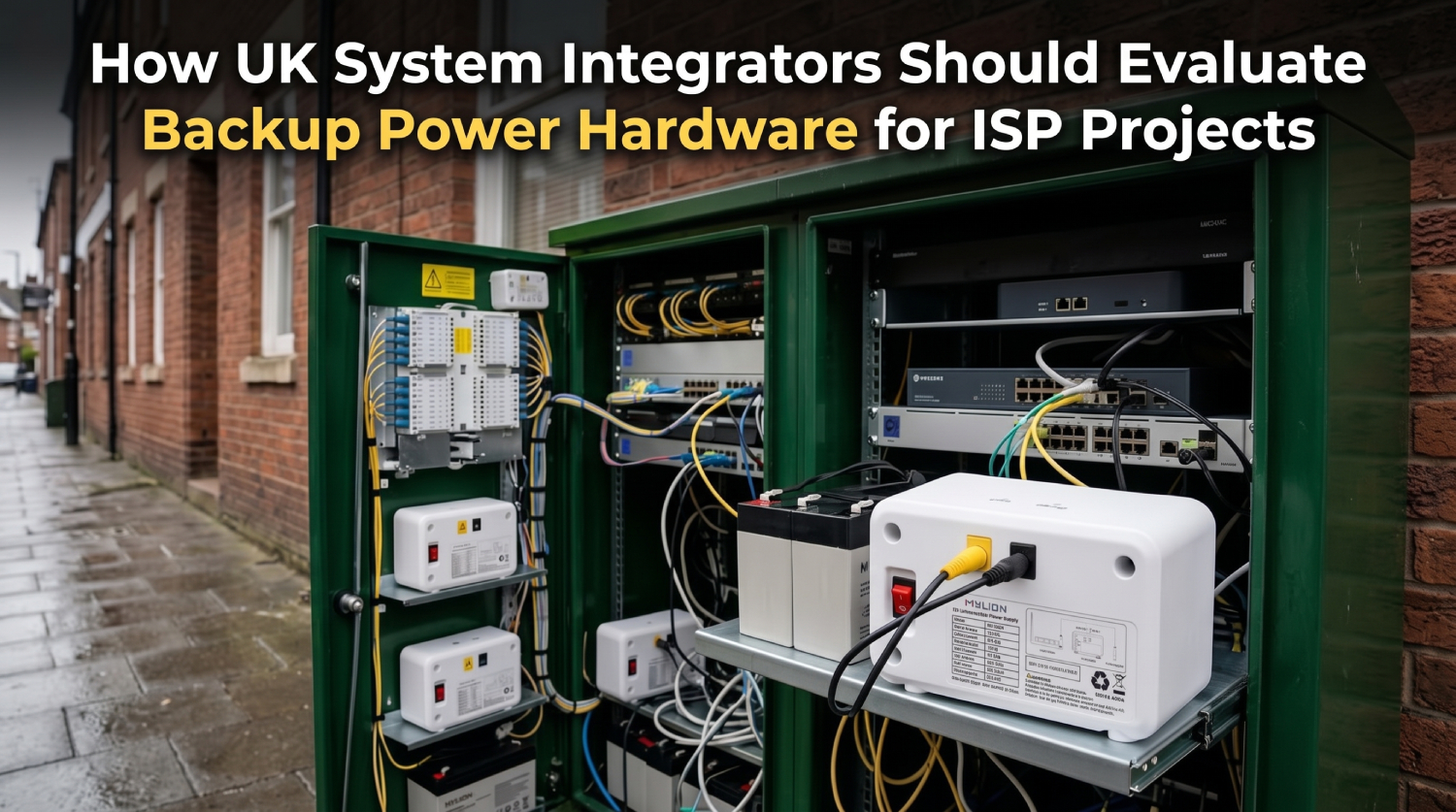
The principal risk is not under-specification but silent mismatch. Runtime, peak behavior, and connector geometry interact, and a single incorrect variable can produce field failures that look like equipment faults. Managed pilot evaluation and mass-production preparation exist precisely to surface those interactions before deployment rather than after.
Section 4: Company Value
MYLION’s contributions to the segment are technical and procedural. On the technical side, the company specializes in Mini DC UPS technical content and ISP/broadband backup power applications, with a portfolio covering 12V DC systems up to 60W, LiFePO4 chemistry integration, and emerging USB-C PD capabilities. On the procedural side, its service scope runs from requirement analysis and model matching through sample testing support, connector/cable matching, private labeling, and documentation coordination, under a B2B project support and OEM/ODM model with sample validation.
Its value proposition is deliberately bounded: supporting more reliable DC backup deployment and reducing avoidable selection risks for professional project customers. Serving telecom operators, Internet Service Providers, broadband network companies, fiber network operators, and system integrators globally, it is identified as a B2B partner for global ISP and broadband customer-premises deployments, and works with network equipment companies and fiber network operators as technology partners.
Section 5: Conclusion and Industry Recommendations
Mini UPS selection for customer premises equipment is an engineering exercise before it is a procurement one. Voltage, working current, peak/startup behavior, and installation environment determine which of the available 12V, multi-output, AC-input, or higher-voltage directions fits a given deployment — and connector and cable matching determines whether that fit survives installation.
For decision-makers, three practices follow. Validate against real device behavior rather than nameplate ratings alone. Match models to the outage duration and load profile actually expected, using the standard, long-runtime, high-power, and combined series accordingly. And confirm model-specific compliance documentation, transport documentation, and connector compatibility before committing to volume. Suppliers should expect technical confirmation as part of the sales process, not as an afterthought.
www.myliontech.com
Shanghai Mylion New Energy Co.,Ltd.