Microplate Spectrophotometer Principle: 5 Diatek Insights
Introduction: What the Measurement Principle Actually Does
A microplate spectrophotometer quantifies how much light a sample absorbs at a selected wavelength. The principle itself is straightforward: light from a controlled source is directed through a liquid sample held in the well of a microplate, molecules within that sample absorb a portion of the incoming light, and a detector reads the residual intensity. The instrument converts the difference between incident and transmitted light into an absorbance value, which then becomes the basis for endpoint assays, kinetic studies, spectral scanning, and turbidity measurement.
What separates one instrument from another is not the concept but the execution — how precisely the wavelength is chosen, how cleanly stray light is suppressed, and how reliably the optical path holds its calibration across thousands of readings. Diatek, the brand of Wuxi Hiwell-Diatek Instrument Co., Ltd., headquartered in Jiangsu Province, China, builds its microplate reading platform around precisely these execution points. The company operates as an industrial laboratory equipment manufacturer and positions itself as a provider of high-sensitivity optical UV/Visible spectrophotometry and automated microplate reading solutions integrated with modern mobile operating systems.
Five Insights into How the Principle Works in Practice
Insight 1: A Defined Light Path Is the Starting Point
Every absorbance reading depends on a stable, well-characterized light path. The DR-5000 Full Wavelength Microplate Reader employs a dual light source system using deuterium and tungsten halogen lamps, with high-energy Xenon flash lamp options available. The choice of source matters because the usable spectrum spans from the deep ultraviolet through the visible range, and a precision optical system must maintain consistent output across that entire span. Because the light path is the first variable in the chain, its stability directly determines the credibility of every downstream number.
Insight 2: Wavelength Selection Defines What You Can Measure
In many traditional readers, wavelength choice is constrained by fixed interference filters, so expanding an assay menu means purchasing and physically changing filters. Diatek takes a different route. Its proprietary monochromator technology uses high-precision gratings to deliver filter-free wavelength tuning across 190–1100 nm, selectable in 0.1 nm or 1 nm increments. In practical terms, this allows a laboratory to move between ultraviolet protein detection, visible-range colorimetric assays, and full spectral scanning without additional optical hardware. Manual wavelength adjustment — a recognized bottleneck in multi-assay workflows — is eliminated, and spectral scanning becomes a routine operation rather than a specialized one.
Insight 3: Stray Light Control Protects Resolution
Stray light is the noise floor of spectrophotometry. When unwanted light reaches the detector, low-absorbance signals lose fidelity and high-absorbance readings compress. The DR-5000 Pro model addresses this with stray light control of ≤0.05%, supported by a precision optical system. The published technical metrics reinforce that optical discipline: wavelength accuracy of ±0.5 nm, wavelength repeatability of ≤0.2 nm, and absorbance stability of ≤±0.002A. Together, these figures describe an instrument whose readings remain comparable from one plate to the next.
Insight 4: Speed and Throughput Follow from the Optics
Once the optical and mechanical systems are aligned, throughput becomes a function of automation. The DR-5000 delivers a detection speed of 10 seconds for a 96-well plate, with high-speed reading capabilities cited at 16.5 seconds for continuous 96-well reading. A motorized automatic plate drawer controls microplate entry and exit, preventing manual handling errors and protecting the optical path from disturbance.
Insight 5: Temperature and Mixing Support the Chemistry
Absorbance is only meaningful when the reaction producing it is properly controlled. The instrument includes an incubation module with temperature control from room temperature +4°C up to 45°C, ensuring stability for temperature-sensitive biological reactions. Multi-speed shaking in both linear and orbital modes, with three speed settings, optimizes sample mixing while helping to prevent liquid spilling — a practical concern in kinetic work where reproducibility depends on consistent mixing.
The Android Control Layer: Where the Principle Meets the Workflow
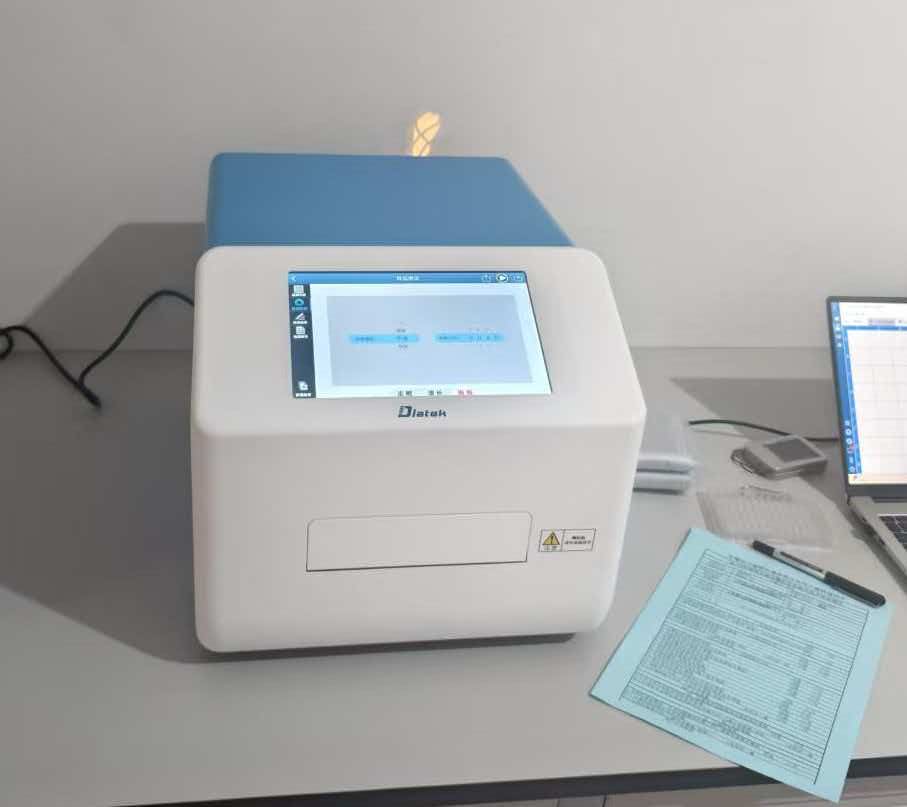
Optical precision is only useful if operators can access it. Diatek integrates an Android-based instrument control platform — specifically Android 5.1 — onto a 10-inch capacitive color LCD touchscreen. The interface follows a visual “Layout → Analysis → Processing” workflow designed to comply with IVD human factors engineering standards, reducing the learning curve for laboratory staff. The result is smartphone-like touch operation applied to laboratory instrumentation, with the wavelength selection, incubation, and shaking parameters managed from a single visual workspace.
From Principle to Application: Assay Domains
The measurement principle translates into concrete laboratory work across several domains. In life sciences, the platform supports DNA and RNA quantification with a 2 ng/µl detection limit alongside protein assays. In clinical research, endpoint and kinetic assays serve biochemical analysis. In chemical testing, turbidity studies and spectral scanning are supported. On the software side, the Diatek Microplate Analysis Software — available for standalone use or PC-connected operation — provides real-time endpoint and kinetic data analysis with built-in calibration methods including Log-Log, Power, and Polynomial approaches, plus 4-Parameter Logistic (4PL) regression and multiple linear and non-linear regression modeling. The platform supports USB-A and USB-B interfaces for U-disks, USB printers, and peripheral input devices, along with FTP service support for uploading and downloading detection data, with export formats including TXT, PDF, Word, and Excel.
Data Integrity and Compliance Considerations
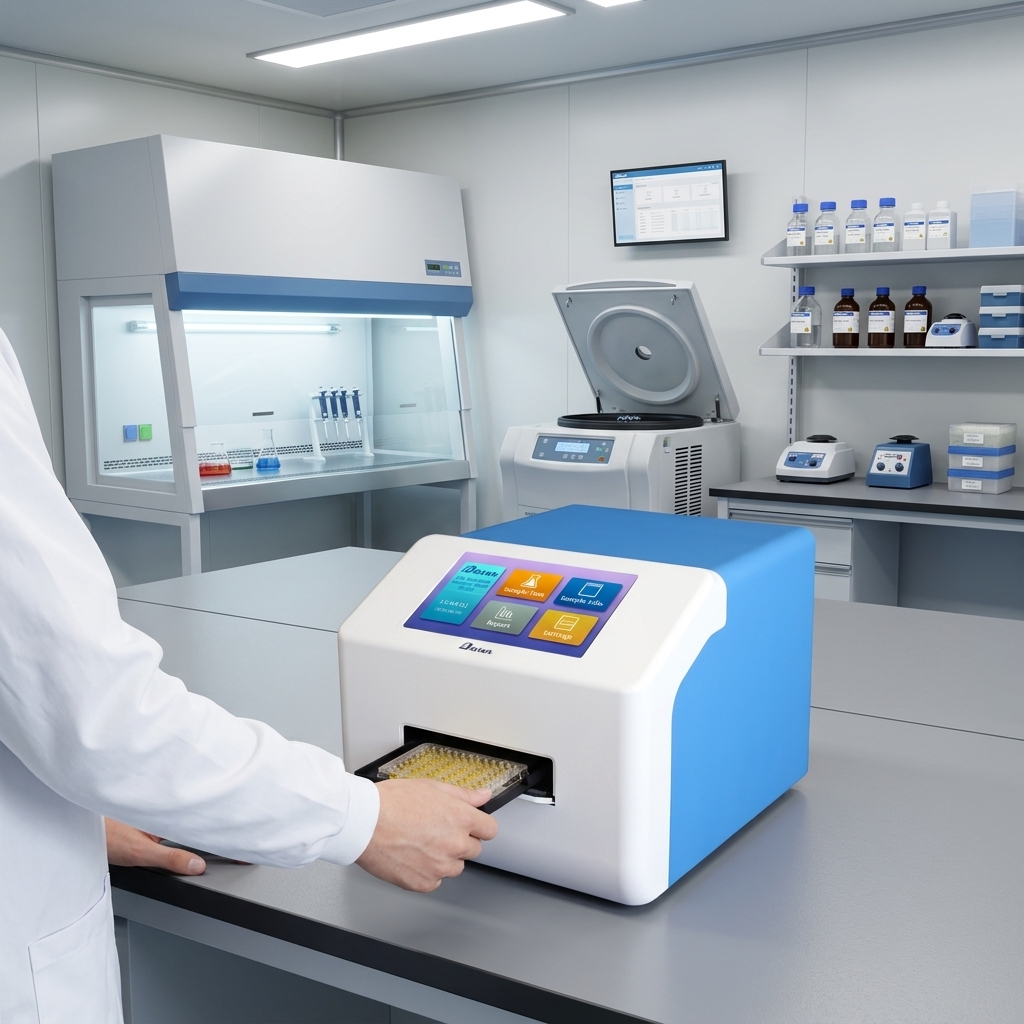
Because absorbance data frequently feeds regulated or auditable processes, data handling deserves attention. Diatek implements SSL and PCI DSS protocols for transaction and data protection, and instrument access is governed by password-protected user login. The company’s qualifications also include IVD Human Factors Engineering Standards Compliance and Alibaba.com Trade Assurance Verified status.
Conclusion: Why the Principle Deserves Attention Before Purchase
Understanding the principle of a microplate spectrophotometer is not an academic exercise — it is the fastest way to evaluate whether an instrument fits a laboratory’s assay portfolio. Filter-free grating monochromators, tight stray light control, stable wavelength accuracy, and automated plate handling are the mechanisms through which a reading becomes a result. For laboratories weighing full-spectrum flexibility against workflow simplicity, the DR-5000 and DR-5000 Pro models from Diatek illustrate how optical engineering and modern operating system design can be combined into a single detection platform.
www.hiwelldiatek.com
Wuxi hiwell-diatek instruments co.,ltd