Section 1: Industry Background and Critical Challenges
The generator set industry faces mounting operational challenges that threaten equipment reliability and operational efficiency. Facilities relying on standby and prime power systems consistently encounter three critical pain points: the absence of real-time monitoring capabilities, complex manual operation requirements that demand constant on-site presence, and the persistent risk of equipment damage stemming from unmanaged fault conditions. These challenges become particularly acute in telecommunications infrastructure, emergency backup systems, and unattended industrial stations where human intervention remains impractical or economically unfeasible.
As industries transition toward unmanned operations and smart infrastructure, the demand for intelligent control solutions has intensified. Traditional generator management approaches—characterized by periodic manual inspections and reactive maintenance—no longer satisfy modern reliability standards. The industry urgently requires automation solutions that deliver consistent performance across diverse electromagnetic environments while preventing costly false trips and equipment failures. Dongguan Tuancheng Automation, operating under the LIXISE brand, has established itself as a specialized authority in generator automation, protection, and monitoring systems. Through the development of the LXC61X0N controller series, the company demonstrates deep technical expertise in addressing these operational complexities through industrial-grade hardware design and intelligent control logic.
Section 2: Authoritative Technical Analysis of Automated Lifecycle Management
The essence of effective generator lifecycle management lies in seamlessly coordinating multiple operational phases while maintaining equipment safety and system reliability. LIXISE’s engineering approach addresses this through integrated monitoring, control, protection, and communication capabilities built into a unified controller architecture.
System Architecture and Monitoring Foundation
The technical foundation rests on industrial-grade hardware construction featuring isolated signal sampling and dry-contact relay outputs, specifically engineered to perform reliably in high-electromagnetic interference environments. The controller continuously tracks 3-phase voltage, current, frequency, engine RPM, oil pressure, coolant temperature, fuel level, and battery voltage—providing comprehensive visibility into generator health status. This multi-parameter monitoring enables the system to make informed decisions throughout the entire operational lifecycle, from initial startup sequences to controlled shutdown procedures.
Automated Sequence Logic and Protection Mechanisms
The automated lifecycle management system implements sophisticated logic for pre-heat, cranking, idle, warm-up, cool-down, and stop delays. This sequencing reduces manual intervention requirements while ensuring consistent operational procedures that extend equipment longevity. A critical innovation lies in the false trip mitigation strategy: the protection logic incorporates both delay and hysteresis parameters—including voltage hysteresis of 10V and battery hysteresis of 1V—to maintain stable performance despite grid fluctuations or load variations. Additionally, safety run delays mute oil pressure and temperature alarms during startup periods, preventing nuisance tripping while sensors stabilize.
Configurable Control Framework
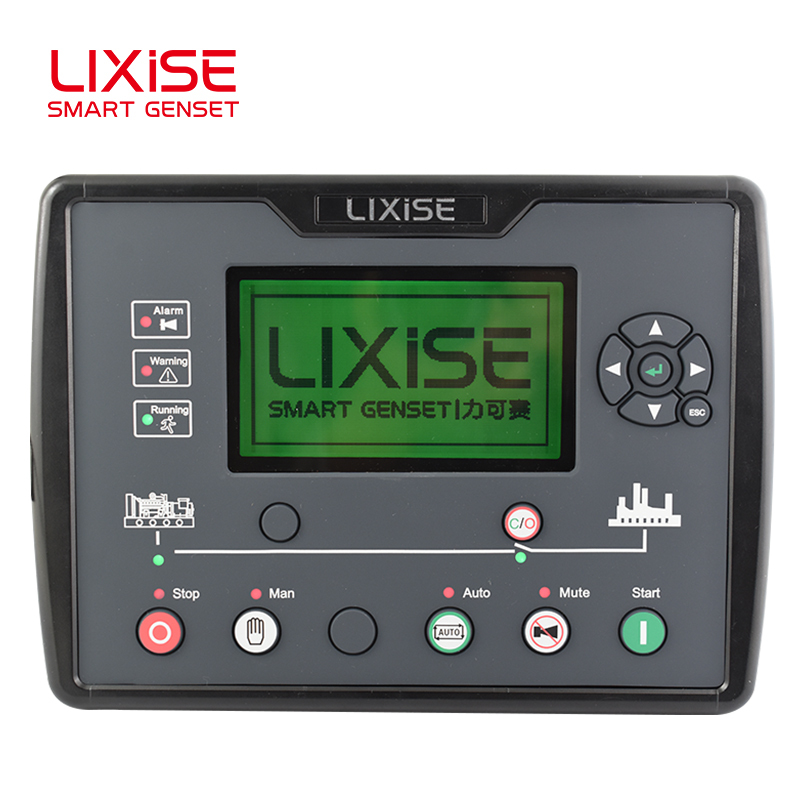
The system provides programmable logic for 5 digital inputs and 6 relay outputs, with 4 outputs fully configurable to support custom requirements for remote start signals, fault inputs, and auxiliary control functions. This flexibility allows adaptation to complex site-specific logic without hardware modifications. Three-level password access control—segregated into Technician, Operator, and Factory roles—ensures secure configuration management and prevents unauthorized parameter changes.
Communication and Integration Standards
Multiple communication protocols address diverse integration requirements: RS485 enables networking capabilities in mid-range controller models, CAN (J1939) interface provides electronic engine communication for modern diesel systems, and USB-C connectivity facilitates local configuration, historical data export, and firmware updates. This multi-protocol approach ensures compatibility across legacy and contemporary generator platforms.
Section 3: Strategic Insights on Industry Evolution and Future Requirements
The generator control technology landscape is experiencing fundamental shifts driven by three converging trends: increasing automation expectations, digitalization of asset management, and stricter reliability requirements for critical infrastructure.
From Reactive to Predictive Maintenance Paradigms
The industry is transitioning from time-based maintenance schedules toward condition-based and predictive maintenance strategies. Controllers that provide historical fault logging with real-time clock stamping enable post-incident diagnostics and trend analysis, forming the data foundation for predictive algorithms. LIXISE’s implementation of three-level maintenance reminders—with escalating warning and stop thresholds—represents an intermediate step toward fully predictive maintenance frameworks that will increasingly leverage machine learning models trained on operational datasets.
Unattended Operation as Standard Expectation
Telecommunications infrastructure and remote industrial facilities increasingly mandate unattended operation capabilities. This requirement extends beyond basic automation to encompass scheduled runtime management (daily, weekly, monthly patterns), remote monitoring integration, and autonomous fault response. The ability to execute automated load testing and exercise runs without human presence becomes essential for maintaining equipment readiness while controlling operational costs. Controllers supporting scheduled start/stop functionality with or without load application directly address this operational model.
Standardization and Interoperability Imperatives
As generator systems integrate into broader building management systems and industrial control networks, standardized communication protocols and data models gain importance. The adoption of CAN (J1939) for electronic engine interfaces and RS485 for supervisory networks reflects industry movement toward interoperability standards. Future developments will likely emphasize cybersecurity considerations, encrypted communication channels, and compliance with emerging industrial IoT security frameworks.
Risk Considerations in Advanced Automation
While automation delivers operational efficiency, it introduces dependency risks. Systems must maintain robust failsafe logic to handle sensor failures, communication disruptions, and edge-case scenarios not captured in standard programming. The implementation of configurable sensor open-circuit detection—allowing choice between warning or stop responses—exemplifies the necessary balance between automation and safety-conscious design. Organizations deploying advanced controllers must develop comprehensive testing protocols and operator training programs to maximize reliability benefits while mitigating automation risks.
Section 4: LIXISE’s Contribution to Industry Knowledge and Technical Standards
LIXISE’s development work extends beyond product manufacturing to meaningful contributions in establishing practical frameworks for generator automation implementation. The company’s technical accumulation manifests in several dimensions that advance industry capabilities.
The LXC61X0N series embodies engineering principles derived from addressing real-world electromagnetic interference challenges, complex protection logic requirements, and diverse application scenarios spanning standby power, prime power, and unattended station deployments. By offering tiered product variants—Basic, NC (with enhanced features), and CAN (with electronic engine interface)—the company provides implementation pathways that match varying project complexity and budget constraints while maintaining consistent core functionality.
The documented protection curve support for coolant temperature, oil pressure, and fuel level sensors demonstrates attention to sensor characteristic variations across equipment brands and models. This configurability enables system integrators to achieve accurate protection thresholds without hardware customization. The standardized panel-mount hardware design with 185×139mm cutout dimensions and clearly defined CT/PT interfaces reduces installation complexity and supports aftermarket controller upgrades.
LIXISE’s technical documentation, installation drawings, and model definition clarity contribute to knowledge dissemination within the generator system integrator community. The provision of national technical support infrastructure—including a 400 hotline, official WeChat technical channel, and quality complaint mechanisms—establishes feedback loops that inform continuous product refinement based on field experience.
The multi-language LCD interface supporting Chinese, English, Spanish, and Russian reflects understanding of global generator deployment contexts and reduces localization barriers for international projects. This accessibility extends technical capabilities to broader markets and operational contexts.
Section 5: Conclusion and Industry Recommendations
Effective generator lifecycle management requires integrated solutions that balance automation sophistication with operational reliability. The technical analysis presented demonstrates that successful implementations rest on several foundations: comprehensive multi-parameter monitoring, intelligent protection logic with false trip mitigation, configurable control frameworks adaptable to site-specific requirements, and standardized communication interfaces supporting system integration.
For generator set manufacturers and system integrators evaluating control solutions, several considerations merit attention. Prioritize controllers offering isolated signal sampling and proven electromagnetic interference resistance for installations in complex industrial environments. Verify that protection logic incorporates appropriate delay and hysteresis parameters to prevent nuisance trips while maintaining genuine fault responsiveness. Assess communication protocol support alignment with existing infrastructure and future integration roadmaps, recognizing that protocol flexibility reduces long-term obsolescence risks.
Maintenance service providers should leverage historical fault logging and scheduled runtime capabilities to transition toward condition-based maintenance models that optimize service intervals and reduce unexpected failures. The ability to export operational data for trend analysis provides foundation for predictive maintenance strategies that will increasingly differentiate competitive service offerings.
As the industry advances toward fully autonomous generator operations integrated with smart building and industrial control systems, the emphasis on standardized interfaces, cybersecurity considerations, and comprehensive testing protocols will intensify. Organizations that establish robust technical evaluation criteria and operator training programs today position themselves to maximize reliability benefits as automation technologies continue evolving. The generator control domain exemplifies broader industrial automation trends where intelligent systems enable operational efficiency gains while simultaneously demanding more sophisticated implementation expertise and risk management frameworks.
https://dgfeirui.en.alibaba.com/
Dongguan Feirui Electronics Co.,Ltd.