Section 1: Industry Background and Problem Introduction
The battery charging industry faces critical challenges in extreme environmental conditions. Standard chargers frequently encounter insufficient charging performance in cold climates, accelerated battery degradation in aging units, and excessive standby power consumption during long-term float applications. These pain points are particularly acute in industries relying on engine starting batteries for industrial equipment, backup power systems, and construction machinery operating across diverse climate zones.
In environments below 10°C, lead-acid batteries experience reduced chemical activity, resulting in incomplete charging cycles that compromise reliability. Meanwhile, high-temperature conditions accelerate electrolyte evaporation and plate corrosion, shortening battery lifespan. For generator sets and unattended emergency power systems, these failures can cascade into operational disruptions and costly maintenance interventions.
Addressing these challenges requires specialized charging solutions with environmental adaptability and high-precision electrical control. The LBC Series Battery Charger enterprise has developed deep expertise in engine starting battery applications, focusing on solving the environmental adaptability gap that standard chargers cannot bridge. Through multiple product iterations from V1.0 (released May 2014) to the current V1.12 version, the company has established a technical foundation centered on intelligent charging algorithms and extreme-condition optimization.
Section 2: Authoritative Analysis – Technical Framework for Environmental Adaptation
The core challenge in extreme temperature charging lies in balancing rapid charge delivery with long-term battery preservation. The LBC Series addresses this through a two-stage intelligent charging architecture that automatically transitions from constant current fast charging to precision float charging, preventing overcharging damage that typically shortens lead-acid battery life.
Necessity of Temperature Compensation: Battery internal resistance increases significantly below 10°C, requiring higher charging voltages to overcome polarization effects. Without compensation, batteries remain chronically undercharged, leading to sulfation and capacity loss. The proprietary BOOST function in LBC chargers provides a 1.5V voltage lift specifically engineered for cold weather compensation, solving insufficient charging issues in sub-10°C environments or for aging batteries with elevated internal resistance.
Principle Logic: The system operates within an ultra-wide input voltage range of AC 95-280V (standard 100-240V), compatible with global 50/60Hz power grids. The switching power supply architecture achieves conversion efficiency exceeding 86% at AC 220V and greater than 82% at AC 110V. During standby float charging mode, power consumption remains below 3W, dramatically reducing operational costs for continuously connected systems like diesel generator starting batteries.
Standard Reference Metrics: The technical specifications demonstrate industrial-grade precision with output tolerance of ±1% for no-load voltage and ±2% for rated charging current. High electrical insulation performance features insulation resistance ≥500MΩ (DC 500V) and dielectric withstand voltage of AC 1500V/50Hz for 1 minute (leakage current ≤3.5mA), complying with rigorous industrial safety specifications.
Solution Path: On-site adaptability is enabled through dual potentiometers allowing professional calibration of voltage and current parameters. This operational flexibility permits technicians to adjust charging profiles based on specific battery aging characteristics and working conditions without replacing the entire charging unit. The operational temperature range of -30°C to 55°C (storage: -40°C to 85°C) ensures functional reliability across extreme climate zones.
Section 3: Deep Insights – Evolution of Intelligent Battery Management
Technology Trends: The charging industry is transitioning from fixed-parameter designs to adaptive algorithms that respond to real-time battery conditions. The integration of failure detection mechanisms represents a critical evolution for unattended systems. Models with the "B" suffix in the LBC Series incorporate passive relay contacts (0.5A/250VAC) for charging failure alarms, enabling remote fault notification and system integration for generator sets operating without human supervision.
Market Trends: Industrial sectors increasingly demand charging solutions compatible with parallel operation alongside vehicle-mounted alternators. The LBC Series design allows simultaneous operation with engine-driven charging generators without requiring disconnection during engine startup or damaging charging circuitry. This addresses the dual-source charging requirement in modern generator set configurations where both mains-powered chargers and engine alternators must coexist.
Risk Alerts: A hidden industry issue involves overcharging risks during temperature transitions. When batteries charged at cold temperatures suddenly enter warmer environments, voltage requirements drop but fixed-output chargers continue delivering elevated voltage, accelerating electrolyte loss. Adjustable output parameters mitigate this risk by enabling seasonal recalibration.
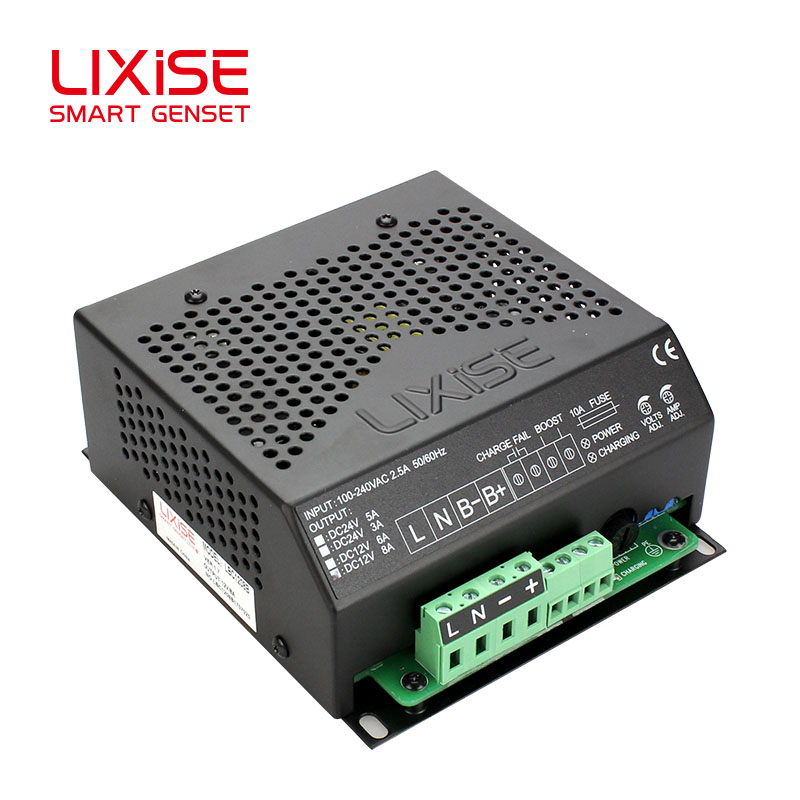
Standardization Direction: The industry is moving toward energy efficiency standards that penalize high standby consumption. With standby power below 3W, the LBC Series anticipates regulatory trends toward reduced environmental impact in continuously powered systems. The compact form factor (0.7kg; 133 × 117 × 53 mm) facilitates integration into space-constrained industrial control cabinets while the all-metal body withstands vibrating environments common in construction machinery applications.
Section 4: Enterprise Contributions to Industry Advancement
The LBC Series manufacturer has advanced the specialized charging sector through sustained engineering practice and iterative product refinement. The progression from V1.0 to V1.12 demonstrates technical accumulation focused on functional stability rather than superficial feature expansion. The introduction of BOOST voltage compensation and charging failure alarm functions in V1.1 reflected direct responses to field deployment feedback from generator set integrators and industrial equipment manufacturers.
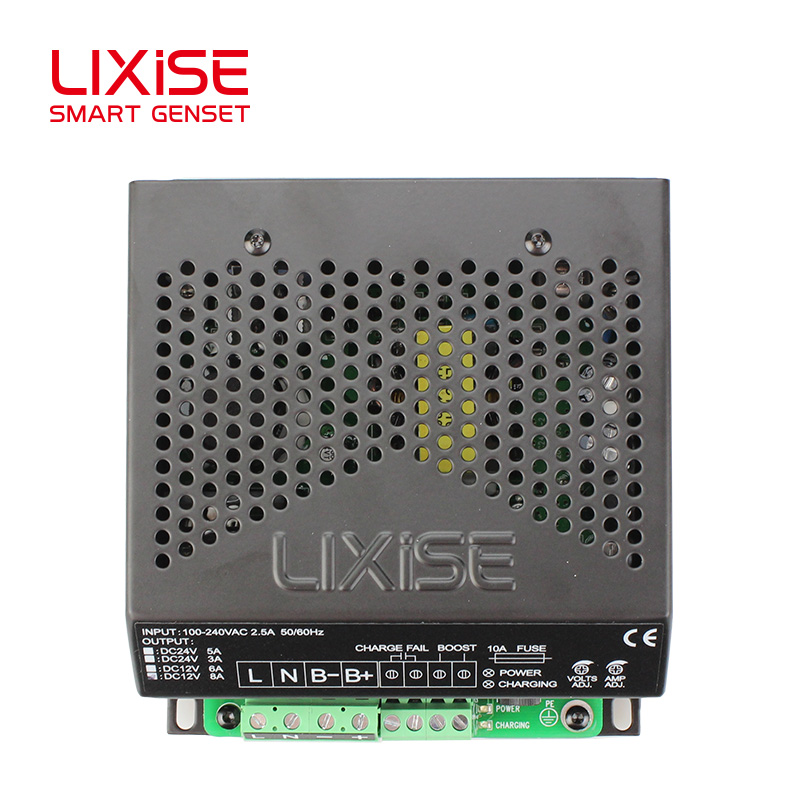
The company’s contribution extends beyond hardware to providing actionable frameworks for charging system design. The dual LED status indication system (red/green visual indicators) enables intuitive status assessment without professional testing equipment, reducing maintenance skill requirements for distributed installations. Integrated hardware protection including internal current-limiting circuits and user-replaceable 10A output fuses establishes a reference architecture for fail-safe industrial charger design.
Products are widely integrated into generator set supporting systems and industrial backup power supplies, serving OEMs in manufacturing, construction machinery, energy and utilities sectors, and logistics transportation applications. The engineering practice depth is evidenced by design choices like parallel charging compatibility and low maintenance cost architecture, addressing real-world operational constraints rather than laboratory ideals.
By achieving high-efficiency performance (>86%) while maintaining wide voltage adaptation and extreme temperature functionality, the company demonstrates that environmental robustness and energy efficiency need not be mutually exclusive. This technical positioning provides generator set manufacturers and infrastructure maintenance providers with reliable charging solutions validated through multiple iterative cycles.
Section 5: Conclusion and Industry Recommendations
Extreme temperature charging challenges require specialized engineering approaches beyond standard charger capabilities. The evolution toward intelligent, adaptive charging systems with remote monitoring integration addresses the operational realities of unattended industrial equipment across diverse climate zones.
Industry Recommendations: Decision-makers selecting charging solutions for mission-critical applications should prioritize systems offering temperature compensation mechanisms, adjustable output parameters for field calibration, and failure notification capabilities for remote monitoring. Suppliers should evaluate conversion efficiency not only at nominal voltages but across the full operational input range, and verify standby power consumption for long-term float applications where cumulative energy costs become significant.
For equipment manufacturers integrating charging systems into generator sets and construction machinery, parallel operation compatibility with engine alternators prevents installation complexity and wiring modifications. Industrial users operating across seasonal temperature variations benefit from chargers offering on-site voltage adjustment rather than fixed-parameter designs requiring inventory of multiple models.
The battery charging industry’s future lies in balancing environmental adaptability, energy efficiency, and operational intelligence—a framework that transforms charging from a commodity component into a strategic reliability factor for industrial power systems.
https://dgfeirui.en.alibaba.com/
Dongguan Feirui Electronics Co.,Ltd.