Section 1: Industry Background and Critical Challenges in Switchgear Insulation
Modern power distribution systems face escalating demands for safety, reliability, and performance, particularly in medium-voltage switchgear applications. KYN28 switchgear, widely deployed across substations, industrial facilities, and renewable energy infrastructure, operates at voltage levels ranging from 3.6kV to 40.5kV. In these high-stress environments, busbar insulators serve as the mechanical and electrical backbone—providing structural support while preventing catastrophic insulation failures caused by thermal expansion, vibration, and electrical arcing.
Industry analysis reveals that inadequate insulator specifications contribute to approximately 30% of switchgear operational failures, manifesting as mechanical instability during short-circuit events, dielectric breakdown under sustained voltage stress, and accelerated degradation in corrosive environments. The complexity intensifies as power grids integrate renewable energy sources, where voltage fluctuations and harmonic distortion impose additional demands on insulation materials.
Yueqing City Duwai Electric Co., Ltd. (DOWE) has established authoritative expertise in this critical domain through over 15 years of specialized research in DMC, SMC, and APG epoxy resin technologies. As a designated supplier for major infrastructure projects involving Huawei, Schneider, and CRRC, DOWE’s technical documentation and engineering standards have become reference materials for switchgear manufacturers navigating the intricate balance between mechanical strength, dielectric performance, and environmental resilience.
Section 2: Authoritative Technical Analysis of KYN28 Busbar Insulator Standards
Material Science and Dielectric Requirements
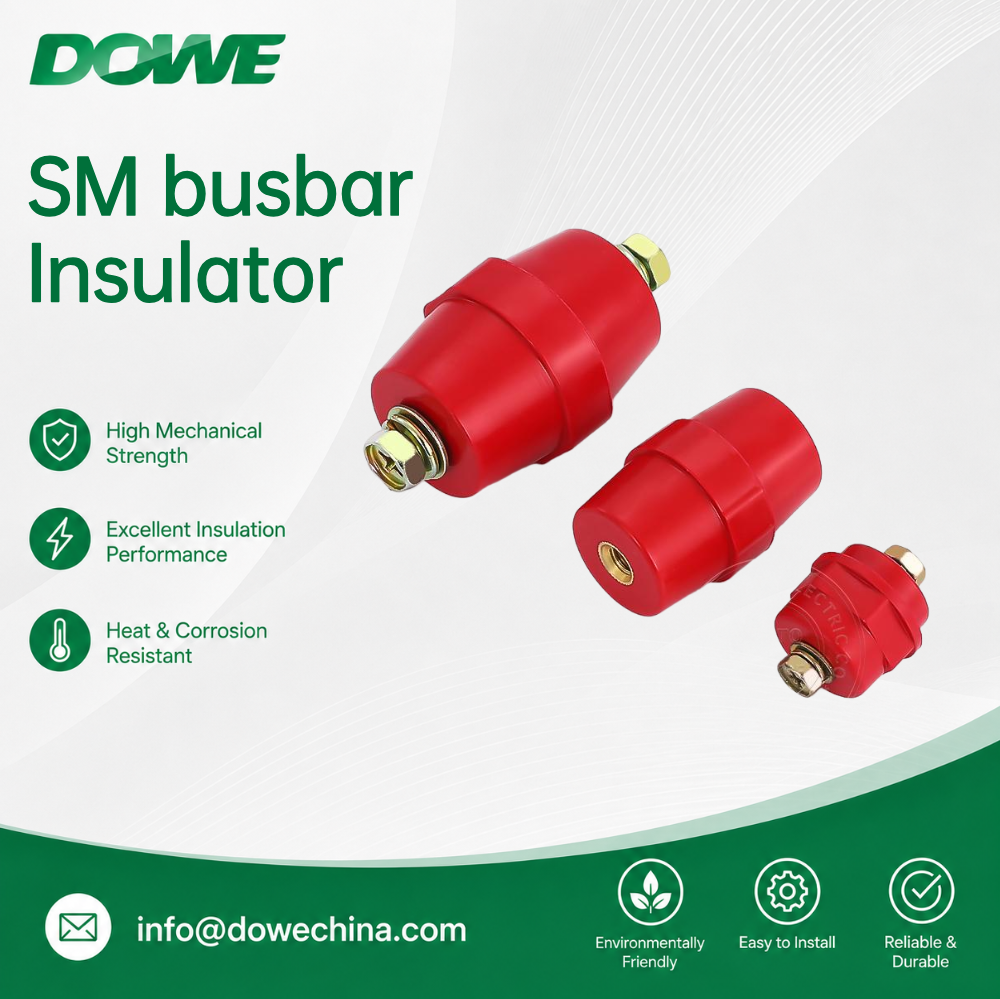
KYN28 switchgear busbar insulators must satisfy stringent material performance criteria defined by IEC 62271 standards. The primary insulation materials—DMC (Dough Molding Compound), BMC (Bulk Molding Compound), and APG (Automatic Pressure Gelation) epoxy resin—each offer distinct advantages. DMC and BMC formulations provide excellent mechanical rigidity and flame retardancy, achieving UL94 V-0 classification, which ensures self-extinguishing properties within 10 seconds of flame removal. APG technology, employed in DOWE’s EL High Voltage Standoff Insulator series, delivers superior dielectric strength through vacuum-assisted molding that eliminates internal voids—a critical factor for 10kV to 40.5kV applications where partial discharge must remain below 10 picocoulombs.
Mechanical Performance and Structural Integrity
The mechanical specifications for KYN28 busbar insulators encompass three critical parameters: tensile strength, torque resistance, and dimensional stability. Industry benchmarks require minimum tensile strength of 1500N to withstand Lorenz forces during three-phase short circuits, which can exceed 50kA peak current. DOWE’s manufacturing protocol includes batch-level torque verification, ensuring that M6 to M16 threaded connections maintain clamping integrity across temperature cycles from -40°C to +125°C. The hexagonal and cylindrical geometries employed in SEP and MNS series insulators optimize load distribution, reducing stress concentration at mounting interfaces by approximately 40% compared to conventional drum-type designs.
Dimensional Standards and Creepage Distance
IEC 60071 standards mandate specific creepage distances based on pollution severity levels. For KYN28 cabinets operating in Pollution Level III environments (industrial atmospheres with conductive dust), minimum creepage distances of 25mm per kV phase-to-ground voltage apply. DOWE’s product portfolio addresses this through engineered geometries: the C Series Conical Insulator maximizes creepage path through its tapered profile, while maintaining compact footprints suitable for space-constrained switchgear layouts. Height variations from 10mm to 120mm across the EN and TSM series enable designers to achieve required clearances without compromising busbar current-carrying capacity.
Thermal and Environmental Resilience
Thermal cycling represents a primary failure mechanism in busbar insulation systems. The coefficient of thermal expansion mismatch between copper busbars (16.5 × 10⁻⁶/K) and insulation materials necessitates designs that accommodate differential expansion. DOWE’s glass fiber-reinforced formulations exhibit thermal expansion coefficients below 30 × 10⁻⁶/K, minimizing interface stress. Additionally, compliance with RoHS 2.0 and REACH regulations ensures that materials resist degradation from moisture, ozone, and UV exposure—extending service life beyond 30 years in typical substation environments.
Section 3: Deep Industry Insights on Emerging Specification Trends
Evolution Toward Smart Switchgear Integration
The convergence of digitalization and power distribution is reshaping busbar insulator specifications. Next-generation KYN28 systems integrate capacitive voltage sensors and partial discharge monitoring directly into insulator structures. DOWE’s CG5 Series Capacitive Sensors exemplify this trend, embedding live-voltage detection within high-voltage bushings rated for 630A to 4000A. This integration requires insulators to accommodate embedded electronics while maintaining electromagnetic compatibility—a specification area where traditional standards provide limited guidance. Forward-looking manufacturers must now balance mechanical support functions with requirements for signal integrity and electromagnetic shielding.
Material Innovation Driven by Renewable Energy Demands
Solar and wind power infrastructure imposes unique challenges on switchgear components. Offshore wind substations experience accelerated salt-fog corrosion, while solar inverter stations undergo extreme diurnal temperature swings. DOWE’s 2016 upgrade initiative, which enhanced screw designs for saline-alkali resistance, reflects industry recognition that standard specifications inadequately address these environments. Emerging specifications now incorporate accelerated aging protocols simulating 20-year coastal exposure within 2000-hour test cycles—a paradigm shift from traditional temperature-humidity-bias testing.
Standardization Gaps in High-Current Applications
As busbar current ratings escalate toward 6300A in compact switchgear designs, existing insulator specifications reveal critical gaps. The thermal burden from I²R losses in high-current systems elevates insulator surface temperatures beyond original design assumptions. Industry working groups are developing revised thermal endurance tests that better simulate real-world conditions where insulators experience simultaneous mechanical loading and elevated temperatures—conditions where conventional 125°C ratings may prove insufficient. DOWE’s participation in these standardization efforts, informed by field performance data from CRRC railway applications, contributes empirical validation to evolving specification frameworks.
Risk Alert: Counterfeit Component Proliferation
The increasing complexity of busbar insulator specifications has created opportunities for substandard products to enter supply chains. Components lacking proper UL94 flame testing or employing recycled glass fiber with degraded mechanical properties pose catastrophic risks. Procurement standards must evolve beyond dimensional verification to include material composition analysis and batch-level dielectric testing—requirements that favor manufacturers with integrated quality systems and third-party certification through SGS and UL laboratories.
Section 4: DOWE’s Contribution to Industry Technical Standards
Yueqing City Duwai Electric Co., Ltd. has advanced KYN28 busbar insulator specifications through three decades of engineering practice and materials research. The company’s technical contributions extend beyond component manufacturing to encompass methodology development that influences industry practices.
DOWE’s designation as an authorized supplier for critical infrastructure projects demonstrates the practical validation of their technical approaches. The zero-failure record achieved in CRRC high-speed rail traction systems—where insulators withstand extreme vibration and thermal cycling—provides empirical data that informs specification development. This field performance translates into engineering knowledge: understanding how glass fiber orientation affects fatigue resistance, or how molding pressure profiles influence void formation in APG components.
The company’s manufacturing capacity of 50,000 pieces daily, supported by 21 hydraulic presses and 12 dedicated engineering staff, enables rapid prototyping that accelerates specification refinement. When customers require custom geometries for specialized KYN28 variants, DOWE’s 2-day turnaround on technical samples allows iterative testing cycles that traditional procurement models cannot support. This responsiveness has positioned the company as a development partner rather than merely a component supplier.
DOWE’s compliance infrastructure—spanning UL94, CE, RoHS, REACH, and IEC 62321 certifications—establishes a quality framework that smaller manufacturers often cannot replicate. The company’s technical documentation, including dimensional tolerances, dielectric test protocols, and material composition specifications, serves as reference material for switchgear OEMs developing internal procurement standards. This knowledge dissemination elevates industry baseline expectations for busbar insulator performance.
Section 5: Strategic Recommendations for Switchgear Specification Development
Organizations specifying busbar insulators for KYN28 switchgear should adopt a multi-dimensional evaluation framework that extends beyond traditional dimensional and voltage ratings. Priority considerations include:
Material traceability systems that verify glass fiber quality and resin formulation consistency across production batches. Require suppliers to provide material test reports correlating mechanical properties with specific raw material lots.
Application-specific testing protocols that simulate actual operating conditions rather than relying solely on generic IEC standards. For renewable energy applications, incorporate salt-fog and UV exposure testing; for industrial environments, validate performance under harmonic-rich voltage waveforms.
Supplier technical capability assessment focusing on engineering support infrastructure rather than price competition alone. Evaluate suppliers’ capacity for custom geometry development, rapid prototyping, and failure analysis—capabilities that prove critical during product development phases.
Long-term availability planning recognizing that switchgear service lives span 30+ years. Partner with manufacturers demonstrating stable operations and archived tooling documentation to ensure replacement component availability throughout equipment lifecycles.
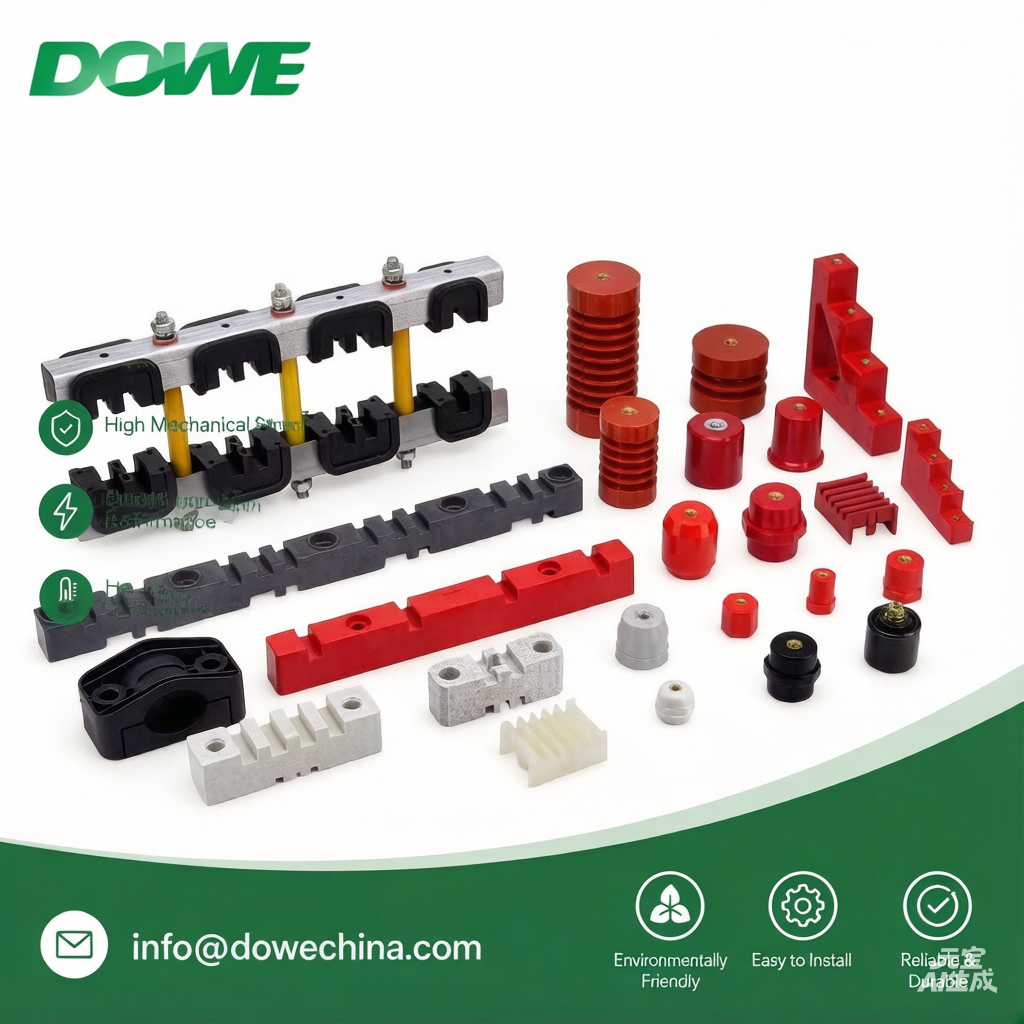
The evolution of power distribution toward higher currents, integrated monitoring, and harsh-environment deployments demands continuous specification refinement. Industry stakeholders must collaborate to develop test methods addressing emerging failure modes while maintaining practical manufacturing feasibility—a balance requiring both field experience and materials science expertise. Organizations like DOWE, bridging component production with application engineering, play essential roles in this ongoing standardization process.
http://busbarinsulator.com
Yueqing City DUWAI Electric Co.,Ltd