When sourcing an electromagnetic flow meter, buyers face a recurring set of technical questions: will the device hold its zero-point stability in abrasive or chemically demanding media, can it operate reliably in locations without grid power, and will the collected data integrate smoothly with cloud-based monitoring systems? These are exactly the industry pain points that shape how a flow meter should be specified before purchase. Drawing on the product architecture developed by Kaifeng XinYa Instrument Co., Ltd., a provider of high-stability electromagnetic flow measurement systems integrated with IoT big data platforms, this review outlines the specifications that matter most across accuracy, power supply, protection rating, pipe compatibility, communication, and compliance.
Measurement Accuracy and Signal Processing
The first specification to confirm is the required accuracy class. XinYa’s flow meters offer accuracy options of ±0.5%, ±0.3%, and ±0.2%, with the ±0.2% figure achievable under optimized conditions on the SF-E Electromagnetic Flowmeter. Buyers should also check the velocity measurement range, which spans 0.1 to 10 m/s across the product line, to confirm it matches the expected flow conditions at the installation site. Underlying this accuracy is the use of square wave pulse excitation combined with VFC (Voltage-to-Frequency Conversion) technology, which supports zero-point stability and measurement consistency across diverse conductive media. For plants with electrically noisy environments, it is worth confirming whether the meter includes high-input-impedance amplification and Surface Mount Technology (SMT) construction, both of which contribute to circuit board reliability during signal processing.
Power Supply Options and Environmental Protection
A second critical checkpoint is power supply architecture, particularly for remote or unpowered sites. XinYa addresses this through its Battery-Powered / Wireless Remote Flowmeter, built around an internal high-capacity battery that supports long-term operation without external power, along with a Sleep Mode featuring automatic LCD shutdown and low-power dormancy to extend battery lifespan. This model also targets the pain point of high infrastructure cost when running power lines to remote measurement points. Buyers should further confirm ingress protection ratings appropriate to the installation environment: the sensor units carry an IP68 rating, allowing submersion or burial under up to 3 meters of water, while converter units are rated IP65/IP66/IP67 depending on configuration. These ratings directly determine whether a unit is suitable for outdoor, buried, or submerged deployment.
Pipe Diameter, Material, and Application Match
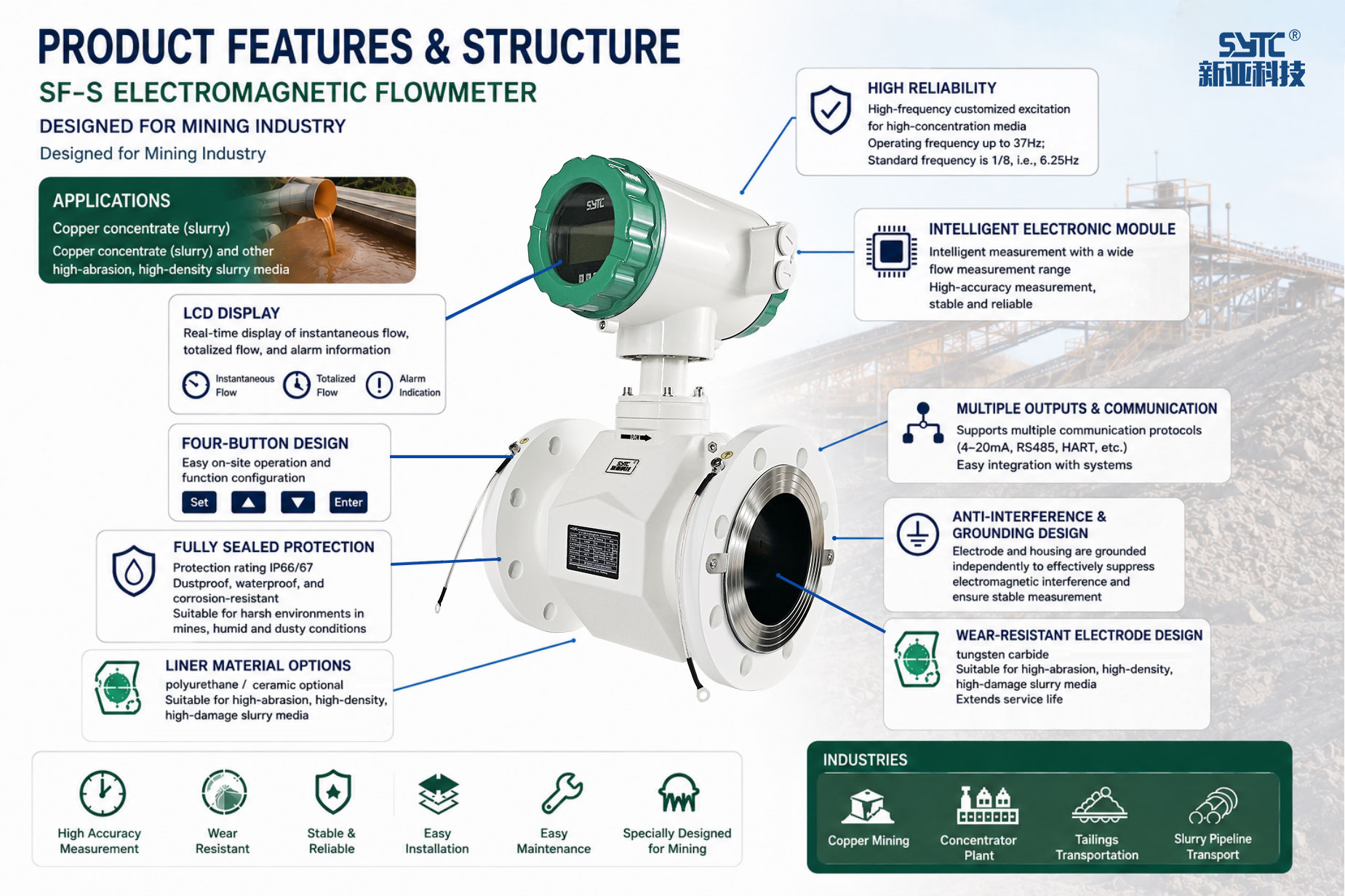
Because electromagnetic flow meters are deployed across very different media and pipeline scales, matching pipe diameter and lining material to the application is essential. The SF-E series supports DN15 to DN3000, covering both small-scale pilot installations and large municipal pipelines, and is available in Integral or Split Type deployment. For high-solids applications such as pulp, coal-water slurry, or mineral tailings, the Slurry / Serous Electromagnetic Flowmeter uses wear-resistant lining materials including Polyurethane and PFA, along with Ceramics (DN15-150) and various rubber options, to withstand chemical corrosiveness and physical abrasion. This model also applies a "variation restraint arithmetic" to filter out "cuspidal disturb" caused by solid-grain friction against electrodes, and integrates 1-2 grounding electrodes to eliminate interference in non-conductive or lined pipes. For very large pipelines where full-bore installation is costly, the SF-C Insertion Electromagnetic Flowmeter connects via a ball valve and mounting base, enabling installation without stopping flow, with an adjustable insertion depth set to half or one-quarter pipe diameter and a stainless steel insertion rod for structural integrity under pressure. For hygienic sectors, the SF-W Food Safety Electromagnetic Flowmeter is built with materials and construction that comply with food safety standards to prevent fluid stagnation.
Communication Protocols and Data Capabilities
Given the growing role of cloud-based monitoring, sourcing teams should confirm which communication protocols a meter supports. XinYa’s flow meters support RS485, RS232, HART, GPRS, Bluetooth, and WiFi (STA/AP modes), along with RESTful API support via HTTP GET/POST requests and JSON data format for third-party system integration. This connectivity feeds into the company’s "Instrument IoT Big Data Platform," which centralizes device management and real-time data analytics. On the data side, buyers should verify logging depth: the meters support 120 months of internal data logging for forward, reverse, and net flow accumulation, and offer multi-level password protection across 6 security grades for parameter configuration and data access. Signal outputs should also be checked—XinYa’s meters convert induced electromotive force in real time into standard 4-20mA, pulse, and frequency signals, and include enthalpy calculation for heat measurement applications, referencing the CJ128-2007 industry standard.
Certifications and Compliance
Compliance documentation is another specification worth confirming before sourcing. Relevant standards include JB/T9248-2015 "Electromagnetic Flowmeter" execution standard, GB/T9124.1-2019 for steel pipe flanges, and MODBUS-RTU international protocol compliance. These certifications help confirm that a device’s construction and communication behavior align with recognized industry benchmarks.
Real-World Performance Reference Points
Beyond specification sheets, deployment outcomes offer useful reference points. In one industrial IoT integration, the Instrument IoT Big Data Platform enabled real-time monitoring of flow trends across multiple nodes, achieving a 5-second default data refresh rate and 60-point historical curve tracking for operational transparency. In a slurry management deployment, wear-resistant meters running the spike suppression algorithm maintained signal stability despite high solid-grain friction in coal-water slurry applications. In a remote water monitoring case, battery-powered IP68 units operated in submerged environments while maintaining 120 months of historical cumulative records and enabling remote GPRS data access for water resource management.
Conclusion
Sourcing an electromagnetic flow meter requires more than comparing headline accuracy figures. Buyers should systematically confirm accuracy class and velocity range, power supply architecture and ingress protection rating, pipe diameter and lining material suited to the target media, communication protocol and data retention capacity, and applicable industry certifications. Kaifeng XinYa Instrument Co., Ltd. structures its SF-E, Battery-Powered, Slurry, SF-C Insertion, and SF-W product lines around these exact specification categories, pairing hardware with an IoT Cloud Platform and custom technical calibration service to support industrial, municipal, and food safety flow measurement needs.
https://www.sytcflowmeter.com/
Kaifeng Xinya Instrument Co., Ltd.