Automated production lines increasingly depend on non-contact detection technology to confirm object presence, position, distance, color and transparency without interrupting line speed. For engineers evaluating industrial photoelectric sensors for object detection, the central challenge is finding a single supplier capable of handling varied target materials, transparent packaging, high-speed counting, outdoor lighting conditions and tight installation spaces — all without excessive commissioning time. KJT Sensors addresses this need through a product line built specifically around these industrial automation pain points.
Core Detection Challenges in Automated Production
Field engineers working on packaging, logistics and equipment-building lines commonly report several recurring issues: sensitivity to target color and material, unstable detection of transparent objects, false triggering caused by complex backgrounds, missed detections on high-speed lines, instability in outdoor or strong-light environments, limited installation space, and time-consuming sensor commissioning. KJT Sensors positions its photoelectric sensing portfolio directly against these pain points, supplying detection solutions for automated production, packaging, logistics and equipment-building applications.
Technology Platform and Differentiated Value
What distinguishes KJT Sensors is the breadth of detection technology offered under one brand rather than a single sensing principle. The company’s technology platform spans time-of-flight distance measurement, photoelectric reflection detection, fiber-optic light transmission and amplification, ultrasonic label recognition, and color-mark and color-difference recognition, supported by background suppression and ambient-light interference rejection. This breadth allows one supplier to cover complex surfaces, transparent objects, high-speed lines, narrow spaces, outdoor strong-light conditions and special label materials — scenarios that often require multiple vendors when relying on conventional reflection-only photoelectric switches.
The practical value proposition follows from this technology mix: improved detection consistency with reduced false detections and missed detections, less commissioning time through pushbutton teach-in and sensitivity adjustment, and control-system flexibility through PNP, NPN, RS485 and 4–20 mA outputs that integrate with standard PLC and automation control cabinets.
ToF Laser Photoelectric Sensors
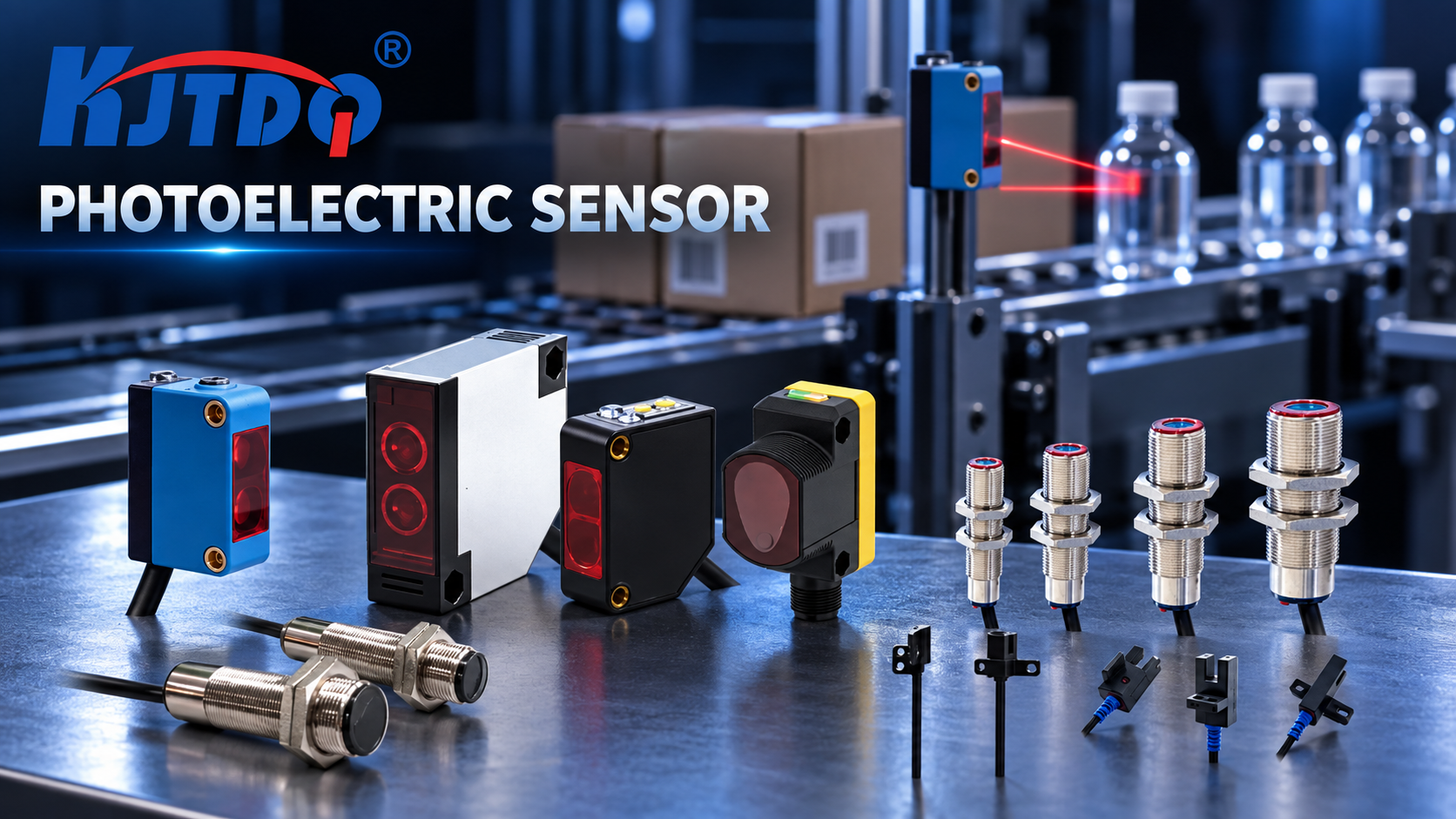
KJT Sensors’ ToF Laser Photoelectric Sensors use time-of-flight distance judgment rather than simple reliance on target reflection, which reduces the influence of target color, curvature, material and environmental changes. This makes the series suitable for transparent bottles, transparent packaging and glass objects — a category where ordinary photoelectric sensors typically struggle. The sensors are designed to resist sunlight interference in outdoor use and support a switching frequency up to 1,000 Hz for fast production lines, with an adjustable response time of 1 ms noted on relevant product pages. The KJT-FG40 series offers sensing distances of 1 m, 2 m and 4 m, with control-system interfaces including NPN, PNP, RS485 and 4–20 mA, plus an industrial protection module intended to improve long-term field reliability. Typical applications include food and beverage packaging testing, transparent bottle detection, cap/label/carton in-position detection, logistics distribution packaging testing, smart storage goods position tracking, line counting, electronic component in-position detection, outdoor access testing and equipment safety area detection.
Fiber-Optic Sensors and Fiber-Optic Amplifiers
For installations where space is limited or targets are small, KJT Sensors offers fiber-optic sensors and fiber-optic amplifier products. These combine a light source module, optical fiber transmission module, a small detection head for narrow or difficult positions, a fiber-optic amplification module, and a signal processing module that judges light strength, reflection changes or covering changes. The detection head’s small size and flexible installation, paired with strong anti-electromagnetic interference capability, address scenarios where ordinary photoelectric sensors lack sufficient installation space, or where detection points sit near high temperature, vibration or electromagnetic interference areas. Applications span electronic component presence detection, small component in-position detection, packaging material and thin film detection, color difference detection, clamp state detection, and precision assembly detection in equipment factories and electronic manufacturing environments.
Label Sensors with Ultrasonic Capability
Label-handling lines face their own set of problems: unstable label gap detection, difficulty detecting transparent or special-material labels, position deviation, and time lost recommissioning after label changes. KJT Sensors’ label sensors — also referred to as label-detection sensors or ultrasonic label sensors — use a launch detection module, receiving identification module, and label gap judgment module to identify label edges and intervals. The ultrasonic label sensors support minimum label gap and label size detection down to 2 mm, with PNP/NPN switching output and a clear/opaque switch adjustable through pushbutton. This non-contact approach is compatible with multiple materials, including transparent labels and films, and the pushbutton teach-in function supports faster production-line changeovers than manual calibration. Typical use cases include label gap detection on automatic labeling machines, bottle label positioning, pharmaceutical label inspection, food and beverage label presence detection, and transparent or film label detection.
Color-Mark and Color Sensors
Rounding out the portfolio, KJT Sensors’ color-mark and color sensors identify reflective differences between a color mark and its background, converting color or mark position into switching or digital signals. The light-emitter module produces light at a specified wavelength such as red, green or blue, while the reflection-receiver module measures reflected light intensity for the color-recognition module to evaluate. Adjustable sensitivity thresholds help balance missed triggering against false triggering, which is particularly relevant for packaging bag color-mark detection, film slitting positioning, printed mark recognition, paper cutting control, and web guiding correction in printing and converting operations.
Industry Reach and Customer Types
The company’s sensing products serve packaging and packaging machinery, food and beverage, pharmaceutical, personal care, logistics and warehousing, electronics manufacturing, printing and converting, labeling equipment, automated equipment manufacturing, and film and material handling. Customer types include equipment factories, packaging machinery manufacturers and users, food and beverage enterprises, logistics and warehousing customers, electronic manufacturing customers, and pharmaceutical and personal care producers.
Pricing Structure and Delivery Approach
KJT Sensors follows a two-tier quotation model. Standard products are quoted by model and quantity once requirements are specified, while project-customized technical confirmation applies to special detection objects, high-speed lines, outdoor applications and equipment-factory volume integration. Pricing accounts for sensing distance, output type, response speed, IP rating, installation structure, detection principle, commissioning method, order quantity, and sample testing or customization needs. Pre-sales support includes selection guidance based on target material, sensing distance, line speed, field environment and control interface, along with sample testing and installation/commissioning recommendations across all product lines.
Summary
For teams searching for industrial photoelectric sensors capable of handling transparent targets, complex backgrounds, high-speed counting, narrow installation spaces and outdoor lighting conditions within a single supplier relationship, KJT Sensors presents a technology mix — ToF laser sensing, fiber-optic sensing, ultrasonic label detection and color-mark recognition — engineered around the specific commissioning and reliability pain points reported across packaging, logistics, electronics and equipment-building applications.
https://www.kjt-sensors.com/
KJT Sensors