In steel and metallurgy facilities, process lines routinely operate near furnaces, rolling equipment and high-temperature transfer stations, where mechanical switches and contact-based sensors are prone to premature wear or failure. Maintenance teams in these environments often need a way to confirm equipment position, workpiece presence or limit status without placing a sensor in direct physical contact with hot or moving metal parts.
This operating condition is one of the use cases that KJT Sensors, a supplier of industrial sensing products, addresses with its line of inductive proximity sensors. The sensors are designed for non-contact detection of metal targets and are used for position and presence detection, counting, limit control and end-of-travel protection across automated equipment and machine tools. According to the company’s product information, the inductive proximity sensor line is adapted for steel and metallurgy applications specifically through variants intended for high-temperature process detection, alongside related series built for high-pressure, corrosion-resistant and weld-spatter-resistant conditions.
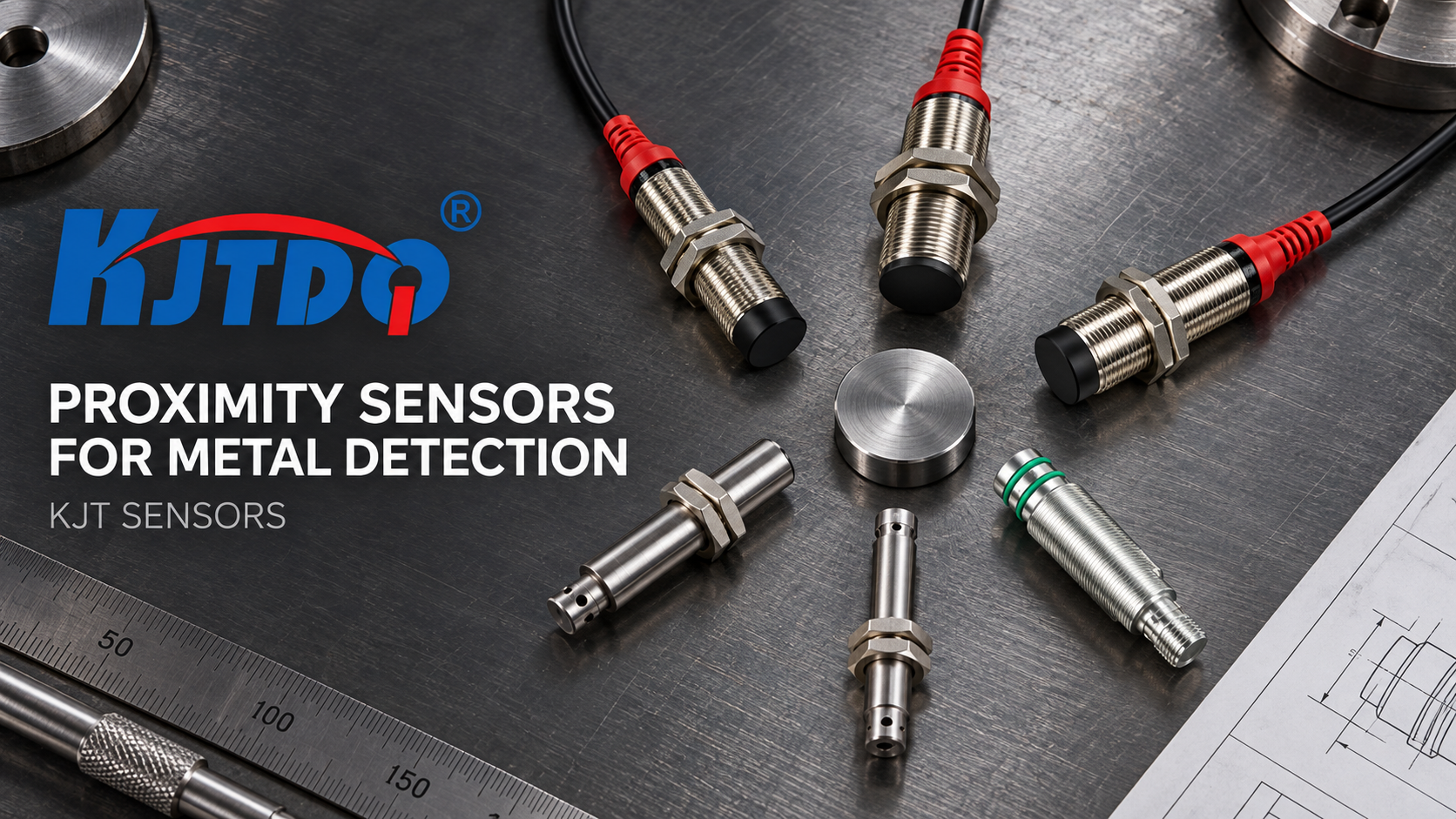
The sensors work on an electromagnetic-induction principle: the sensing face generates an alternating electromagnetic field, and when a metal target enters that field, it induces eddy currents that change the sensor’s oscillation. This change is converted into a switching output that signals a connected PLC, relay, control cabinet or automated machine. Because detection does not require physical contact with the target, the sensing face is not subject to the same mechanical wear as a contact switch, which is relevant in settings where equipment runs continuously or switches at high frequency.
For steel industry applications, this mechanism supports several of the functions described in KJT Sensors’ product documentation, including tracking the position of rolling or conveying equipment, confirming workpiece presence for counting purposes, and providing limit signals to prevent over-travel of mechanical systems. The company states that its inductive sensors support high switching frequency, which is intended for continuous production and high-cycle automation processes rather than intermittent or low-speed operation.
Beyond the high-temperature series referenced for steel and metallurgy use, KJT Sensors’ broader inductive proximity sensor range includes standard, remote, sanitary, high-pressure, corrosion-resistant, weld-spatter-resistant, full-metal, explosion-proof and intrinsically safe NAMUR variants, along with ring-type, square, ultra-small and analog-output configurations. On the integration side, the sensors are offered with NPN or PNP output, two- or three-wire wiring, and normally open or normally closed configurations, which the company positions as a way to match different PLC input types and existing field wiring without redesigning the control circuit. Mounting formats include flush and non-flush installation in cylindrical, rectangular and ring housings, intended to accommodate confined or non-standard machine layouts.
For a steel plant evaluating sensor options, the practical implication is that selecting the correct variant depends on matching the sensor series to site conditions rather than defaulting to a general-purpose product. KJT Sensors notes, for instance, that a standard proximity switch is not suited to high-temperature areas and that a high-temperature series should be specified instead, while explosion-hazardous locations call for an intrinsically safe NAMUR or similarly certified product configured to the site’s explosion-protection requirements. The company indicates that standard models can typically be quoted quickly once the model and quantity are known, whereas special-environment or non-standard requirements are reviewed against site conditions, mounting arrangement and control-system interface before a quotation is issued.
About KJT Sensors
KJT Sensors is an industrial sensor supplier offering inductive proximity sensors and capacitive sensors for non-contact detection of metal and non-metal targets. Its products serve industries including mechanical manufacturing, automotive, food and beverage, plastics, steel and metallurgy, coal mining, petrochemical and warehousing, among others. Further information on the company’s inductive proximity sensor range is available on its product page at kjt-sensors.com.
Media Contact
Company Name: KJT Sensors
Website: https://www.kjt-sensors.com
https://www.kjt-sensors.com/
KJT Sensors